


In vitro cross-linking of Mycobacterium tuberculosis peptidoglycan by L,D-transpeptidases and inactivation of these enzymes by carbapenems
- PMID: 24041897
- PMCID: PMC3837840
- DOI: 10.1128/AAC.01663-13
In vitro cross-linking of Mycobacterium tuberculosis peptidoglycan by L,D-transpeptidases and inactivation of these enzymes by carbapenems
Abstract
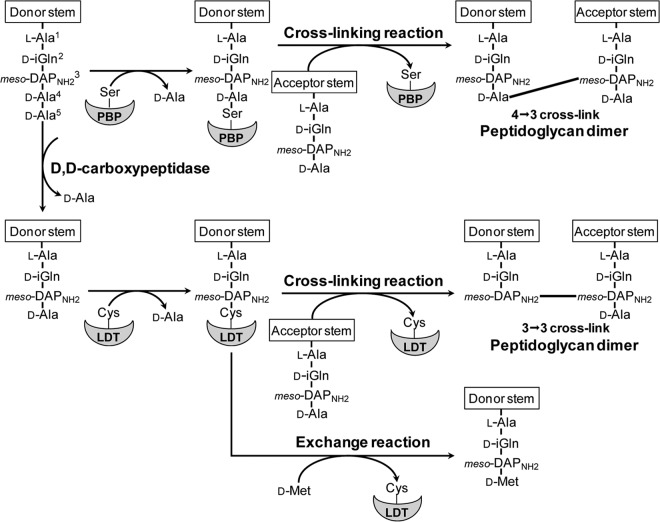
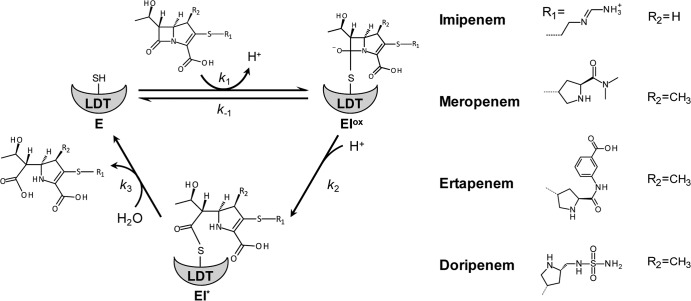
The Mycobacterium tuberculosis peptidoglycan is cross-linked mainly by l,d-transpeptidases (LDTs), which are efficiently inactivated by a single β-lactam class, the carbapenems. Development of carbapenems for tuberculosis treatment has recently raised considerable interest since these drugs, in association with the β-lactamase inhibitor clavulanic acid, are uniformly active against extensively drug-resistant M. tuberculosis and kill both exponentially growing and dormant forms of the bacilli. We have purified the five l,d-transpeptidase paralogues of M. tuberculosis (Mt1 to -5) and compared their activities with those of peptidoglycan fragments and carbapenems. The five LDTs were functional in vitro since they were active in assays of peptidoglycan cross-linking (Mt5), β-lactam acylation (Mt3), or both (Mt1, Mt2, and Mt4). Mt3 was the only LDT that was inactive in the cross-linking assay, suggesting that this enzyme might be involved in other cellular functions such as the anchoring of proteins to peptidoglycan, as shown in Escherichia coli. Inactivation of LDTs by carbapenems is a two-step reaction comprising reversible formation of a tetrahedral intermediate, the oxyanion, followed by irreversible rupture of the β-lactam ring that leads to formation of a stable acyl enzyme. Determination of the rate constants for these two steps revealed important differences (up to 460-fold) between carbapenems, which affected the velocity of oxyanion and acyl enzyme formation. Imipenem inactivated LDTs more rapidly than ertapenem, and both drugs were more efficient than meropenem and doripenem, indicating that modification of the carbapenem side chain could be used to optimize their antimycobacterial activity.
Figures
References
-
- Anonymous 2012. Tuberculosis 2011. WHO report. WHO, Geneva, Switzerland
-
- Dick T. 2001. Dormant tubercle bacilli: the key to more effective TB chemotherapy? J. Antimicrob. Chemother. 47:117–118 - PubMed
-
- Wayne LG, Sohaskey CD. 2001. Nonreplicating persistence of Mycobacterium tuberculosis. Annu. Rev. Microbiol. 55:139–163 - PubMed
-
- Kliiman K, Altraja A. 2009. Predictors of extensively drug-resistant pulmonary tuberculosis. Ann. Intern. Med. 150:766–775 - PubMed
Publication types
MeSH terms
Substances
LinkOut - more resources
Full Text Sources
Other Literature Sources
Molecular Biology Databases
