


Characterization of potential drug targets farnesyl diphosphate synthase and geranylgeranyl diphosphate synthase in Schistosoma mansoni
- PMID: 24041901
- PMCID: PMC3837879
- DOI: 10.1128/AAC.00699-13
Characterization of potential drug targets farnesyl diphosphate synthase and geranylgeranyl diphosphate synthase in Schistosoma mansoni
Abstract
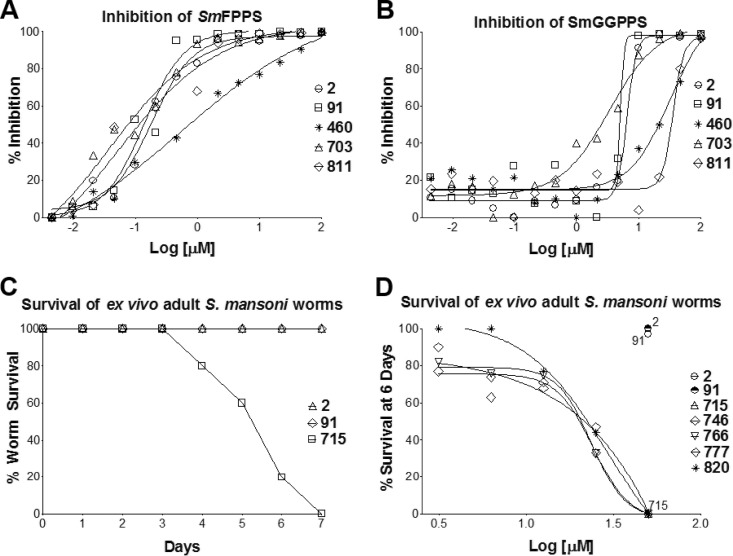
Schistosomiasis affects over 200 million people worldwide, with over 200,000 deaths annually. Currently, praziquantel is the only drug available against schistosomiasis. We report here that Schistosoma mansoni farnesyl diphosphate synthase (SmFPPS) and geranylgeranyl diphosphate synthase (SmGGPPS) are potential drug targets for the treatment of schistosomiasis. We expressed active, recombinant SmFPPS and SmGGPPS for subsequent kinetic characterization and testing against a variety of bisphosphonate inhibitors. Recombinant SmFPPS was found to be a soluble 44.2-kDa protein, while SmGGPPS was a soluble 38.3-kDa protein. Characterization of the substrate utilization of the two enzymes indicates that they have overlapping substrate specificities. Against SmFPPS, several bisphosphonates had 50% inhibitory concentrations (IC50s) in the low micromolar to nanomolar range; these inhibitors had significantly less activity against SmGGPPS. Several lipophilic bisphosphonates were active against ex vivo adult worms, with worm death occurring over 4 to 6 days. These results indicate that FPPS and GGPPS could be of interest in the context of the emerging resistance to praziquantel in schistosomiasis therapy.
Figures
References
-
- Hotez PJ, Fenwick A, Savioli L, Molyneux DH. 2009. Rescuing the bottom billion through control of neglected tropical diseases. Lancet 373:1570–1575 - PubMed
-
- Steinmann P, Keiser J, Bos R, Tanner M, Utzinger J. 2006. Schistosomiasis and water resources development: systematic review, meta-analysis, and estimates of people at risk. Lancet Infect. Dis. 6:411–425 - PubMed
-
- Wang W, Wang L, Liang YS. 2012. Susceptibility or resistance of praziquantel in human schistosomiasis: a review. Parasitol. Res. 111:1871–1877 - PubMed
-
- Dömling A, Khoury K. 2010. Praziquantel and schistosomiasis. ChemMedChem 5:1420–1434 - PubMed
Publication types
MeSH terms
Substances
Grants and funding
- CA158191/CA/NCI NIH HHS/United States
- R01 CA158191/CA/NCI NIH HHS/United States
- T32 GM008276/GM/NIGMS NIH HHS/United States
- R01 AI065622/AI/NIAID NIH HHS/United States
- GM065307/GM/NIGMS NIH HHS/United States
- AI065622/AI/NIAID NIH HHS/United States
- HHSN272201000005I/AI/NIAID NIH HHS/United States
- AI074233/AI/NIAID NIH HHS/United States
- R01 GM065307/GM/NIGMS NIH HHS/United States
- HHSN272201000005C/AI/NIAID NIH HHS/United States
- GM008276/GM/NIGMS NIH HHS/United States
- R01 AI074233/AI/NIAID NIH HHS/United States
LinkOut - more resources
Full Text Sources
Other Literature Sources
