Asthma patients' inability to use a pressurised metered-dose inhaler (pMDI) correctly correlates with poor asthma control as defined by the global initiative for asthma (GINA) strategy: a retrospective analysis
- PMID: 24042172
- PMCID: PMC6442852
- DOI: 10.4104/pcrj.2013.00084
Asthma patients' inability to use a pressurised metered-dose inhaler (pMDI) correctly correlates with poor asthma control as defined by the global initiative for asthma (GINA) strategy: a retrospective analysis
Abstract
Background: In practice it is logical that inhalers are prescribed only after patients have received training and demonstrated their ability to use the device. However, many patients are unable to use their pressurised metered-dose inhaler devices (pMDIs) correctly. We assessed the relationship between asthma control and patients' ability to use their prescribed pMDIs.
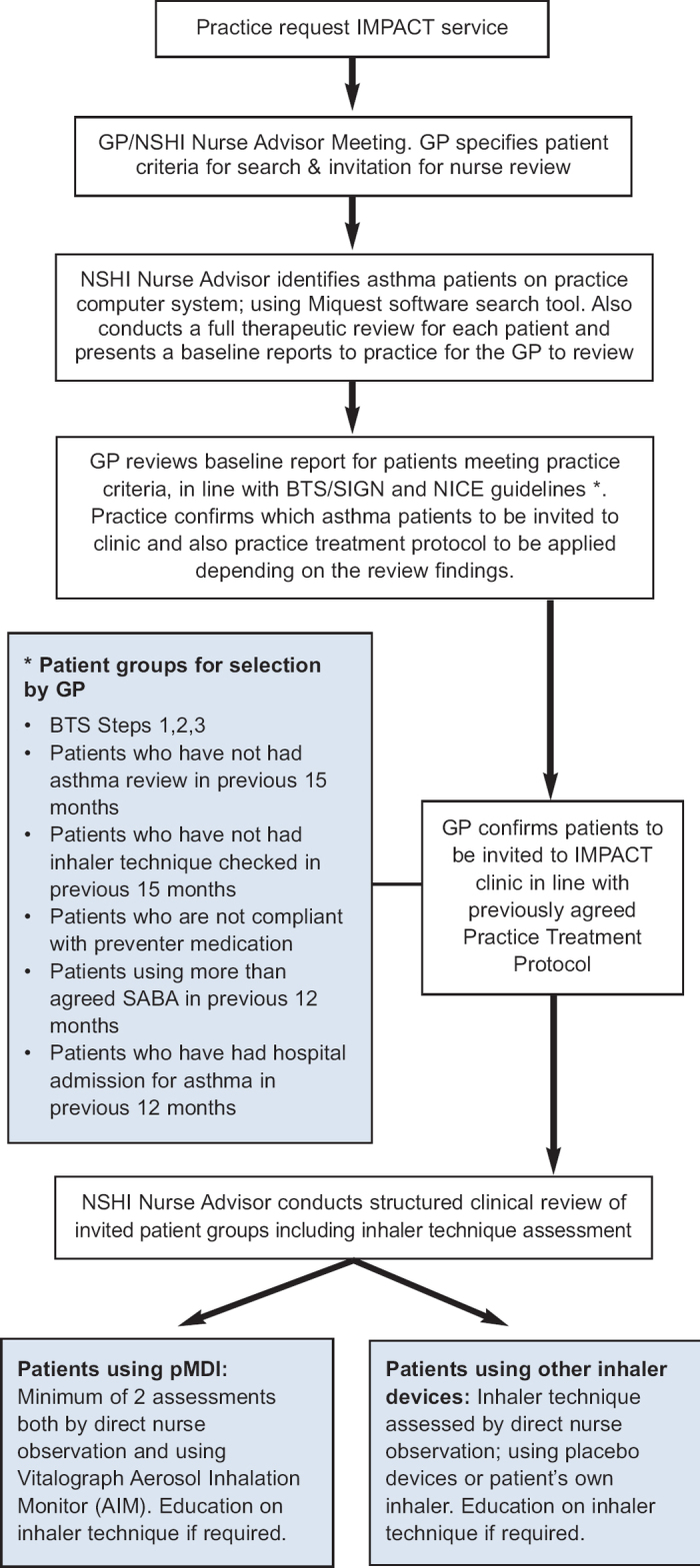
Methods: Evaluation of 3,981 (46% male) primary care asthma patient reviews, which included inhaler technique and asthma control, by specialist nurses in primary care in 2009. The paper focuses on people currently prescribed pMDI devices.
Results: Accurate data on reliever and preventer inhaler prescriptions were available for 3,686 and 2,887 patients, respectively. In patients prescribed reliever inhalers, 2,375 (64%) and 525 (14%) were on pMDI alone or pMDI plus spacer, respectively. For those prescribed preventers, 1,976 (68%) and 171 (6%) were using a pMDI without and with a spacer, respectively. Asthma was controlled in 50% of patients reviewed. The majority of patients (60% of 3,686) were using reliever pMDIs, 13% with spacers. Incorrect pMDI use was associated with poor asthma control (p<0.0001) and more short burst systemic steroid prescriptions in the last year (p=0.038). Of patients using beclometasone (the most frequently prescribed preventer drug in our sample), significantly more of those using a breath-actuated pMDI device (p<0.0001) and a spacer (p<0.0001) were controlled compared with those on pMDIs alone.
Conclusions: Patients who are able to use pMDIs correctly have better asthma control as defined by the GINA strategy document. Beclometasone via a spacer or breath-actuated device resulted in better asthma control than via a pMDI alone. Patients prescribed pMDIs should be carefully instructed in technique and have their ability to use these devices tested; those unable to use the device should be prescribed a spacer or an alternative device such as one that is breath-actuated.
Conflict of interest statement
EM and AH are both employees of National Services for Health Improvement (NSHI). JH is an employee of Teva UK Limited, Harlow, Essex. MLL has accepted sponsorship from GlaxoSmithKline (GSK), AstraZeneca (AZ), Boehringer Ingelheim (BI), Chiesi, Merck Sharpe and Dohme (MSD), Merck, Altana Pharma, Novartis, Meda Pharmaceuticals, 3M Pharmaceuticals, Napp Pharmaceuticals and Schering Plough for attending conferences. He has accepted lecture fees from BI, GSK, AZ, Chiesi and Alk-Abello. He has been on advisory boards or provided consultancy for GSK, Schering Plough, MSD, Chiesi, Altana Pharma, Ranbaxy, AZ, Clement Clarke International, National Services for Health Improvement (NSHI) and Novartis. He has had research grants from BI, Pfizer and GSK. He is a member of The Aerosol Drug Management Improvement Team (ADMIT) which is supported by an unrestricted educational grant from Consorzio Ferrara Ricerche. MLL is the Editor Emeritus of the
Figures
Comment in
-
Correct inhalation technique is critical in achieving good asthma control.Prim Care Respir J. 2013 Dec;22(4):385-6. doi: 10.4104/pcrj.2013.00097. Prim Care Respir J. 2013. PMID: 24270367 Free PMC article. No abstract available.
References
-
- Crompton GK. Problems patients have using pressurized aerosol inhalers. Eur J Respir Dis 1982;63(Suppl 119):101–4. - PubMed
-
- Goodman DE, Israel E, Rosenberg M, Johnston R, Weiss ST, Drazen JM. The influence of age, diagnosis, and gender on proper use of metered-dose inhalers. Am J Respir Crit Care Med 1994;150(5 Pt 1):1256–61. http://dx.doi.org/10.1164/ajrccm.150.5.7952549 - PubMed
-
- Melani AS, Bonavia M, Cilenti V, et al. Inhaler mishandling remains common in real life and is associated with reduced disease control. Respir Med 2011;105(6):930–8. http://dx.doi.org/10.1016/j.rmed.2011.01.005 - PubMed
-
- Hardwell A, Barber V, Hargadon T, McKnight E, Holmes J, Levy ML. Technique training does not improve the ability of most patients to use pressurised metered-dose inhalers (pMDIs). Prim Care Respir J 2011;20(1):92–6. http://dx.doi.org/10.4104/pcrj.2010.00088 - PMC - PubMed
-
- British Thoracic Society, Scottish Intercollegiate Guidelines Network. British guideline on the management of asthma. Thorax 2008;63(Suppl 4):iv1–121. Available from: http://www.sign.ac.uk/guidelines/fulltext/101/index.html http://dx.doi.org/10.1136/thx.2008.097741 - PubMed
Publication types
MeSH terms
Substances
LinkOut - more resources
Full Text Sources
Other Literature Sources
Medical