Cost-effectiveness of tolvaptan in autosomal dominant polycystic kidney disease
- PMID: 24042366
- PMCID: PMC3981098
- DOI: 10.7326/0003-4819-159-6-201309170-00004
Cost-effectiveness of tolvaptan in autosomal dominant polycystic kidney disease
Abstract
Chinese translation
Background: In the TEMPO (Tolvaptan Efficacy and Safety in Management of Autosomal Dominant Polycystic Kidney Disease and Its Outcomes) trial, tolvaptan significantly reduced expansion of kidney volume and loss of kidney function.
Objective: To determine how the benefits of tolvaptan seen in TEMPO may relate to longer-term health outcomes, such as progression to end-stage renal disease (ESRD) and death, and cost-effectiveness.
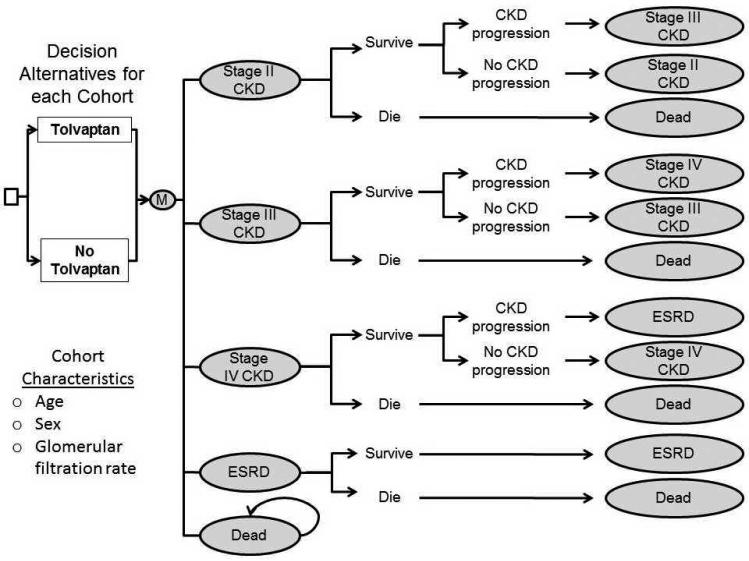
Design: A decision-analytic model.
Data sources: Published literature from 1993 to 2012.
Target population: Persons with early autosomal dominant polycystic kidney disease.
Time horizon: Lifetime.
Perspective: Societal.
Intervention: Patients received tolvaptan therapy until death, development of ESRD, or liver complications or no tolvaptan therapy.
Outcome measures: Median age at ESRD onset, life expectancy, discounted quality-adjusted life-years and lifetime costs (in 2010 U.S. dollars), and incremental cost-effectiveness ratios.
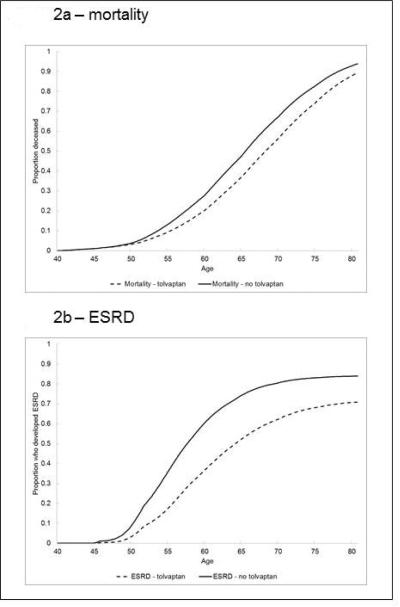
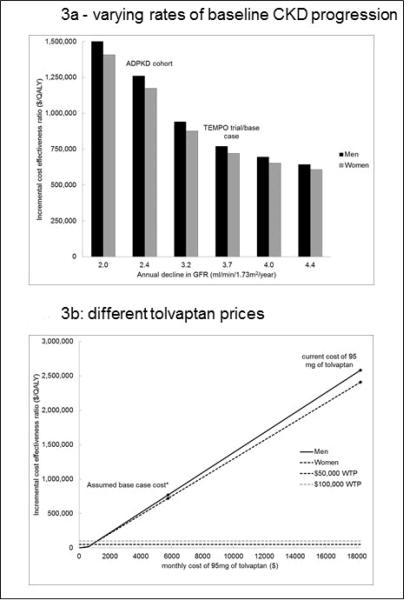
Results of base-case analysis: Tolvaptan prolonged the median age at ESRD onset by 6.5 years and increased life expectancy by 2.6 years. At $5760 per month, tolvaptan cost $744 100 per quality-adjusted life-year gained compared with standard care.
Results of sensitivity analysis: For patients with autosomal dominant polycystic kidney disease that progressed more slowly, the cost per quality-adjusted life-year gained was even greater for tolvaptan.
Limitation: Although TEMPO followed patients for 3 years, the main analysis assumed that clinical benefits persisted over patients' lifetimes.
Conclusion: Assuming that the benefits of tolvaptan persist in the longer term, the drug may slow progression to ESRD and reduce mortality rates. However, barring an approximately 95% reduction in price, cost-effectiveness does not compare favorably with many other commonly accepted medical interventions.
Primary funding source: National Institutes of Health and Agency for Healthcare Research and Quality.
Figures
Comment in
-
Translating science to improve health: hope for patients with kidney disease at what cost?Ann Intern Med. 2013 Sep 17;159(6):430-1. doi: 10.7326/0003-4819-159-6-201309170-00012. Ann Intern Med. 2013. PMID: 24042371 No abstract available.
-
Cost-effectiveness of tolvaptan in autosomal dominant polycystic kidney disease.Ann Intern Med. 2014 Jan 21;160(2):143. doi: 10.7326/L14-5001-7. Ann Intern Med. 2014. PMID: 24445704 Free PMC article. No abstract available.
-
Cost-effectiveness of tolvaptan in autosomal dominant polycystic kidney disease.Ann Intern Med. 2014 Jan 21;160(2):141-2. doi: 10.7326/L14-5001-5. Ann Intern Med. 2014. PMID: 24592503 No abstract available.
-
Cost-effectiveness of tolvaptan in autosomal dominant polycystic kidney disease.Ann Intern Med. 2014 Jan 21;160(2):142-3. doi: 10.7326/L14-5001-6. Ann Intern Med. 2014. PMID: 24592504 No abstract available.
References
-
- USRDS . United States Renal Data System. National Institutes of Health, National Institute of Diabetes and Digestive and Kidney Diseases; Bethesda, MD: 2011. Annual Data Report: Atlas of Chronic Kidney Disease and End-Stage Renal Disease in the United States.
-
- Levy M, Feingold J. Estimating prevalence in single-gene kidney diseases progressing to renal failure. Kidney International. 2000;58(3):925–43. - PubMed
-
- Fick-Brosnahan GM, Belz MM, McFann KK, Johnson AM, Schrier RW. Relationship between renal volume growth and renal function in autosomal dominant polycystic kidney disease: a longitudinal study. American Journal of Kidney Diseases. 2002;39(6):1127–34. - PubMed
-
- Schrier RW, McFann KK, Johnson AM. Epidemiological study of kidney survival in autosomal dominant polycystic kidney disease. Kidney International. 2003;63(2):678–85. - PubMed
-
- Maschio G, Alberti D, Janin G, Locatelli F, Mann JF, Motolese M, et al. Effect of the angiotensin-converting-enzyme inhibitor benazepril on the progression of chronic renal insufficiency. The Angiotensin-Converting-Enzyme Inhibition in Progressive Renal Insufficiency Study Group. New England Journal of Medicine. 1996;334(15):939–45. - PubMed
Publication types
MeSH terms
Substances
Grants and funding
LinkOut - more resources
Full Text Sources
Other Literature Sources