. 2013 Sep 16;2(9):e71.
doi: 10.1038/oncsis.2013.35.

Epigenetic and genetic features of 24 colon cancer cell lines

Affiliations

Epigenetic and genetic features of 24 colon cancer cell lines

D Ahmed et al. Oncogenesis. .

Abstract

Cell lines are invaluable biomedical research tools, and recent literature has emphasized the importance of genotype authentication and characterization. In the present study, 24 out of 27 cell line identities were confirmed by short tandem repeat profiling. The molecular phenotypes of the 24 colon cancer cell lines were examined, and microsatellite instability (MSI) and CpG island methylator phenotype (CIMP) were determined, using the Bethesda panel mononucleotide repeat loci and two epimarker panels, respectively. Furthermore, the BRAF, KRAS and PIK3CA oncogenes were analyzed for mutations in known hotspots, while the entire coding sequences of the PTEN and TP53 tumor suppressors were investigated. Nine cell lines showed MSI. Thirteen and nine cell lines were found to be CIMP positive, using the Issa panel and the Weisenberger et al. panel, respectively. The latter was found to be superior for CIMP classification of colon cancer cell lines. Seventeen cell lines harbored disrupting TP53 mutations. Altogether, 20/24 cell lines had the mitogen-activated protein kinase pathway activating mutually exclusive KRAS or BRAF mutations. PIK3CA and PTEN mutations leading to hyperactivation of the phosphoinositide 3-kinase/AKT pathway were observed in 13/24 cell lines. Interestingly, in four cell lines there were no mutations in neither BRAF, KRAS, PIK3CA nor in PTEN. In conclusion, this study presents molecular features of a large number of colon cancer cell lines to aid the selection of suitable in vitro models for descriptive and functional research.


Figures
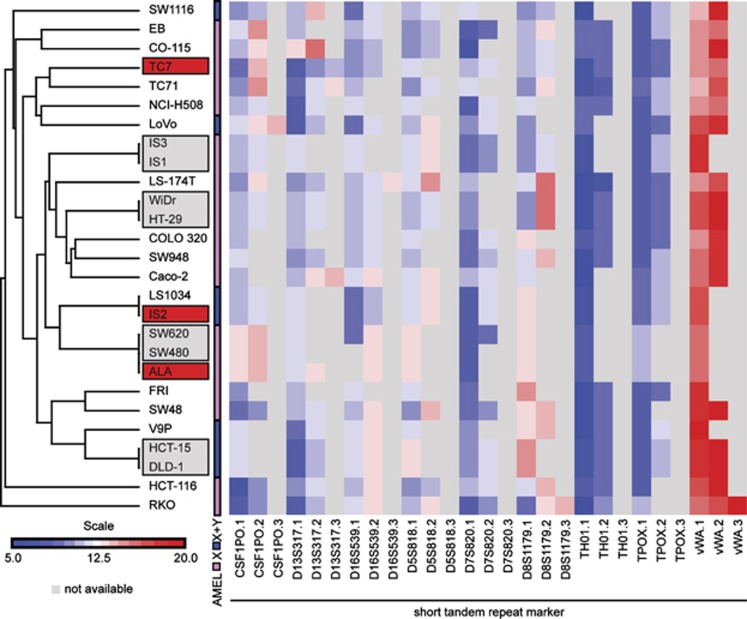
Figure 1
Figure 1
Colon cancer cell lines STR profiling. Hierarchical clustering of cell lines based on STR length of three alleles of nine STR markers. Gray color in the heatmap indicates missing allele. AMEL marker indicates sex chromosomes present. Cell lines found misclassified and excluded from further analysis are highlighted in red. Cell line pairs previously known to be derived from the same patients are highlighted in gray.
Figure 2
Figure 2
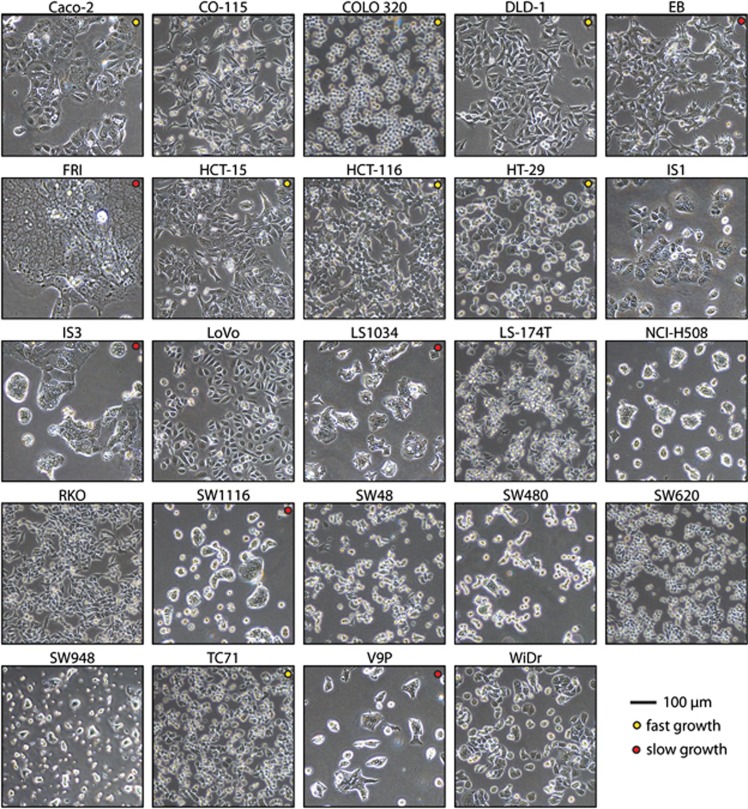
Colon cancer cell lines vary in growth rate and morphology. Phase-contrast micrographs depict the individual cell cultures 24 h after trypsinization and seeding. Fast-growing cancer cell lines are indicated with a yellow dot and slower-growing cell lines are indicated by a red dot. The remaining cell lines had an intermediate growth rate. Scale bar, 100 μm.
Figure 3
Figure 3
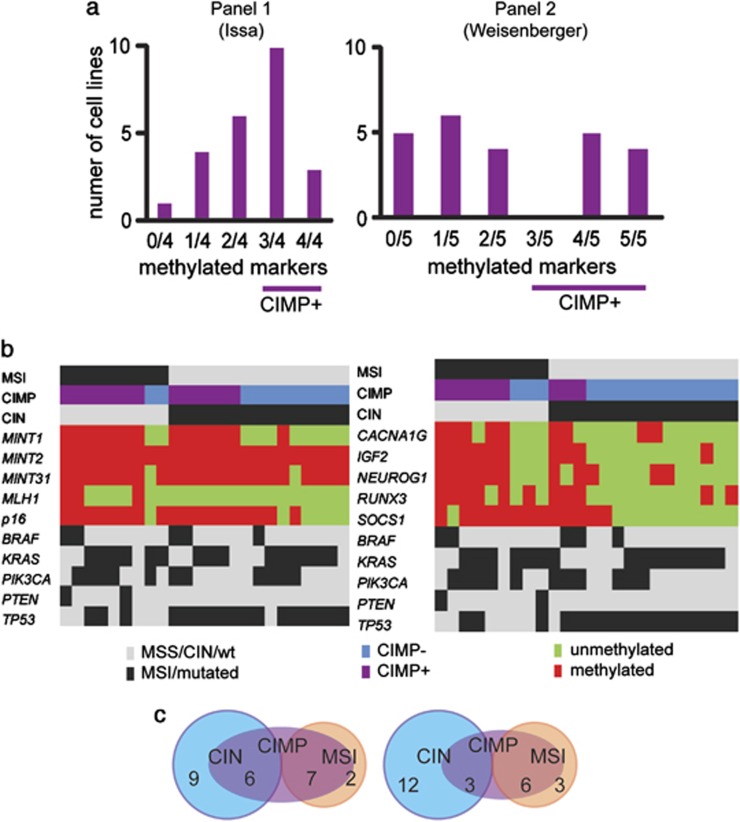
CIMP in colon cancer cell lines. (a) The status of CIMP panel 1 (Issa left) and panel 2 (Weisenberger et al. right) are illustrated. Panel 2 displayed a bimodal distribution of the number of methylated markers, identifying a distinct group of colon cancer cell lines with frequent DNA methylation. (b) Molecular profiles of colon cancer cell lines. A total of 10 markers in 2 preselected panels were tested for CIMP-related DNA methylation in 24 colon cancer cell lines. Green and red color signifies unmethylated and methylated samples, respectively. CIMP-positive samples are indicated with purple color, light blue signifies CIMP-negative samples. Samples with CIN or MSI, or BRAF, KRAS, PIK3CA, PTEN and/or TP53 mutations are marked by black color. (c) Venn diagrams illustrate the association between the three CRC phenotypes CIN, MSI and CIMP panel 1 (left) and CIMP panel 2 (right) in colon cancer cell lines.

References

    1. Gazdar AF, Gao B, Minna JD. Lung cancer cell lines: useless artifacts or invaluable tools for medical science. Lung Cancer. 2010;68:309. - PMC - PubMed
    1. Shoemaker RH. The NCI60 human tumour cell line anticancer drug screen. Nat Rev Cancer. 2006;6:813. - PubMed
    1. Ashraf SQ, Nicholls AM, Wilding JL, Ntouroupi TG, Mortensen NJ, Bodmer WF. Direct and immune mediated antibody targeting of ERBB receptors in a colorectal cancer cell-line panel. Proc Natl Acad Sci USA. 2012;109:21046. - PMC - PubMed
    1. Lind GE, Danielsen SA, Ahlquist T, Merok MA, Andresen K, Skotheim RI, et al. Identification of an epigenetic biomarker panel with high sensitivity and specificity for colorectal cancer and adenomas, Mol. Cancer. 2011;10:85. - PMC - PubMed
    1. Barretina J, Caponigro G, Stransky N, Venkatesan K, Margolin AA, Kim S, et al. The Cancer Cell Line Encyclopedia enables predictive modelling of anticancer drug sensitivity. Nature. 2012;483:603. - PMC - PubMed