


Aerobic Fitness Is Disproportionately Low in Adult Burn Survivors Years After Injury
- PMID: 24043241
- PMCID: PMC3954961
- DOI: 10.1097/BCR.0b013e3182a22915
Aerobic Fitness Is Disproportionately Low in Adult Burn Survivors Years After Injury
Abstract
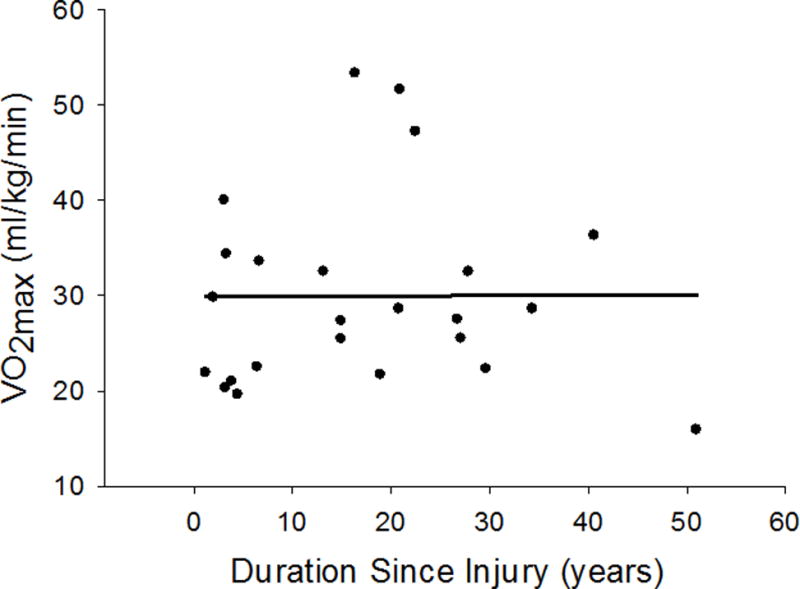
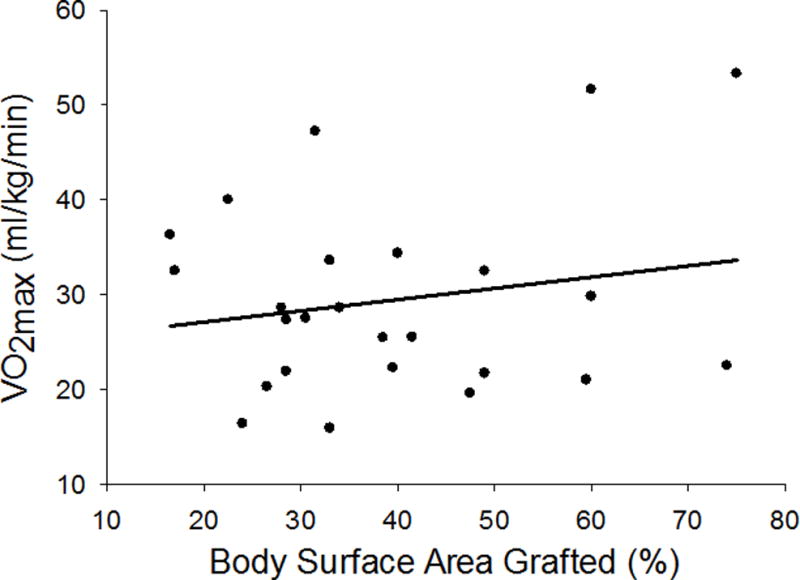
A maximal aerobic capacity below the 20th percentile is associated with an increased risk of all-cause mortality (Blair 1995). Adult Adult burn survivors have a lower aerobic capacity compared with nonburned adults when evaluated 38 ± 23 days postinjury (deLateur 2007). However, it is unknown whether burn survivors with well-healed skin grafts (ie, multiple years postinjury) also have low aerobic capacity. This project tested the hypothesis that aerobic fitness, as measured by maximal aerobic capacity (VO2max), is reduced in well-healed adult burn survivors when compared with normative values from nonburned individuals. Twenty-five burn survivors (36 ± 12 years old; 13 females) with well-healed split-thickness grafts (median, 16 years postinjury; range, 1-51 years) covering at least 17% of their BSA (mean, 40 ± 16%; range, 17-75%) performed a graded cycle ergometry exercise to test volitional fatigue. Expired gases and minute ventilation were measured via a metabolic cart for the determination of VO2max. Each subject's VO2max was compared with sex- and age-matched normative values from population data published by the American College of Sports Medicine, the American Heart Association, and recent epidemiological data (Aspenes 2011). Subjects had a VO2max of 29.4 ± 10.1 ml O2/kg body mass/min (median, 27.5; range, 15.9-53.3). The use of American College of Sports Medicine normative values showed that mean VO2max of the subjects was in the lower 24th percentile (median, 10th percentile). A total of 88% of the subjects had a VO2max below American Heart Association age-adjusted normative values. Similarly, 20 of the 25 subjects had a VO2max in the lower 25% percentile of recent epidemiological data. Relative to nongrafted subjects, 80 to 88% of the evaluated skin-graft subjects had a very low aerobic capacity. On the basis of these findings, adult burn survivors are disproportionally unfit relative to the general U.S. population, and this puts them at an increased risk of all-cause mortality (Blair 1995).
Conflict of interest statement
The authors have no conflict of interest to declare.
Figures
References
-
- Blair SN, Kohl HW, 3rd, Barlow CE, S PR, Jr, Gibbons LW, Macera CA. Changes in physical fitness and all-cause mortality. A prospective study of healthy and unhealthy men. Jama. 1995;273:1093–8. - PubMed
-
- de Lateur BJ, Magyar-Russell G, Bresnick MG, et al. Augmented exercise in the treatment of deconditioning from major burn injury. Archives of physical medicine and rehabilitation. 2007;88:S18–23. - PubMed
-
- Aspenes ST, Nilsen TI, Skaug EA, et al. Peak oxygen uptake and cardiovascular risk factors in 4631 healthy women and men. Med Sci Sports Exerc. 2011;43:1465–1473. - PubMed
-
- American burn association national burn repository. Chicago, IL: American Burn Association; 2007.
-
- Blakeney PE, Rosenberg L, Rosenberg M, Faber AW. Psychosocial care of persons with severe burns. Burns. 2008;34:433–440. - PubMed
