


The effects of an acute challenge with the NMDA receptor antagonists, MK-801, PEAQX, and ifenprodil, on social inhibition in adolescent and adult male rats
- PMID: 24043344
- PMCID: PMC3956710
- DOI: 10.1007/s00213-013-3278-3
The effects of an acute challenge with the NMDA receptor antagonists, MK-801, PEAQX, and ifenprodil, on social inhibition in adolescent and adult male rats
Abstract
Rationale: NMDA antagonists consistently produce social inhibition in adult animals, although effects of these manipulations on social behavior of adolescents are relatively unknown.
Objectives: The aim of this study was to assess potential age differences in the socially inhibitory effects of the non-competitive NMDA antagonist, MK-801, as well as NR2 subunit selective effects, given the regional and developmental differences that exist for the NR2 subunit during ontogeny.
Methods: In separate experiments, adolescent and adult male Sprague-Dawley rats were treated acutely with MK-801 (0, 0.05, 0.1, 0.2 mg/kg, i.p.), the NR2A antagonist, PEAQX (2.5, 5, 10, 20 mg/kg, s.c.), or the NR2B antagonist, ifenprodil (1.5, 3, 6, 12 mg/kg, i.p.), 10 min prior to a social interaction test.
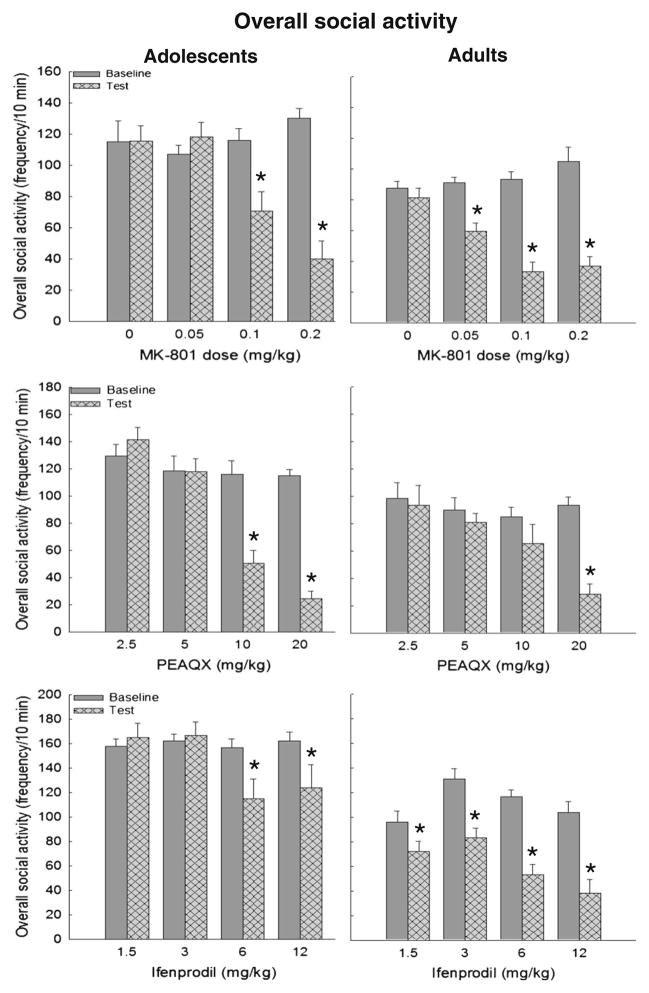
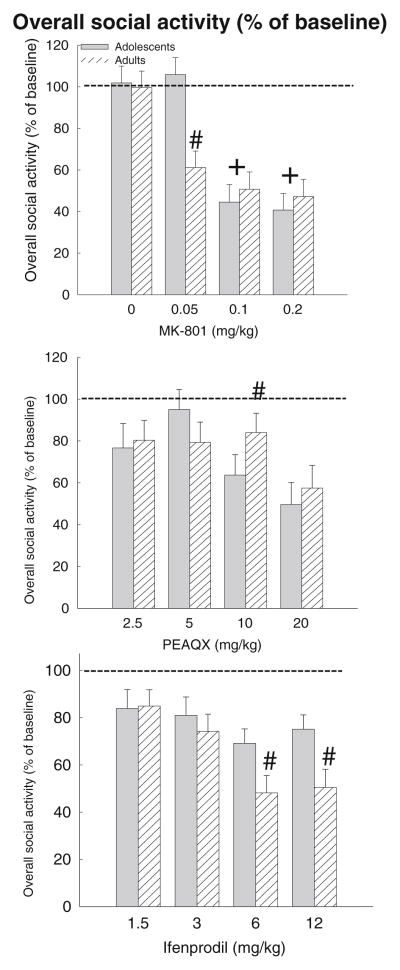
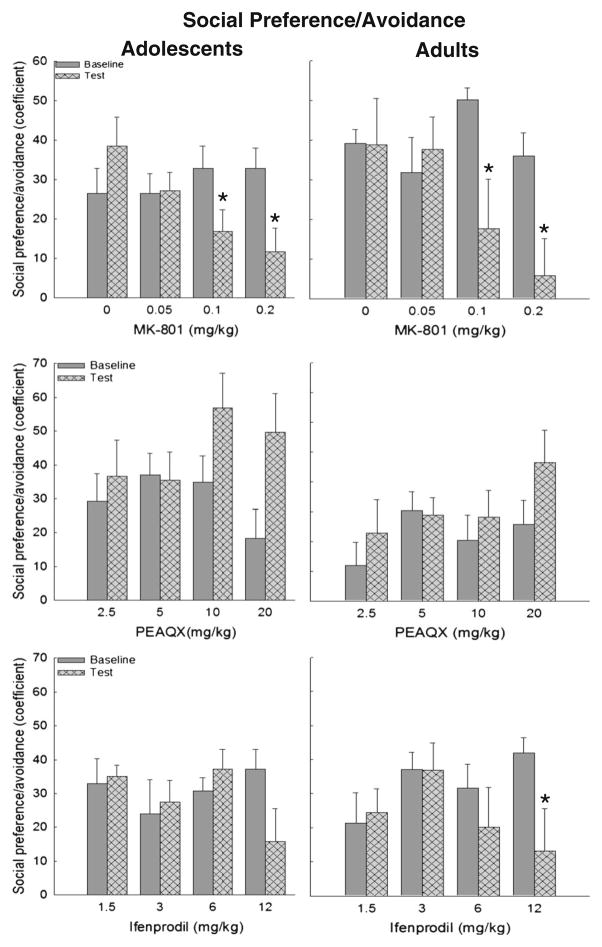
Results: Adolescents required higher doses of MK-801 (0.1 and 0.2 mg/kg) to induce social suppression, whereas adults demonstrated reductions in social activity after all doses. Likewise, adolescents required higher doses of ifenprodil (6 and 12 mg/kg) to produce social inhibitory effects relative to adults (all doses). In contrast, adults were less sensitive to PEAQX than adolescents, with adults showing social inhibition after 20 mg/kg whereas adolescents showed this effect following 10 and 20 mg/kg. Although locomotor activity was generally reduced at both ages by all drugs tested, ANCOVAs using locomotor activity as a covariate revealed similar patterns of social inhibitory effects.
Conclusions: Adolescents are less sensitive than adults to the disruption of social behavior by NMDA and NR2B-selective receptor antagonism, but not by an NR2A antagonist-age differences that may be related to different subunit expression patterns during development.
Conflict of interest statement
Figures
References
-
- Allgaier C. Ethanol sensitivity of NMDA receptors. Neurochem Int. 2002;41:377–382. - PubMed
-
- Anderson RI, Spear LP. NMDA 2A and 2B receptor involvement in the discriminative stimulus properties of ethanol in adult male rats. Society for Neuroscience; New Orleans: 2012.
-
- Audet MC, Goulet S, Dore FY. Impaired social motivation and increased aggression in rats subchronically exposed to phencyclidine. Physiol Behav. 2009;96:394–398. - PubMed
Publication types
MeSH terms
Substances
Grants and funding
LinkOut - more resources
Full Text Sources
Other Literature Sources
