Chronic inflammation as a determinant of future aging phenotypes
- PMID: 24043651
- PMCID: PMC3826354
- DOI: 10.1503/cmaj.122072
Chronic inflammation as a determinant of future aging phenotypes
Abstract
Background: The importance of chronic inflammation as a determinant of aging phenotypes may have been underestimated in previous studies that used a single measurement of inflammatory markers. We assessed inflammatory markers twice over a 5-year exposure period to examine the association between chronic inflammation and future aging phenotypes in a large population of men and women.
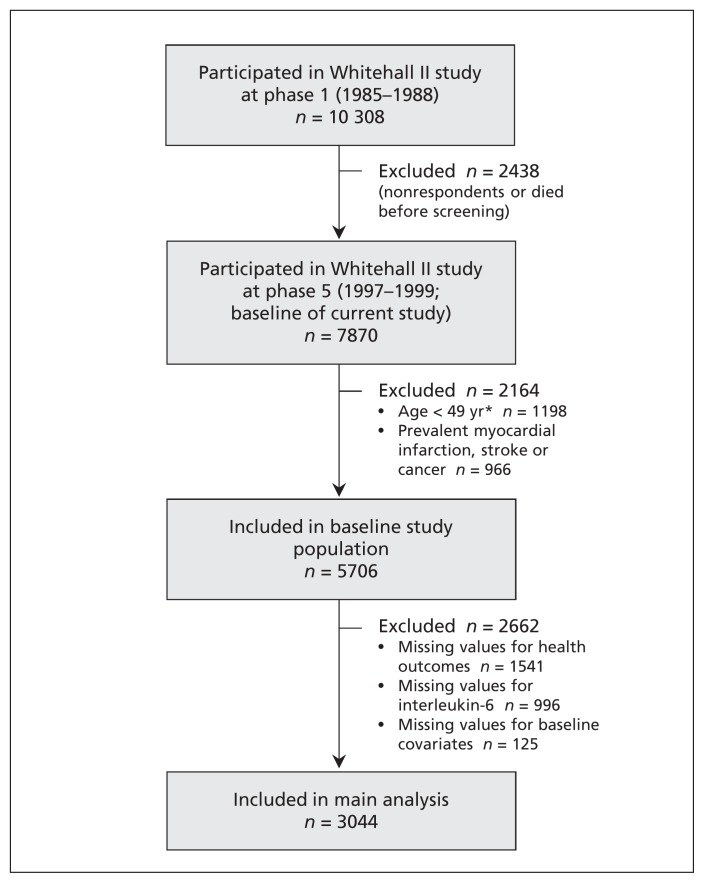
Methods: We obtained data for 3044 middle-aged adults (28.2% women) who were participating in the Whitehall II study and had no history of stroke, myocardial infarction or cancer at our study's baseline (1997-1999). Interleukin-6 was measured at baseline and 5 years earlier. Cause-specific mortality, chronic disease and functioning were ascertained from hospital data, register linkage and clinical examinations. We used these data to create 4 aging phenotypes at the 10-year follow-up (2007-2009): successful aging (free of major chronic disease and with optimal physical, mental and cognitive functioning), incident fatal or nonfatal cardiovascular disease, death from noncardiovascular causes and normal aging (all other participants).
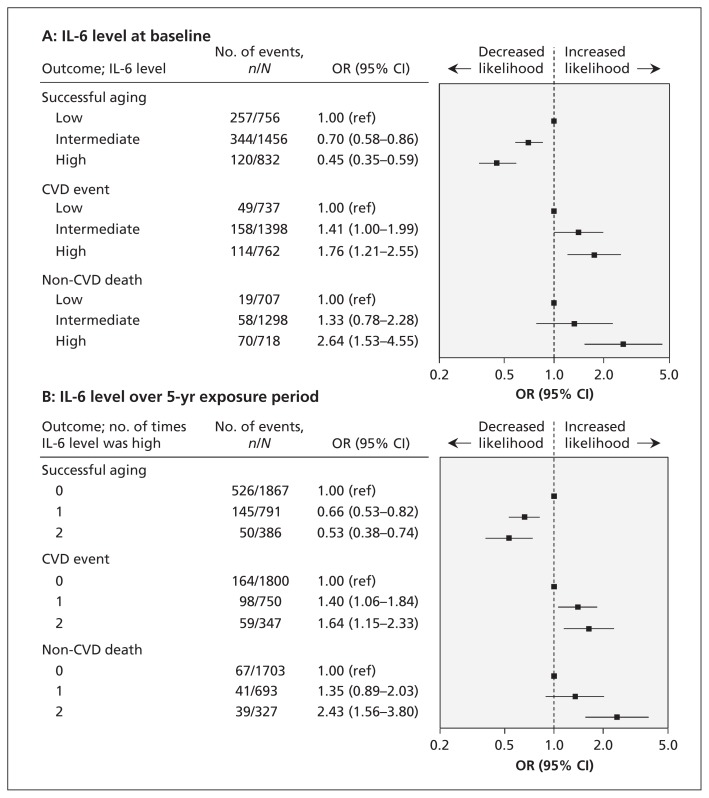
Results: Of the 3044 participants, 721 (23.7%) met the criteria for successful aging at the 10-year follow-up, 321 (10.6%) had cardiovascular disease events, 147 (4.8%) died from noncardiovascular causes, and the remaining 1855 (60.9%) were included in the normal aging phenotype. After adjustment for potential confounders, having a high interleukin-6 level (> 2.0 ng/L) twice over the 5-year exposure period nearly halved the odds of successful aging at the 10-year follow-up (odds ratio [OR] 0.53, 95% confidence interval [CI] 0.38-0.74) and increased the risk of future cardiovascular events (OR 1.64, 95% CI 1.15-2.33) and noncardiovascular death (OR 2.43, 95% CI 1.58-3.80).
Interpretation: Chronic inflammation, as ascertained by repeat measurements, was associated with a range of unhealthy aging phenotypes and a decreased likelihood of successful aging. Our results suggest that assessing long-term chronic inflammation by repeat measurement of interleukin-6 has the potential to guide clinical practice.
Figures
References
-
- Pradhan AD , Manson JE , Rifai N , et al. . C-reactive protein, interleukin 6, and risk of developing type 2 diabetes mellitus . JAMA 2001 . ; 286 : 327 – 34 . - PubMed
-
- Wellen J , Helmer KG , Grigg P , et al. . Spatial characterization of T1 and T2 relaxation times and the water apparent diffusion coefficient in rabbit Achilles tendon subjected to tensile loading . Magn Reson Med 2005 . ; 53 : 535 – 44 . - PubMed
-
- Gorelick PB . Role of inflammation in cognitive impairment: results of observational epidemiological studies and clinical trials . Ann N Y Acad Sci 2010 . ; 1207 : 155 – 62 . - PubMed
Publication types
MeSH terms
Substances
Grants and funding
- K013351/MRC_/Medical Research Council/United Kingdom
- RG/13/2/30098/BHF_/British Heart Foundation/United Kingdom
- R01 HL036310/HL/NHLBI NIH HHS/United States
- DH_/Department of Health/United Kingdom
- R01 AG034454/AG/NIA NIH HHS/United States
- HS06516/HS/AHRQ HHS/United States
- R01AG013196/AG/NIA NIH HHS/United States
- MR/K013351/1/MRC_/Medical Research Council/United Kingdom
- R01 AG013196/AG/NIA NIH HHS/United States
- PG/11/63/29011/BHF_/British Heart Foundation/United Kingdom
- R01AG034454/AG/NIA NIH HHS/United States
- R01HL036310/HL/NHLBI NIH HHS/United States
LinkOut - more resources
Full Text Sources
Other Literature Sources
Medical
Molecular Biology Databases
Research Materials
Miscellaneous