. 2013 Oct 20;31(30):3782-90.
doi: 10.1200/JCO.2012.47.4007. Epub 2013 Sep 16.

Effect of donor KIR2DL1 allelic polymorphism on the outcome of pediatric allogeneic hematopoietic stem-cell transplantation

Affiliations

Effect of donor KIR2DL1 allelic polymorphism on the outcome of pediatric allogeneic hematopoietic stem-cell transplantation

Rafijul Bari et al. J Clin Oncol. .

Abstract

Purpose: Killer-cell immunoglobulin-like receptors (KIRs) that regulate natural-killer cells are highly polymorphic. Some KIR2DL1 alleles encode receptors that have stronger signaling function than others. We tested the hypothesis that the clinical outcomes of allogeneic hematopoietic stem-cell transplantation (HSCT) could be affected by donor KIR2DL1 polymorphism.

Patients and methods: All 313 pediatric patients received allogeneic HSCT at a single institution. Donor KIR2DL1 functional allele typing was retrospectively performed using single nucleotide polymorphism assay.

Results: Patients who received a donor graft containing the functionally stronger KIR2DL1 allele with arginine at amino acid position 245 (KIR2DL1-R(245)) had better survival (P = .0004) and lower cumulative incidence of disease progression (P = .001) than those patients who received a donor graft that contained only the functionally weaker KIR2DL1 allele with cysteine at the same position (KIR2DL1-C(245)). The effect of KIR2DL1 allelic polymorphism was similar in patients with acute myeloid leukemia or acute lymphoblastic leukemia among all allele groups (P ≥ .71). Patients who received a KIR2DL1-R(245)-positive graft with HLA-C receptor-ligand mismatch had the best survival (P = .00003) and lowest risk of leukemia progression (P = .0005) compared with those who received a KIR2DL1-C(245) homozygous graft.

Conclusion: Donor KIR2DL1 allelic polymorphism affects recipient outcomes after allogeneic HSCT. These findings have substantial implications for prognostication and donor selection.


Conflict of interest statement

Authors' disclosures of potential conflicts of interest and author contributions are found at the end of this article.

Figures
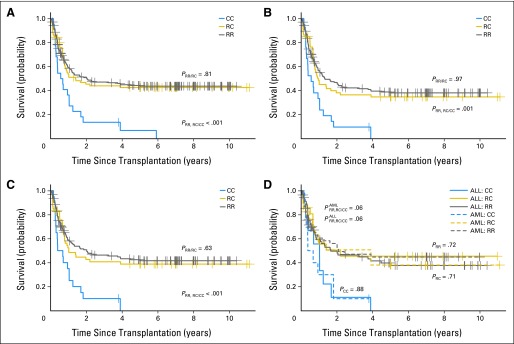
Fig 1.
Fig 1.
Survival of patients stratified by donor KIR2DL1 functional allelic groups. Shown are the overall survival of (A) the entire cohort of 313 transplantation recipients, (B) the 256 patients with malignant disease, (C) the 231 patients with a hematologic malignancy, and (D) the patients with acute lymphoblastic leukemia (ALL) and acute myeloid leukemia (AML) displayed separately after receiving a KIR2DL1-R245 homozygous (RR), KIR2DL1-R245/C245 heterozygous (RC), or KIR2DL1-C245 homozygous (CC) graft. PRR/RC, P value between RR and RC group; PRR,RC/CC, P value comparing RR and RC groups with CC group; ALL:RR, patients with ALL who received an RR donor graft; ALL:RC, patients with ALL who received an RC donor graft; ALL:CC, patients with ALL who received a CC donor graft; AML:RR, patients with AML who received an RR donor graft; AML:RC, patients with AML who received an RC donor graft; AML:CC, patients with AML who received a CC donor graft; P×RR,RC/CC, P value when comparing RR and RC groups with CC group for patients with the diagnosis of AML or ALL as indicated; PRR, PRC, and PCC, P values when comparing ALL and AML patients who received a similar RR, RC, or CC donor graft.
Fig 2.
Fig 2.
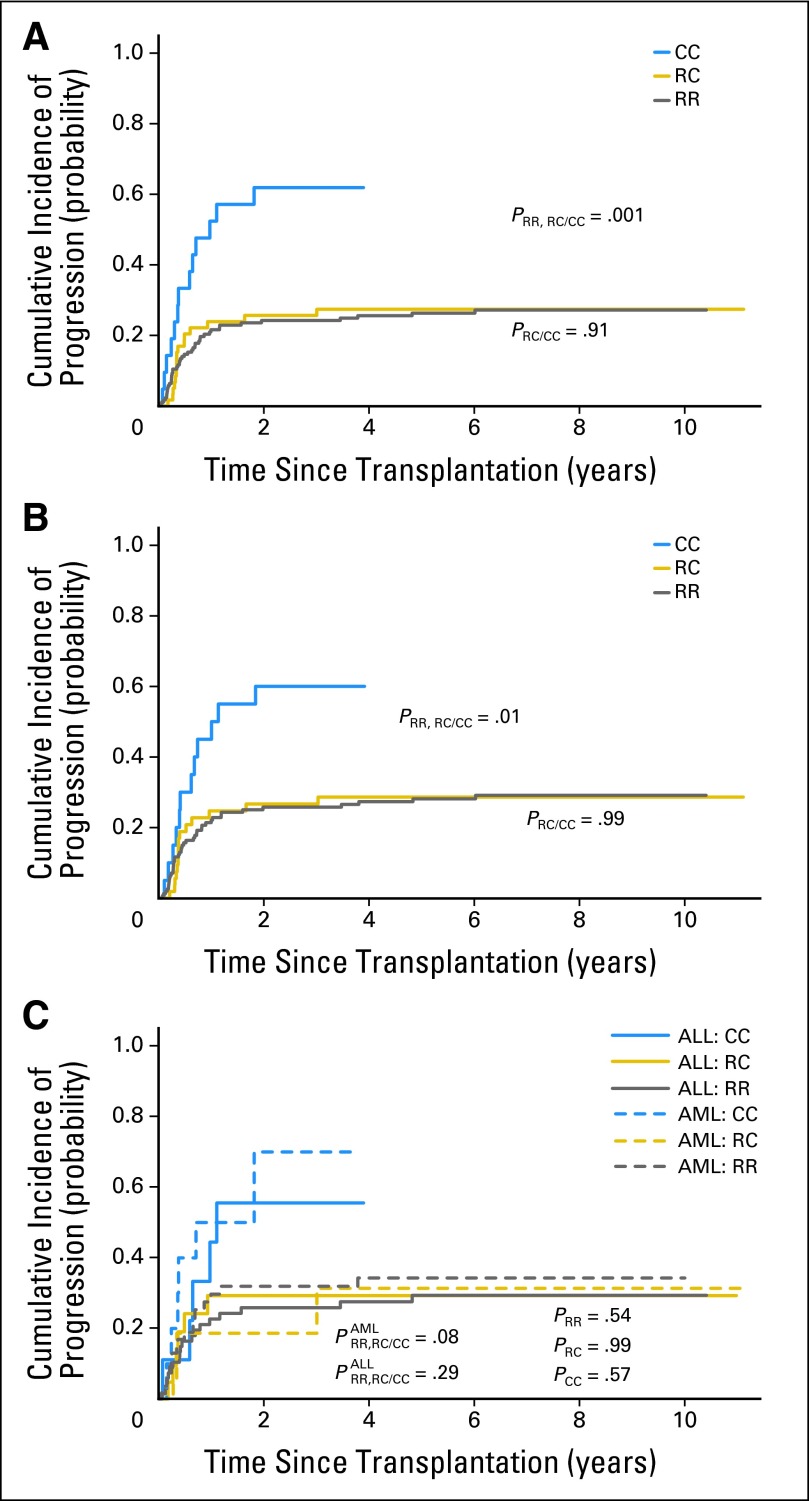
Cumulative incidence of disease progression after transplantations stratified by donor KIR2DL1 functional allelic groups. Shown are the cumulative incidence (CI) of disease progression or relapse in (A) 256 patients with malignancy, (B) 231 patients with hematologic malignancy, and (C) patients with acute lymphoblastic leukemia (ALL) and acute myeloid leukemia (AML) displayed separately after receiving a KIR2DL1-R245 homozygous (RR), KIR2DL1-R245/C245 heterozygous (RC), or KIR2DL1-C245 homozygous (CC) graft. Deaths unrelated to disease were considered competing events. ALL:RR, patients with ALL who received an RR donor graft; ALL:RC, patients with ALL who received an RC donor graft; ALL:CC, patients with ALL who received a CC donor graft; AML:RR, patients with AML who received an RR donor graft; AML:RC, patients with AML who received an RC donor graft; AML:CC, patients with AML who received a CC donor graft; PRR,RC/CC, P value when comparing RR and RC groups with CC group; PRR/RC, P value between the RR and RC groups; PRR, PRC, and PCC indicate the P values when comparing ALL and AML patients who received a similar RR, RC, or CC donor graft.
Fig 3.
Fig 3.
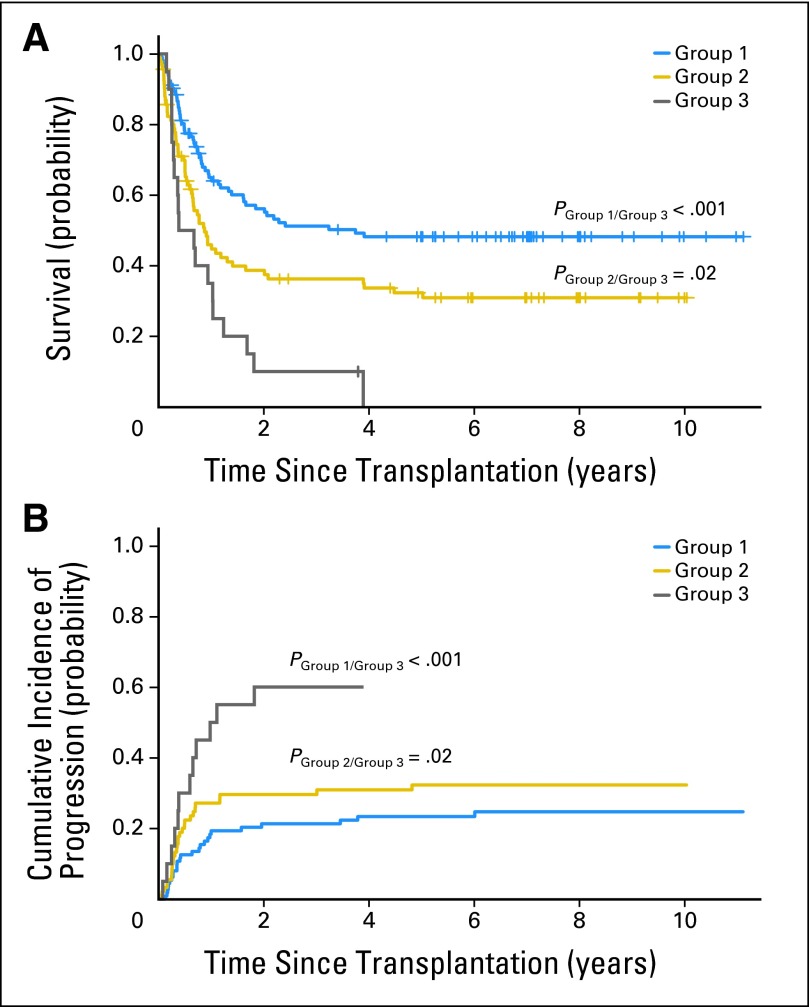
Survival and cumulative incidence (CI) of disease progression stratified by donor KIR2DL1 allelic groups and the presence of HLA-C receptor-ligand mismatch. Shown are the (A) overall survival probability and (B) CI of disease progression or relapse among different groups of patients with hematologic malignancy. Group 1, patients with a KIR2DL1-R245 homozygous (RR) or KIR2DL1-R245/C245 heterozygous (RC) donor and HLA-C receptor-ligand mismatch; group 2, patients with a KIR2DL1 RR or RC donor but not HLA-C receptor-ligand mismatched; group 3, patients who received a KIR2DL1-C245 homozygous (CC) graft with or without HLA-C receptor-ligand mismatch. Pgroup 1/group 3, P value between group 1 and group 3; Pgroup 2/group 3, P value between group 2 and group 3.
Fig A1.
Fig A1.
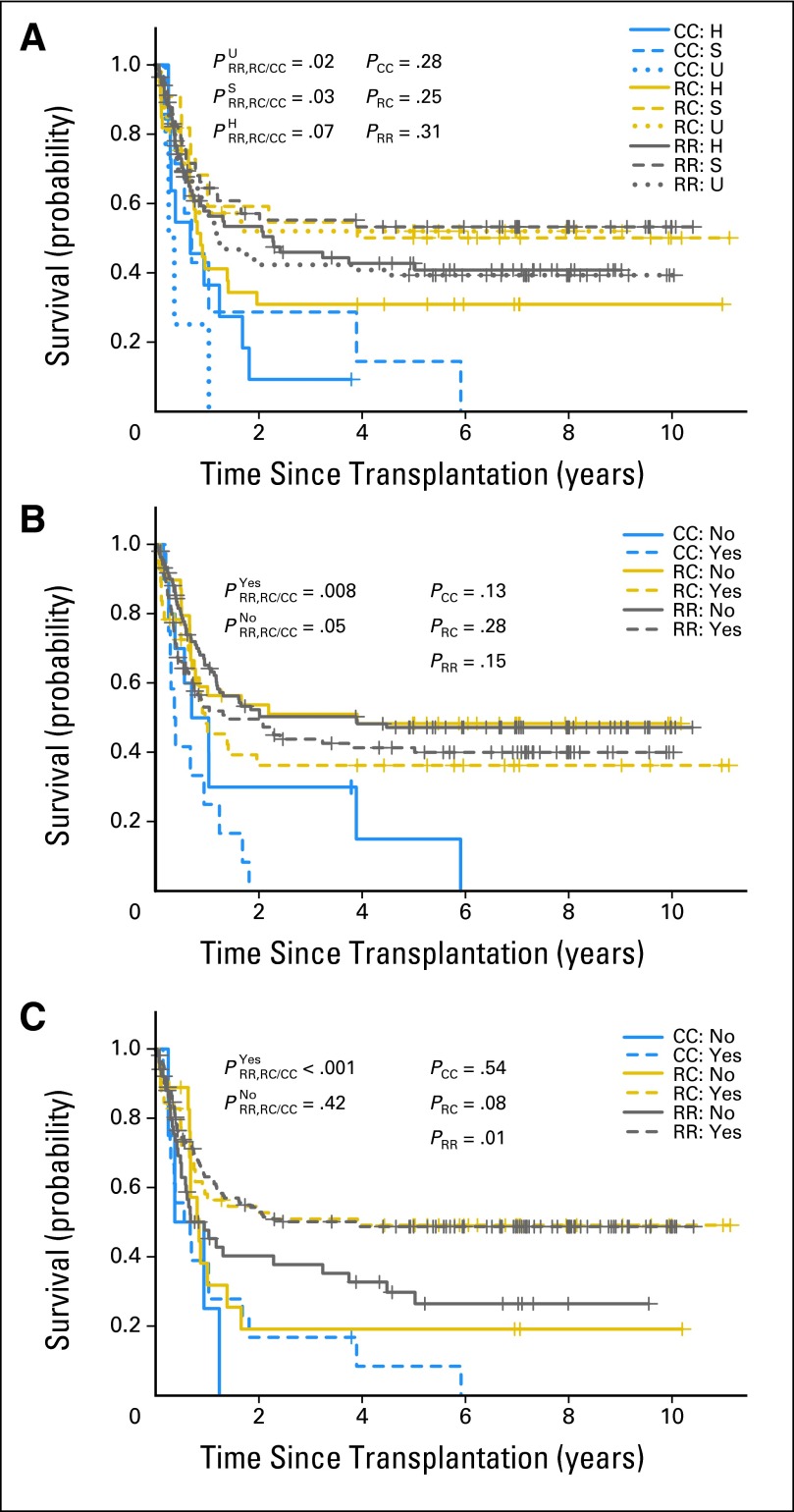
Overall survival stratified by donor KIR2DL1 functional allelic groups. (A) Survival of patients who received a graft from a haploidentical (H), sibling (S), or unrelated (U) donor. (B) Survival of patients who received a T cell depleted (yes) or replete (no) graft. (C) Survival of patients who received a myeloablative (yes) or nonmyeloablative (no) conditioning. CC, KIR2DL1-C245 homozygous graft; PRR, PRC, and PCC, P values when comparing patients who received a similar RR, RC, or CC donor graft, respectively; P×RR, RC/CC, P value when comparing the RR and RC groups with the CC group in the corresponding subset; RC, KIR2DL1-R245/C245 heterozygous graft; KIR2DL1-R245 homozygous graft.

Comment in

References

    1. Cooley S, Weisdorf DJ, Guethlein LA, et al. Donor selection for natural killer cell receptor genes leads to superior survival after unrelated transplantation for acute myelogenous leukemia. Blood. 2010;116:2411–2419. - PMC - PubMed
    1. Chen DF, Prasad VK, Broadwater G, et al. Differential impact of inhibitory and activating Killer Ig-Like Receptors (KIR) on high-risk patients with myeloid and lymphoid malignancies undergoing reduced intensity transplantation from haploidentical related donors. Bone Marrow Transplant. 2012;47:817–823. - PMC - PubMed
    1. Venstrom JM, Pittari G, Gooley TA, et al. HLA-C-dependent prevention of leukemia relapse by donor activating KIR2DS1. N Engl J Med. 2012;367:805–816. - PMC - PubMed
    1. Malmberg KJ, Michaëlsson J, Parham P, et al. Killer cell immunoglobulin-like receptor workshop: Insights into evolution, genetics, function, and translation. Immunity. 2011;35:653–657. - PubMed
    1. Ruggeri L, Capanni M, Urbani E, et al. Effectiveness of donor natural killer cell alloreactivity in mismatched hematopoietic transplants. Science. 2002;295:2097–2100. - PubMed

Publication types

MeSH terms