. 2013 Oct 1;110(40):16109-14.
doi: 10.1073/pnas.1315292110. Epub 2013 Sep 16.

Mice lacking ANGPTL8 (Betatrophin) manifest disrupted triglyceride metabolism without impaired glucose homeostasis

Affiliations

Mice lacking ANGPTL8 (Betatrophin) manifest disrupted triglyceride metabolism without impaired glucose homeostasis

Yan Wang et al. Proc Natl Acad Sci U S A. .

Abstract

Angiopoietin-like protein (ANGPTL)8 (alternatively called TD26, RIFL, Lipasin, and Betatrophin) is a newly recognized ANGPTL family member that has been implicated in both triglyceride (TG) and glucose metabolism. Hepatic overexpression of ANGPTL8 causes hypertriglyceridemia and increased insulin secretion. Here we examined the effects of inactivating Angptl8 on TG and glucose metabolism in mice. Angptl8 knockout (Angptl8(-/-)) mice gained weight more slowly than wild-type littermates due to a selective reduction in adipose tissue accretion. Plasma levels of TGs of the Angptl8(-/-) mice were similar to wild-type animals in the fasted state but paradoxically decreased after refeeding. The lower TG levels were associated with both a reduction in very low density lipoprotein secretion and an increase in lipoprotein lipase (LPL) activity. Despite the increase in LPL activity, the uptake of very low density lipoprotein-TG is markedly reduced in adipose tissue but preserved in hearts of fed Angptl8(-/-) mice. Taken together, these data indicate that ANGPTL8 plays a key role in the metabolic transition between fasting and refeeding; it is required to direct fatty acids to adipose tissue for storage in the fed state. Finally, glucose and insulin tolerance testing revealed no alterations in glucose homeostasis in mice fed either a chow or high fat diet. Thus, although absence of ANGPTL8 profoundly disrupts TG metabolism, we found no evidence that it is required for maintenance of glucose homeostasis.


Conflict of interest statement

The authors declare no conflict of interest.

Figures
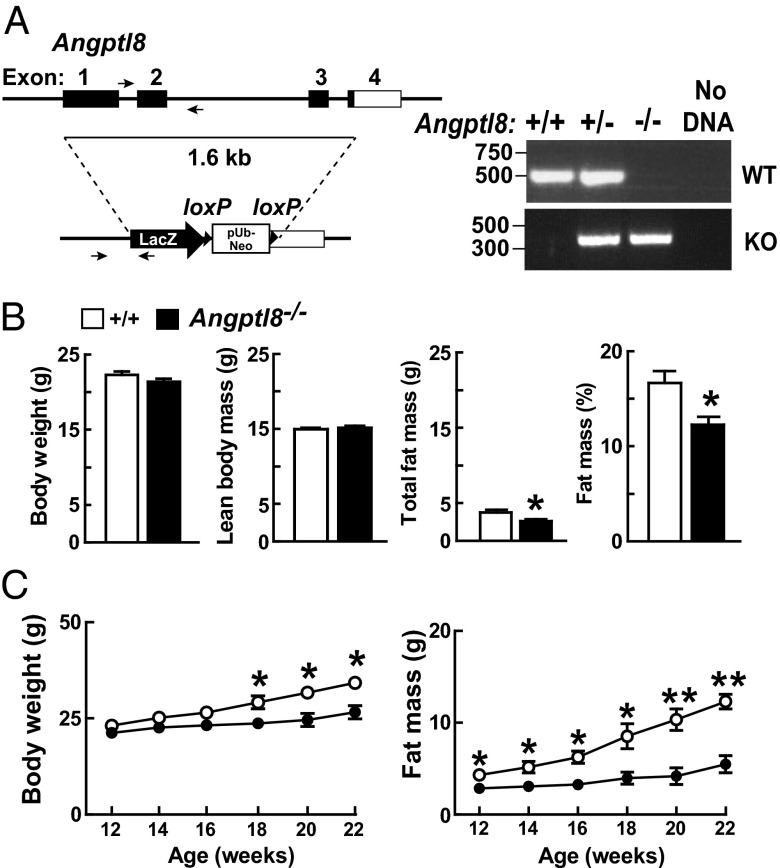
Fig. 1.
Fig. 1.
Development and characterization of Angptl8 knockout mice. (A) Targeted disruption of mouse Angptl8. The targeting vector replaced exons 1–3 and part of exon 4 of Angptl8 (nucleotides 21639965–21641596 of chromosome 9; Genome Build 37, http://www.ncbi.nlm.nih.gov/projects/genome/assembly/grc/mouse/) with a LacZ-pUb-Neo cassette. Genotypes were assayed using PCR and the indicated primers for the wild-type (518 bp) and mutant (357 bp) alleles, as described in Materials and Methods. (B) Body weight and composition were measured in 10- to 13-wk-old female Angptl8−/− mice and wild-type littermates (n = 14–15 per group) as described in SI Materials and Methods. (C) Body weight and total fat mass were monitored every other week in female Angptl8−/− and wild-type mice (n = 4–5 per group, age 12 wk). *P < 0.05, **P < 0.01. Values are means +/− SEM.
Fig. 2.
Fig. 2.
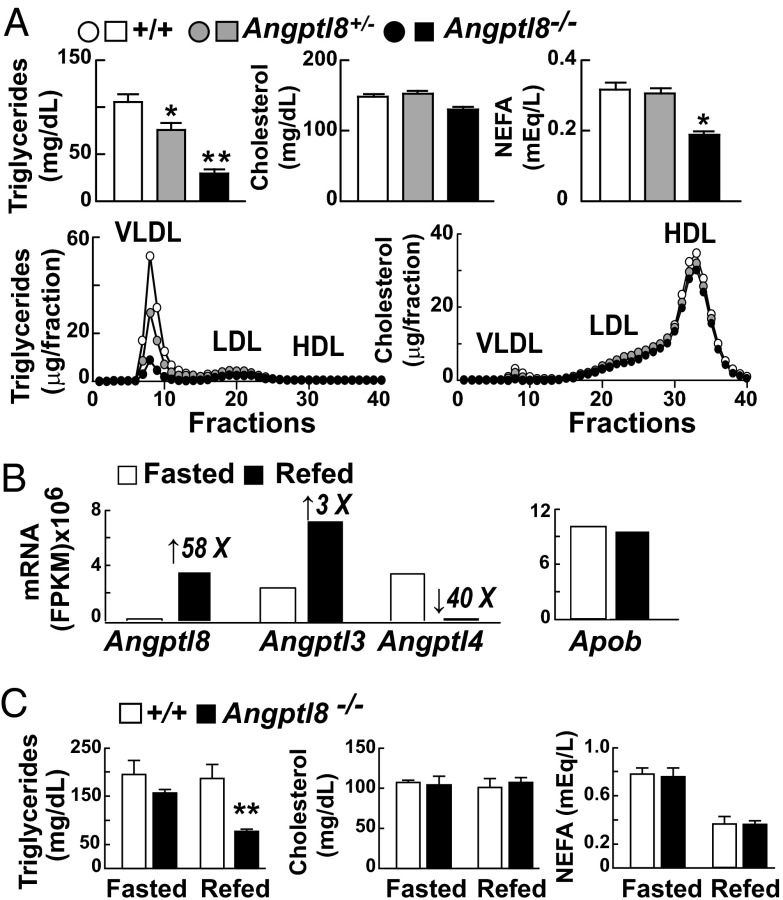
Effects of Angptl8 inactivation on lipid metabolism. (A) Plasma lipids of male Angptl8−/− and Angptl8+/− mice and wild-type littermates (n = 4–5 per group, age 10–12 wk) fed a chow diet ad libitum. Samples were collected at 7:00 AM. Pooled plasma from each group was fractionated by FPLC (n = 40 fractions) and the TG and cholesterol contents of each fraction were determined enzymatically. The experiments were repeated three times with similar results. (B) Poly(A) mRNA was isolated from livers of three fasted and three refed 10-wk-old male C57BL/6J mice. The mRNA from each group was pooled, reverse-transcribed, and subjected to whole-transcriptome shotgun sequencing (RNA-Seq). Transcript abundance was expressed as fragments per kilobase of exon per million fragments mapped (FPKM). The number above each bar indicates fold change relative to the fasted group. (C) Angptl8−/− mice and wild-type littermates (n = 4 per group, 8- to 12-wk-old male mice) were habituated for 3 d to a dietary regimen, and plasma lipids were determined in the fasted and fed states as described in Material and Methods. *P < 0.05, **P < 0.01. Values are means +/− SEM.
Fig. 3.
Fig. 3.
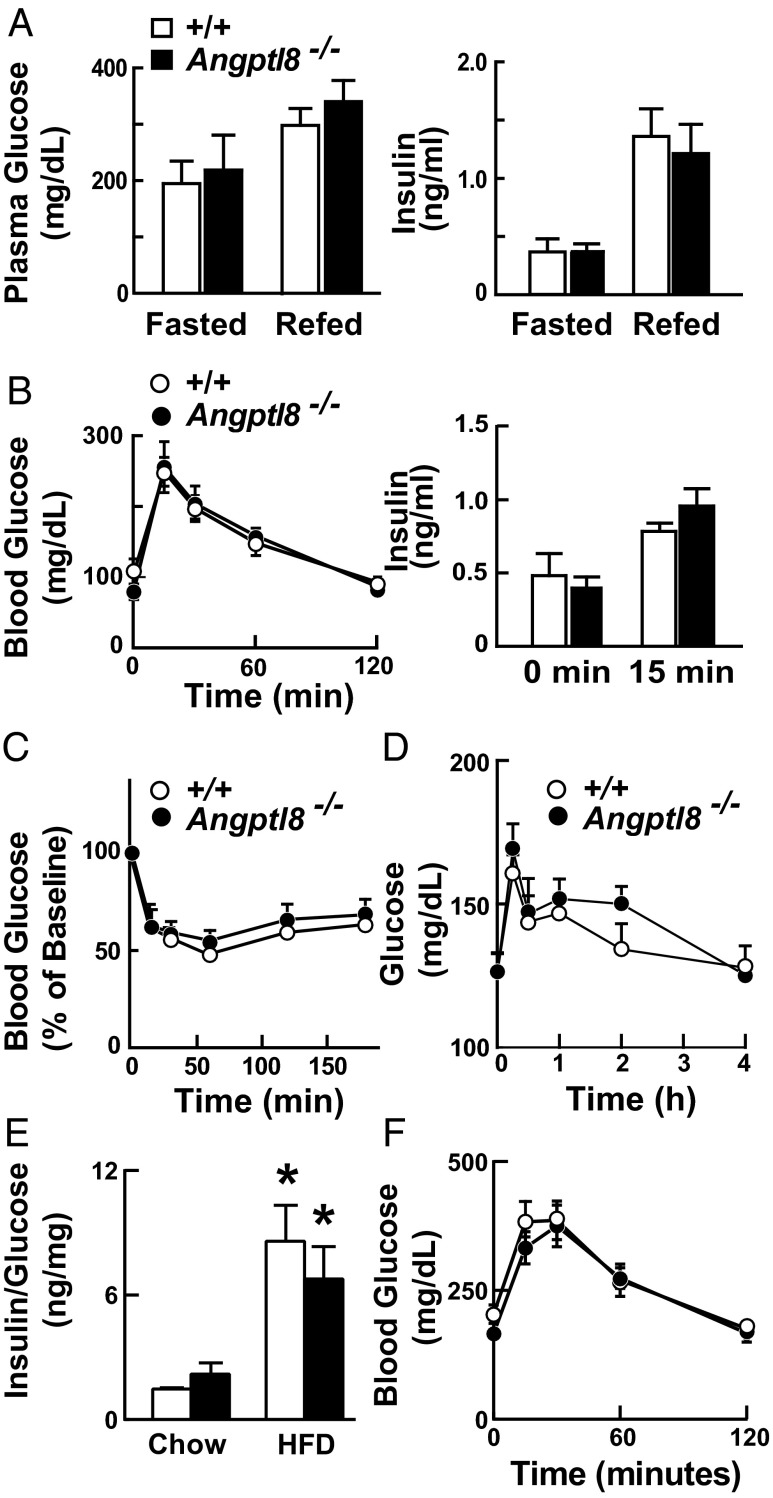
Glucose homeostasis in Angptl8−/− mice. (A) Plasma levels of glucose and insulin in fasted and fed Angptl8−/− mice. Glucose and insulin concentrations were measured in the same samples as shown in Fig. 2B using the Vitros 250 System (GMI) and by ELISA, as described in Materials and Methods. (B) Glucose tolerance tests performed after overnight fasting in female Angptl8−/− mice and wild-type littermates (n = 5, age 8–12 wk). Blood glucose and plasma insulin levels were measured using a glucometer and ELISAs as described in Materials and Methods. (C) Insulin tolerance tests performed after a 4-h fast in female Angptl8−/− mice and wild-type littermates (n = 5 per group, age 8–12 wk). Blood glucose levels are expressed as percentage of baseline levels. The experiments shown here were repeated with similar results. (D) Pyruvate tolerance tests were performed in female Angptl8−/− mice and wild-type littermates (n = 5 per group, age 12–17 wk) as described in Materials and Methods. (E) Female Angptl8−/− and wild-type littermates (n = 4–5 per group, age 10–13 wk) were fed a high-fat diet (HFD; 60% fat) for 11 wk. Plasma glucose and insulin levels were obtained at the end of the dark cycle. *P < 0.05. (F) Glucose tolerance tests were performed after a 5-h fast and blood glucose levels were measured using a glucometer. This experiment was repeated and the results were similar. Values are means +/− SEM.
Fig. 4.
Fig. 4.
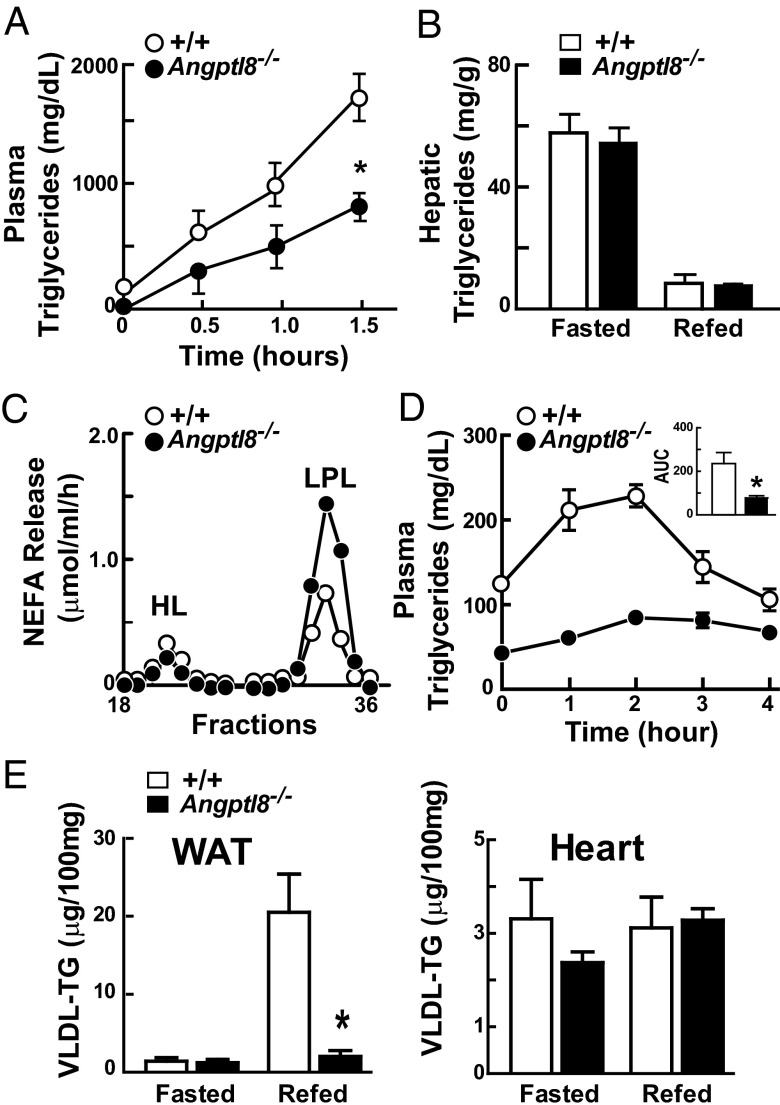
VLDL secretion and postheparin LPL activity in Angptl8−/− mice. (A) Plasma TG levels after injection of Triton WR-1339 in chow-fed male Angptl8−/− mice and wild-type littermates (n = 4–6 per group, age 20–23 wk). P value for slope = 0.007. (B) Hepatic TG levels in Angptl8−/− mice and wild-type littermates during fasting and refeeding. The liver samples are from the mice described in Fig. 2B. (C) Lipase activity in postheparin plasma of Angptl8−/− mice and wild-type littermates (n = 6 per group). Postheparin plasma was pooled and fractionated on a heparin column to separate HL and LPL, and TG hydrolase activity was measured as indicated in SI Materials and Methods. (D) Fat tolerance tests in chow-fed male Angptl8−/− mice and wild-type littermates (n = 4–6 per group, age 20–23 wk). The area under the curve (AUC) was calculated by linear interpolation. (E) Tissue uptake of VLDL-TG in female Angptl8−/− mice during fasting and refeeding (n = 4 per group, age 8 wk). VLDL was labeled with [3H]palmitate as described (36). Mice were entrained for 3 d to a 12-h fasting/12-h refeeding regimen. A total of 120 μg of [3H]VLDL was injected into the circulation of either fasted or refed mice and tissues were collected after 15 min as described in Materials and Methods. WAT, white adipose tissue. *P = 0.02. Values are means +/− SEM.
Fig. 5.
Fig. 5.
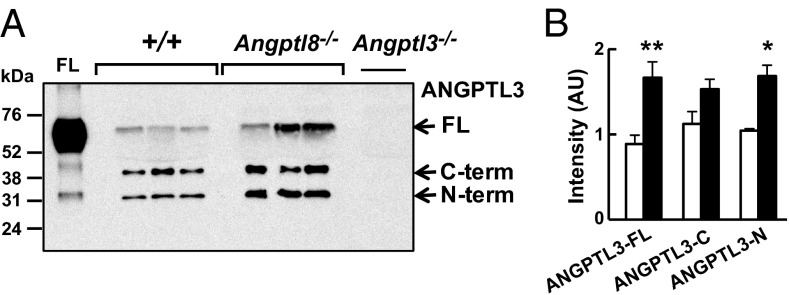
Immunoblot (A) and quantification (B) of ANGPTL3 in nonreduced serum from fed mice of the indicated genotypes using a polyclonal anti-mouse ANGPTL3 antibody. Films were scanned using an HP Scanjet 5590 and quantified using ImageJ (National Institutes of Health). The intensity of each band was corrected for background using a blank from the same film. *P < 0.05, **P < 0.01. The experiments shown here were repeated with similar results. FL, full-length. Values are means +/− SEM.

References

    1. Beigneux AP, et al. Glycosylphosphatidylinositol-anchored high-density lipoprotein-binding protein 1 plays a critical role in the lipolytic processing of chylomicrons. Cell Metab. 2007;5(4):279–291. - PMC - PubMed
    1. Wang H, Eckel RH. Lipoprotein lipase: From gene to obesity. Am J Physiol Endocrinol Metab. 2009;297(2):E271–E288. - PubMed
    1. Kuwajima M, Foster DW, McGarry JD. Regulation of lipoprotein lipase in different rat tissues. Metabolism. 1988;37(6):597–601. - PubMed
    1. Koishi R, et al. Angptl3 regulates lipid metabolism in mice. Nat Genet. 2002;30(2):151–157. - PubMed
    1. Kersten S, et al. Characterization of the fasting-induced adipose factor FIAF, a novel peroxisome proliferator-activated receptor target gene. J Biol Chem. 2000;275(37):28488–28493. - PubMed

Publication types

MeSH terms