. 2013 Oct 1;110(40):16157-62.
doi: 10.1073/pnas.1311542110. Epub 2013 Sep 16.

Reverse genetics with a full-length infectious cDNA of the Middle East respiratory syndrome coronavirus

Affiliations

Reverse genetics with a full-length infectious cDNA of the Middle East respiratory syndrome coronavirus

Trevor Scobey et al. Proc Natl Acad Sci U S A. .

Abstract

Severe acute respiratory syndrome with high mortality rates (~50%) is associated with a novel group 2c betacoronavirus designated Middle East respiratory syndrome coronavirus (MERS-CoV). We synthesized a panel of contiguous cDNAs that spanned the entire genome. Following contig assembly into genome-length cDNA, transfected full-length transcripts recovered several recombinant viruses (rMERS-CoV) that contained the expected marker mutations inserted into the component clones. Because the wild-type MERS-CoV contains a tissue culture-adapted T1015N mutation in the S glycoprotein, rMERS-CoV replicated ~0.5 log less efficiently than wild-type virus. In addition, we ablated expression of the accessory protein ORF5 (rMERS•ORF5) and replaced it with tomato red fluorescent protein (rMERS-RFP) or deleted the entire ORF3, 4, and 5 accessory cluster (rMERS-ΔORF3-5). Recombinant rMERS-CoV, rMERS-CoV•ORF5, and MERS-CoV-RFP replicated to high titers, whereas MERS-ΔORF3-5 showed 1-1.5 logs reduced titer compared with rMERS-CoV. Northern blot analyses confirmed the associated molecular changes in the recombinant viruses, and sequence analysis demonstrated that RFP was expressed from the appropriate consensus sequence AACGAA. We further show dipeptidyl peptidase 4 expression, MERS-CoV replication, and RNA and protein synthesis in human airway epithelial cell cultures, primary lung fibroblasts, primary lung microvascular endothelial cells, and primary alveolar type II pneumocytes, demonstrating a much broader tissue tropism than severe acute respiratory syndrome coronavirus. The availability of a MERS-CoV molecular clone, as well as recombinant viruses expressing indicator proteins, will allow for high-throughput testing of therapeutic compounds and provide a genetic platform for studying gene function and the rational design of live virus vaccines.

Keywords: emerging pathogen; synthetic genome; zoonosis.


Conflict of interest statement

The authors declare no conflict of interest.

Figures

Fig. 1.
Fig. 1.
Organization of the MERS-CoV molecular clone. (A) The organization of the MERS-CoV genome. (B) The full-length MERS-CoV genome was ultimately divided into seven contiguous cDNAs designated MERS A–F and flanked by unique BglI sites that allow for directed assembly of a full-length cDNA: MERS A (nucleotides 1–4692), MERS-B (4693–8811), MERS-C (8812–12258), MERS-D1 (12259–15470), MERS-D2 (15471–18806), MERS-E (18807–24397), and MERS-F (24398–30119).
Fig. 2.
Fig. 2.
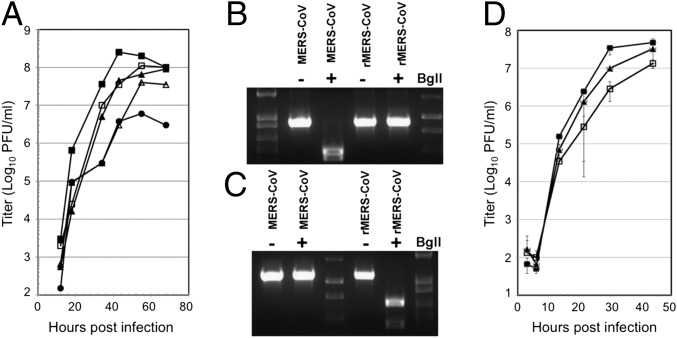
Recombinant virus growth. (A) Cultures of Vero 81 cells were infected with MERS-CoV, rMERS-CoV, rMERS-CoV•ORF5, rMERS-CoV-RFP, and rMERS-CoV-ΔORF3–5 at an MOI of 0.01. Virus samples were harvested at different times postinfection and titered by plaque assay (■, MERS-CoV; □, rMERS-CoV; ▲, rMERS-CoV•ORF5; Δ, rMERS-CoV-RFP; ●, rMERS-CoV-ΔORF3–5). (B) RFLP analysis spanning a naturally occurring BglI site at ∼17,717 bp that is ablated in rMERS-CoV; uncut vs. digested with Bgll. (C) RFLP analysis across the engineered rMERS-CoV E/F junction at approximately nucleotide 24397 either uncut or cut with Bgll. (D) Wild-type MERS-CoV, rMERS-CoV, and rMERS-CoV T1015N growth were compared in triplicate in Vero 81 cells (■, MERS-CoV; □, rMERS-CoV; ▲, rMERS-CoV T1015N). Error bars represent SD from the mean.
Fig. 3.
Fig. 3.
rMERS-CoV-RFP expression and comparative plaque morphology. (AD) Cultures of Vero cells were infected with rMERS-CoV-RFP (A and C) or rMERS-CoV (B and D). At 12 h postinfection, the cultures were visualized for tomato red fluorescence (A and B) or by light microscopy (C and D). (E) Plaque size differences between wild-type MERS-CoV, rMERS-CoV, and rMERS-CoV T1015N.
Fig. 4.
Fig. 4.
Recombinant virus phenotypes. Cultures of cells were infected with MERS-CoV or recombinant derivative viruses, and intracellular RNA was harvested and analyzed by Northern blot (A; lane 1, MERS-CoV; lane 2, rMERS-CoV; lane 3, rMERS-CoV•ORF5; lane 4, rMERS-CoV-RFP; lane 5, rMERS-CoV-ΔORF3–5; lane 6, uninfected control). In parallel, cell lysates were resolved by SDS/PAGE and probed with anti-S and anti-N antibodies; increased S- but not N-protein expression levels were apparent in rMERS-CoV-ΔORF3–5–infected cells (B). B includes an actin control. rMERS-CoV-ΔORF3–5–infected cells (D) displayed an increased fusion phenotype compared with the parental control (C).
Fig. 5.
Fig. 5.
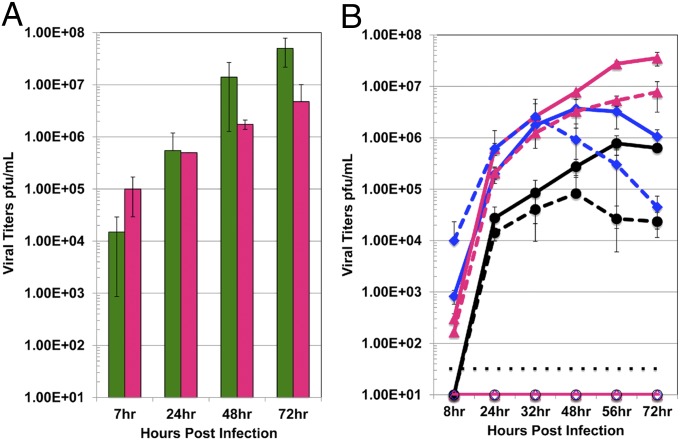
Recombinant virus growth in primary human lung cells. HAEs, primary alveolar type II pneumocytes, primary lung microvascular endothelial cells, and primary lung fibroblast cells were infected with wild-type rSARS-CoV, wild-type MERS-CoV, or rMERS-CoV-RFP. (A) Wild-type MERS-CoV and SARS-CoV growth kinetics in HAEs. Data are representative of two independent experiments. Error bars represent SD from the mean. Green bars, wild-type SARS-CoV; pink bars, wild-type MERS-CoV. (B) Wild-type SARS-CoV, wild-type MERS-CoV, and rMERS-CoV-RFP growth kinetics were compared in alveolar type II (ATII) pneumocytes, lung microvascular endothelial (MVE) cells, and lung fibroblasts (FBs). SARS-CoV did not replicate in any of the primary cell types examined in B. Cells were specific to one of two donors, and neither was permissive for SARS-CoV. Data are representative of two independent experiments. Error bars represent SD from the mean. The dotted black line in B represents the limit of detection for the assay. All points under this line are considered to be negative for replication in the samples assayed. Solid blue line with closed diamond, wild-type MERS-CoV in ATII cells; dotted blue line with closed diamond, rMERS-CoV-RFP in ATII cells; solid blue line with open diamond, wild-type SARS-CoV in ATII cells (did not replicate); solid pink line with closed triangle, wild-type MERS-CoV in FB cells; dotted pink line with closed triangle, rMERS-CoV-RFP in FB cells; solid pink line with open triangle, wild-type SARS-CoV in FB cells (did not replicate); solid black line with closed circle, wild-type MERS-CoV in MVE cells; dotted black line with closed circle, rMERS-CoV-RFP in MVE cells; solid black line with open circle, wild-type SARS-CoV in MVE cells (did not replicate).
Fig. 6.
Fig. 6.
Recombinant virus expression in primary human lung cells. (A and B) HAE and FB cultures were infected with rMERS-CoV-RFP and visualized by fluorescent microscopy [20×; (A, a) HAE, 48 h; (A, b) HAE, 72 h; (A, c) FB, 48 h; (A, d) FB, 72 h]. MERS-CoV intracellular RNA was harvested and analyzed by Northern blot (B; lane 1, primary alveolar type II pneumocytes; lane 2, primary lung fibroblasts; lane 3, primary undifferentiated airway epithelium; lane 4, primary lung microvascular endothelial cells). Images are representative of two independent experiments. (C and D) Real-time RT-PCR and Western blot analysis of DPP4 expression in primary human cells. AT2, alveolar type II pneumocytes; HAE, human airway epithelial cells under an air–liquid interface.

References

    1. Tsushima K, et al. Acute lung injury review. Intern Med. 2009;48(9):621–630. - PubMed
    1. Baric RS, Yount B, Hensley L, Peel SA, Chen W. Episodic evolution mediates interspecies transfer of a murine coronavirus. J Virol. 1997;71(3):1946–1955. - PMC - PubMed
    1. Zaki AM, van Boheemen S, Bestebroer TM, Osterhaus AD, Fouchier RA. Isolation of a novel coronavirus from a man with pneumonia in Saudi Arabia. N Engl J Med. 2012;367(19):1814–1820. - PubMed
    1. Huynh J, et al. Evidence supporting a zoonotic origin of human coronavirus strain NL63. J Virol. 2012;86(23):12816–12825. - PMC - PubMed
    1. Perlman S, Netland J. Coronaviruses post-SARS: Update on replication and pathogenesis. Nat Rev Microbiol. 2009;7(6):439–450. - PMC - PubMed

Publication types

MeSH terms