


Targeting cancer stem cells: emerging role of Nanog transcription factor
- PMID: 24043946
- PMCID: PMC3772775
- DOI: 10.2147/OTT.S38114
Targeting cancer stem cells: emerging role of Nanog transcription factor
Abstract
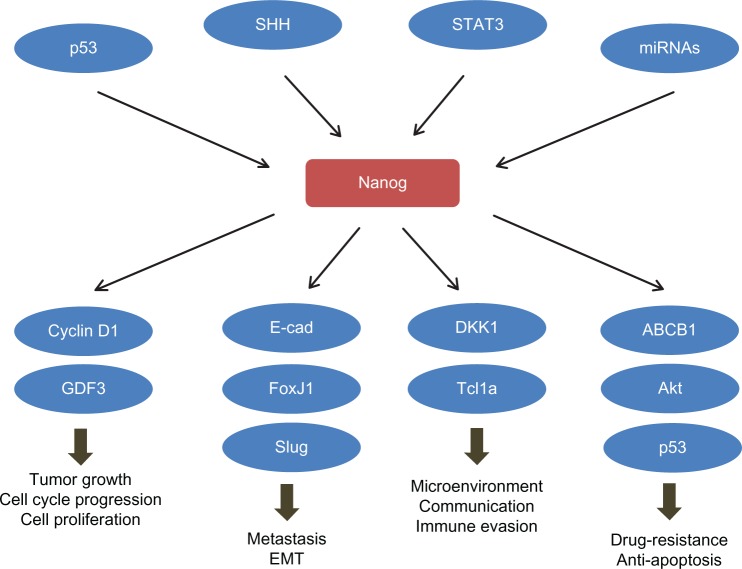
The involvement of stemness factors in cancer initiation and progression has drawn much attention recently, especially after the finding that introducing four stemness factors in somatic cells is able to reprogram the cells back to an embryonic stem cell-like state. Following accumulating data revealing abnormal elevated expression levels of key stemness factors, like Nanog, Oct4, and Sox2, in several types of cancer stem cells; the importance and therapeutic potential of targeting these stemness regulators in cancers has turned to research focus. Nanog determines cell fate in both embryonic and cancer stem cells; activating Nanog at an inappropriate time would result in cancer stem cells rather than normal pluripotent stem cells or differentiated somatic cells. Upregulated Nanog is correlated with poor survival outcome of patients with various types of cancer. The discoveries of downstream regulatory pathways directly or indirectly mediated by Nanog indicate that Nanog regulates several aspects of cancer development such as tumor cell proliferation, self-renewal, motility, epithelial-mesenchymal transition, immune evasion, and drug-resistance, which are all defined features for cancer stem cells. The current review paper illustrates the central role of Nanog in the regulatory networks of cancer malignant development and stemness acquirement, as well as in the communication between cancer cells and the surrounding stroma. Though a more defined model is needed to test the therapeutic efficacy of targeting Nanog as a cancer treatment method, current animal experiments using siNanog or shNanog have shown the promising therapeutic potential of Nanog targeting in several types of cancer.
Keywords: cancer stemness; target therapy.
Figures
References
-
- Wicha MS, Liu S, Dontu G. Cancer stem cells: an old idea – a paradigm shift. Cancer Res. 2006;66(4):1883–1890. discussion 1895–1886. - PubMed
-
- Visvader JE, Lindeman GJ. Cancer stem cells in solid tumours: accumulating evidence and unresolved questions. Nat Rev Cancer. 2008;8(10):755–768. - PubMed
-
- Lee TK, Castilho A, Cheung VC, Tang KH, Ma S, Ng IO. CD24(+) liver tumor-initiating cells drive self-renewal and tumor initiation through STAT3-mediated NANOG regulation. Cell Stem Cell. 2011;9(1):50–63. - PubMed
-
- Ibrahim EE, Babaei-Jadidi R, Saadeddin A, et al. Embryonic NANOG activity defines colorectal cancer stem cells and modulates through AP1- and TCF-dependent mechanisms. Stem Cells. 2012;30(10):2076–2087. - PubMed
Publication types
LinkOut - more resources
Full Text Sources
Other Literature Sources
Research Materials
