


Outdoor malaria transmission in forested villages of Cambodia
- PMID: 24044424
- PMCID: PMC3848552
- DOI: 10.1186/1475-2875-12-329
Outdoor malaria transmission in forested villages of Cambodia
Abstract
Background: Despite progress in malaria control, malaria remains an important public health concern in Cambodia, mostly linked to forested areas. Large-scale vector control interventions in Cambodia are based on the free distribution of long-lasting insecticidal nets (LLINs), targeting indoor- and late-biting malaria vectors only. The present study evaluated the vector density, early biting activity and malaria transmission of outdoor-biting malaria vectors in two forested regions in Cambodia.
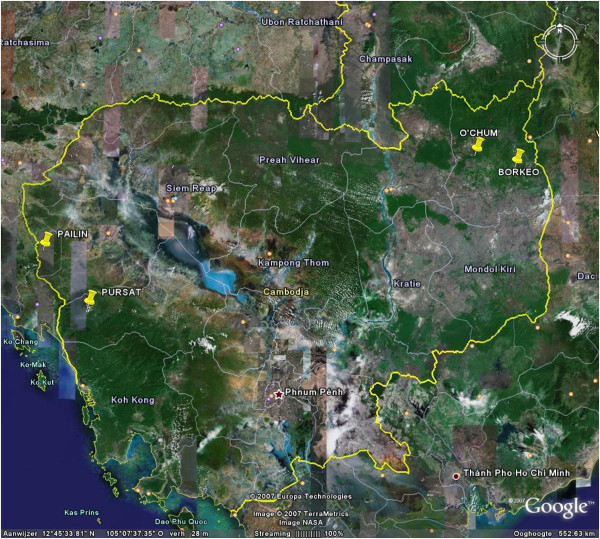
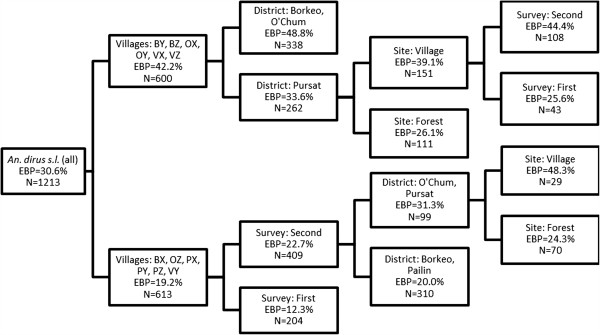
Methods: In 2005 two entomological surveys were conducted in 12 villages and their related forest plots in the east and west of Cambodia. Mosquitoes were collected outdoors by human landing collections and subjected to enzyme-linked immunosorbent assay (ELISA) to detect Plasmodium sporozoites after morphological identification. Blood samples were collected in the same villages for serological analyses. Collected data were analysed by the classification and regression tree (CART) method and linear regression analysis.
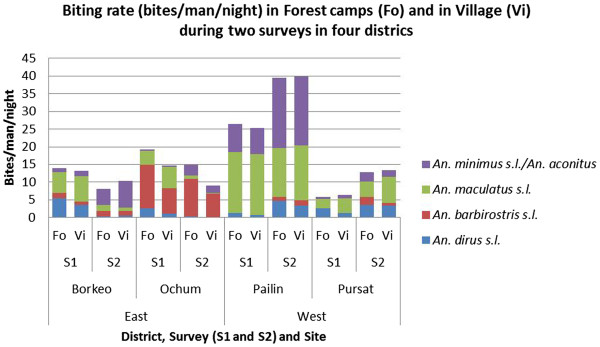
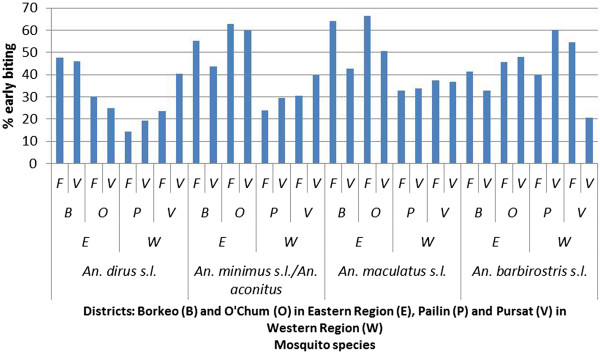
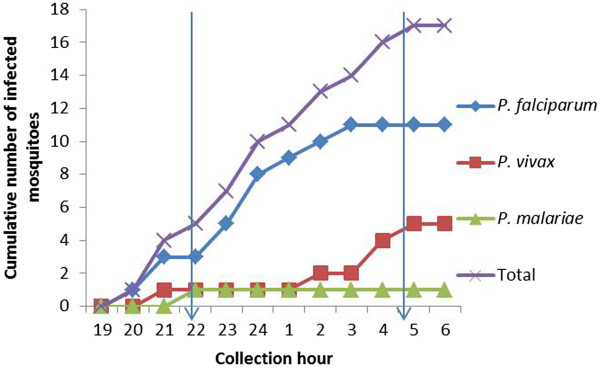
Results: A total of 11,826 anophelines were recorded landing in 787 man-night collections. The majority (82.9%) were the known primary and secondary vectors. Most of the variability in vector densities and early biting rates was explained by geographical factors, mainly at village level. Vector densities were similar between forest and village sites. Based on ELISA results, 29% out of 17 Plasmodium-positive bites occurred before sleeping time, and 65% in the forest plots. The entomological inoculation rates of survey 1 were important predictors of the respective seroconversion rates in survey 2, whereas the mosquito densities were not.
Discussion: In Cambodia, outdoor malaria transmission in villages and forest plots is important. In this context, deforestation might result in lower densities of the primary vectors, but also in higher densities of secondary vectors invading deforested areas. Moreover, higher accessibility of the forest could result in a higher man-vector contact. Therefore, additional vector control measures should be developed to target outdoor- and early-biting vectors.
Figures
References
-
- Delacollette C, D’Souza C, Christophel E, Thimasarn K, Abdur R, Bell D, Dai TC, Gopinath D, Lu S, Mendoza R, Ortega L, Rastogi R, Tantinimitkul C, Ehrenberg J. Malaria trends and challenges in the Greater Mekong Subregion. Southeast Asian J Trop Med Public Health. 2009;40:674–691. - PubMed
-
- WHO. World Malaria Report 2011. Geneva: World Health Organization; 2012. p. 278.
-
- WHO. Malaria in the Greater Mekong Subregion: Regional and Country Profiles. Geneva: World Health Organization; 2010. p. 58.
-
- SCW. “The School Atlas of Cambodia”. Phnom Penh, Cambodia: Save Cambodia’s Wildlife; 2006.
Publication types
MeSH terms
Substances
LinkOut - more resources
Full Text Sources
Other Literature Sources
Medical
