. 2013 Sep;25(9):3472-90.
doi: 10.1105/tpc.113.117168. Epub 2013 Sep 17.

The membrane-bound NAC transcription factor ANAC013 functions in mitochondrial retrograde regulation of the oxidative stress response in Arabidopsis

Affiliations

The membrane-bound NAC transcription factor ANAC013 functions in mitochondrial retrograde regulation of the oxidative stress response in Arabidopsis

Inge De Clercq et al. Plant Cell. 2013 Sep.

Abstract

Upon disturbance of their function by stress, mitochondria can signal to the nucleus to steer the expression of responsive genes. This mitochondria-to-nucleus communication is often referred to as mitochondrial retrograde regulation (MRR). Although reactive oxygen species and calcium are likely candidate signaling molecules for MRR, the protein signaling components in plants remain largely unknown. Through meta-analysis of transcriptome data, we detected a set of genes that are common and robust targets of MRR and used them as a bait to identify its transcriptional regulators. In the upstream regions of these mitochondrial dysfunction stimulon (MDS) genes, we found a cis-regulatory element, the mitochondrial dysfunction motif (MDM), which is necessary and sufficient for gene expression under various mitochondrial perturbation conditions. Yeast one-hybrid analysis and electrophoretic mobility shift assays revealed that the transmembrane domain-containing no apical meristem/Arabidopsis transcription activation factor/cup-shaped cotyledon transcription factors (ANAC013, ANAC016, ANAC017, ANAC053, and ANAC078) bound to the MDM cis-regulatory element. We demonstrate that ANAC013 mediates MRR-induced expression of the MDS genes by direct interaction with the MDM cis-regulatory element and triggers increased oxidative stress tolerance. In conclusion, we characterized ANAC013 as a regulator of MRR upon stress in Arabidopsis thaliana.


Figures
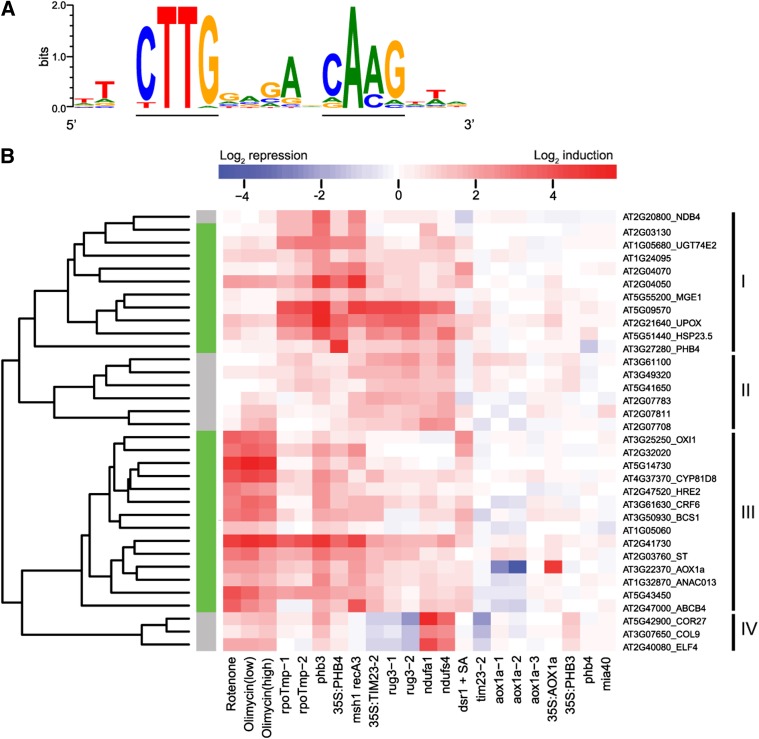
Figure 1.
Figure 1.
Identification of the MDM cis-Regulatory Element in MRR-Upregulated Genes. (A) Position weight matrix of MDM representing the occurrence in the 24 MDS promoters, showing the probability of (a) nucleotide(s) at each position. The MDM consensus (CTTGNNNNNCA[AC]G) is underlined. (B) Hierarchical clustering of expression profiles of the 34 MRR-upregulated genes (P < 0.01, log2-fold change > 1, in five or more mitochondrial dysfunction conditions). Color codes represent the actual log2-fold changes in transgenic or treated plants compared with wild-type or untreated plants, respectively. The MDS genes containing the cis-regulatory MDM in their 1-kb upstream sequence are indicated with a green bar.
Figure 2.
Figure 2.
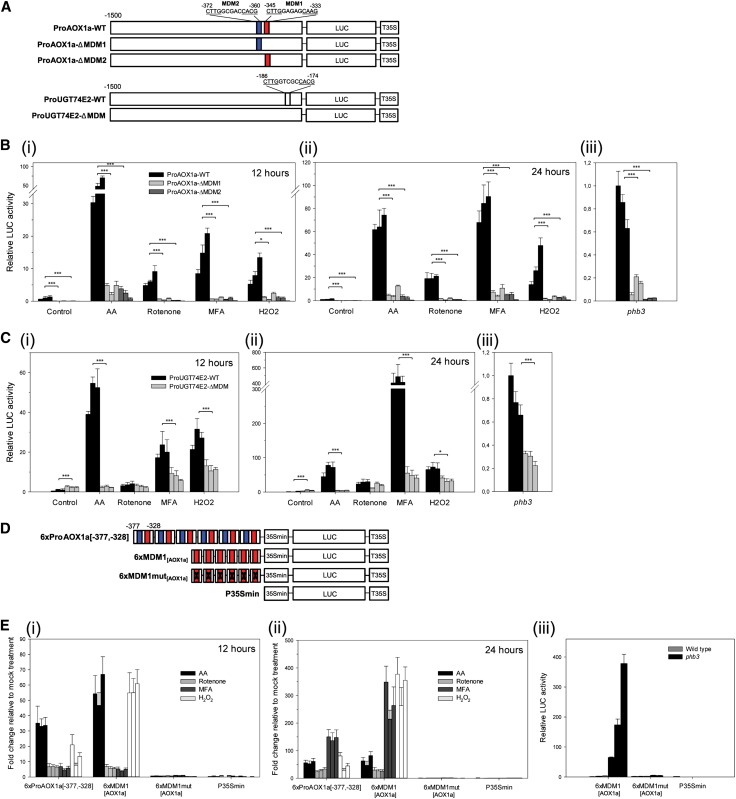
The MDM Is Necessary and Sufficient for MRR-Mediated Promoter Activation. (A) Schematic overview of AOX1a and UGT74E2 promoter deletion constructs. MDM deletions were generated in the 1.5-kb promoters and fused in frame to the LUC reporter gene. (B) Regulatory characteristics of the MDM elements from the AOX1a promoter tested by comparison of the LUC expression driven by the AOX1a promoter (ProAOX1a-WT) to the same promoter construct with deletion of either MDM1[AOX1a] (ProAOX1a-ΔMDM1) or MDM2[AOX1a] (ProAOX1a-ΔMDM2) in transgenic Arabidopsis plants. Promoter activities were analyzed after mock (Control), AA, rotenone, MFA, or H2O2 treatment for 12 h (i) or 24 h (ii) and in phb3 mutants (iii). Bars indicate average relative LUC activities from eight biological replicates ± se. Per construct, data of three independent transgenic lines are shown. Asterisk indicates significant differences from ProAOX1a-WT (Student’s t test; *P < 0.05, **P < 0.01, and ***P < 0.001). (C) Regulatory characteristics of the MDM element from the UGT74E2 promoter tested by comparing the LUC expression driven by the UGT74E2 promoter (ProUGT74E2-WT) to the same promoter construct with deletion of MDM[UGT74E2] (ProUGT74E2-ΔMDM) under the same conditions as in (B). (D) Schematic overview of gain-of-function promoter constructs containing hexamers of the AOX1a promoter regions cloned upstream of the minimal CaMV 35S promoter (P35Smin) that drives the LUC gene transcription. (E) Regulatory activity of the synthetic sequence containing six consecutive repeats of the 50-bp AOX1a promoter fragment, including two MDM elements (6xProAOX1a[-377,-328]) and one of the MDM sequences alone (6xMDM1[AOX1a]) in transgenic Arabidopsis plants. Constructs mutated in the MDM sequence (6xMDM1mut[AOX1a]) or without promoter fragment (P35Smin) were included as negative control. Average fold changes of LUC activity after 12 h (i) or 24 h (ii) of AA, rotenone, MFA, or H2O2 treatment relative to mock treatment are shown for three independent transgenic lines (±se; n = 8 biological replicates). (iii) Average relative LUC activity of the synthetic sequences in phb3 mutants (±se; n = 8 biological replicates). [See online article for color version of this figure.]
Figure 3.
Figure 3.
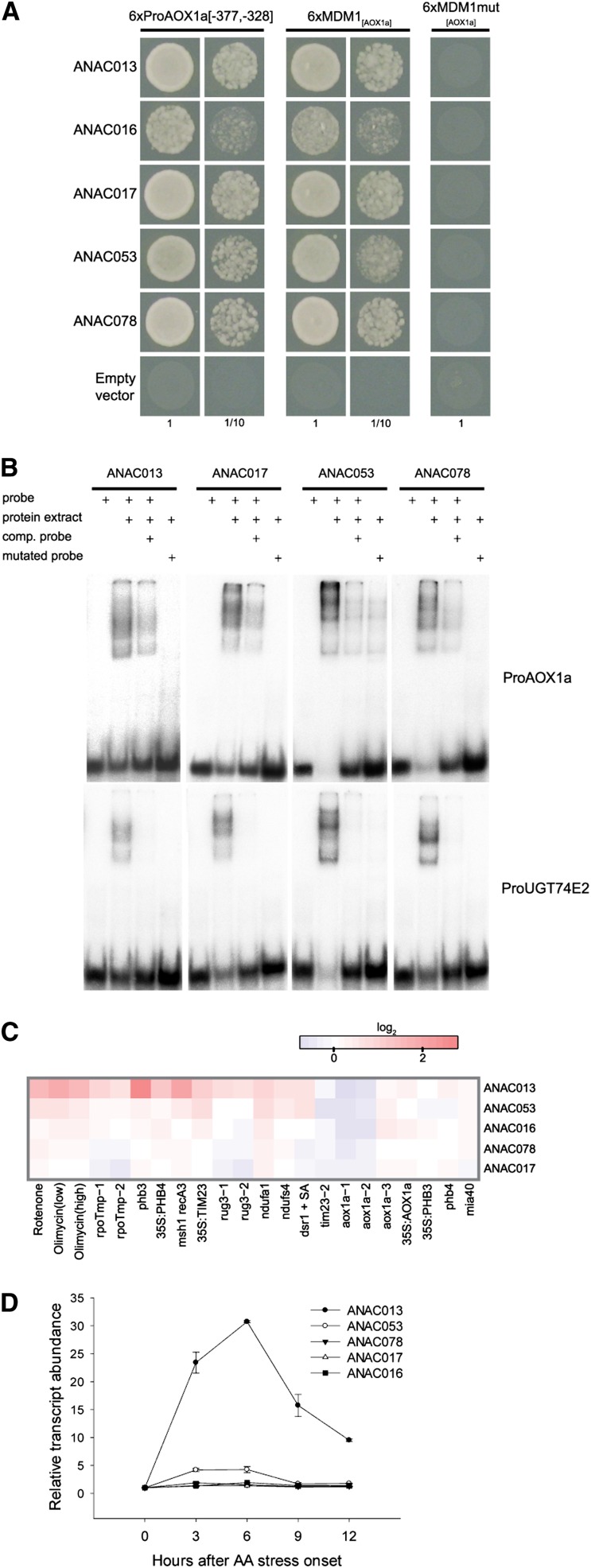
Binding of NAC Transcription Factors to the MDM. (A) Interaction of NAC transcription factors with the MDM in yeast as shown by Y1H assays. The promoter sequences of interest were fused to histidinol-phosphate aminotransferase imidazole acetol phosphate transaminase (HIS3). The interaction was positive upon growth on 20 mM 3-amino-1,2,4-triazole (3-AT), a competitive inhibitor of HIS3, and was observed with synthetic sequences containing six consecutive repeats of the 50-bp AOX1a promoter fragment, including two MDM elements (6xProAOX1a[-377,-328]) and one of the MDM sequences alone (6xMDM1[AOX1a]), but was abolished when the MDM sequence was mutated (6xMDM1mut[AOX1a]). (B) Binding of NAC transcription factors with the MDM in vitro as shown by electrophoretic mobility shift assays. Purified NAC-GST proteins interact with radioactively labeled probes of the MDM element–containing AOX1a and UGT74E2 promoter regions. Interactions were abolished in the presence of excess unlabeled competitor probes or when the MDM sequence was mutated. (C) and (D) Expression pattern of the isolated NAC transcription factors under mitochondrial dysfunction conditions. Expression data were obtained from publicly available microarray data (C) or from own quantitative RT-PCR analyses of AA time series (±se; n = 2 biological replicates) (D).
Figure 4.
Figure 4.
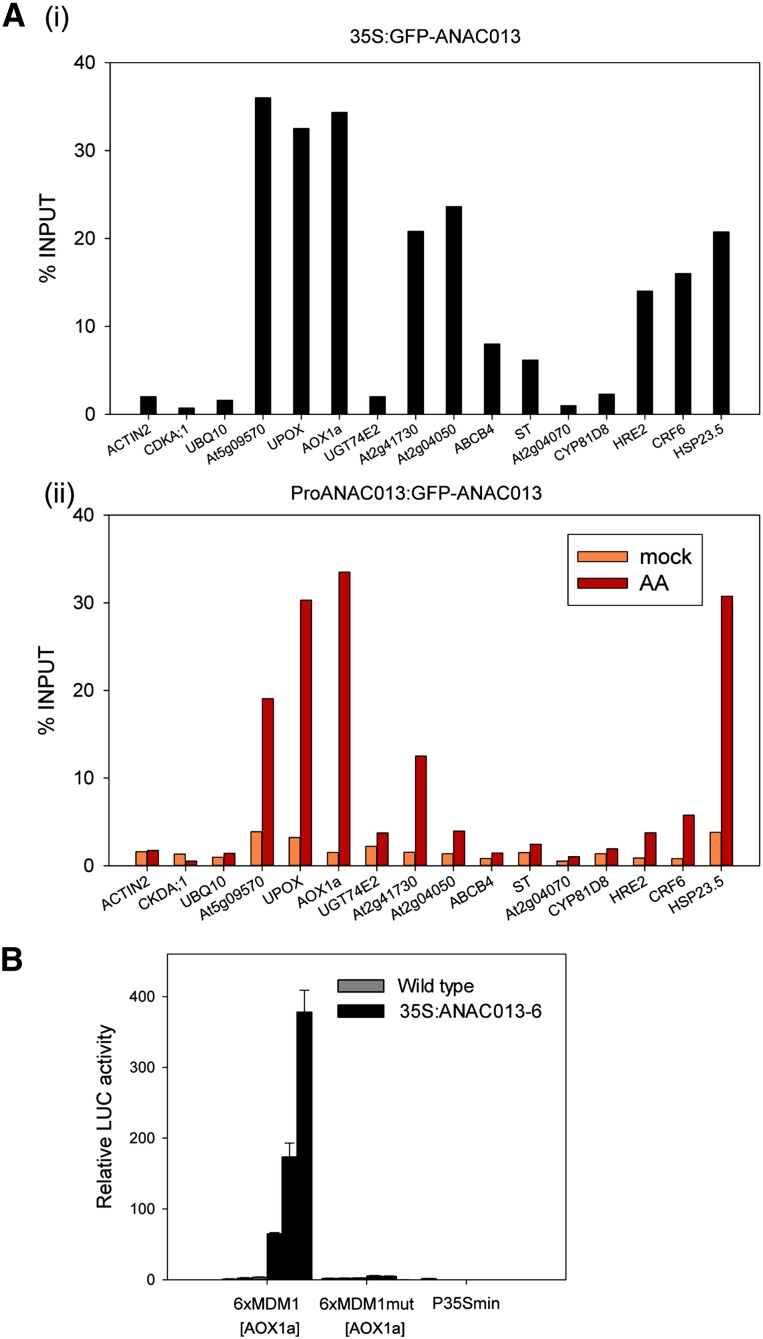
Interaction of ANAC013 with the MDM from Several MDS Genes in Arabidopsis. (A) Interaction of ANAC013 with MDS promoters in planta as shown by ChIP. Enrichment of promoter fragments surrounding the MDM after ChIP on control-grown 35S:GFP-ANAC013 (i) and mock- and AA-treated ProANAC013:GFP-ANAC013 (ii) seedlings with anti-GFP antibodies. ACTIN2, CDKA;1, and UBQ10 fragments were used as negative controls. Bars represent fold enrichment relative to the total genomic DNA from one biological sample (% INPUT). Similar data were obtained in at least one other biological repeat experiment and with different independent transgenic lines. (B) Transactivation of the MDM from the AOX1a promoter by ANAC013 in Arabidopsis. ANAC013 activated the 6xMDM1[AOX1a]-driven LUC reporter gene in ANAC013-overexpressing plants (35S:ANAC013-6) when compared with wild-type plants. The induction was abolished when the MDM was mutated (6xMDM1mut[AOX1a]) or in the absence of the promoter fragment (P35Smin). Bars indicate average relative LUC activities ± se (n = 8 biological replicates). [See online article for color version of this figure.]
Figure 5.
Figure 5.
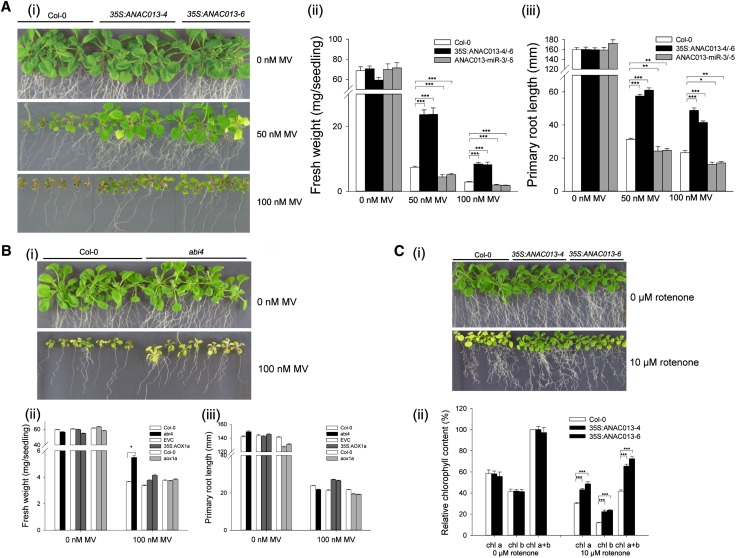
Increased MV and Rotenone Tolerance of ANAC013-Overexpressing Plants. (A) Three-week-old wild-type (Col-0), 35S:ANAC013-4, and 35S:ANAC013-6 seedlings germinated and grown on 1/2MS medium supplemented with 0, 50, or 100 nM MV (i). Fresh weight (ii) and primary root length (iii) of 3-week-old wild-type (Col-0), 35S:ANAC013-4, 35S:ANAC013-6, ANAC013-miR-3, and ANAC013-miR-5 seedlings germinated and grown in the presence of 0, 50, or 100 nM MV. Data represent average ± se (n = 20 to 25 plants). Asterisk indicates significant differences from Col-0 (Student’s t test; *P < 0.05, **P < 0.01, and ***P < 0.001). (B) Three-week-old wild-type (Col-0) and abi4 mutant seedlings (i) germinated and grown on 1/2MS medium supplemented with 0 or 100 nM MV. Fresh weight (ii) and primary root length (iii) of 3-week-old wild-type (Col-0), abi4 mutant, empty-vector control (EVC), AOX1a-overexpressing (35S:AOX1a-1 and 35S:AOX1a-2), and AOX1a knockout (aox1a-1 and aox1a-2) seedlings germinated and grown in the presence of 0 or 100 nM MV. Data represent average ± se (n = 20 to 25 plants). Asterisk indicates significant differences from Col-0 (Student’s t test; *P < 0.05, **P < 0.01, and ***P < 0.001). (C) Three-week-old wild-type (Col-0) and 35S:ANAC013 seedlings germinated and grown on 1/2MS medium supplemented with 0 or 10 μM rotenone (i) and relative chlorophyll content (ii). Chlorophyll content was measured and normalized per gram fresh weight of green tissue (ii). The total chlorophyll (Chl a+b) content in the wild type was set to 100%, and the relative chlorophyll contents were calculated accordingly. Data represent average ± se (n = 5 biological repeat samples). Chl a, chlorophyll a; Chl b, chlorophyll b. Asterisk indicates significant differences from Col-0 (Student’s t test; *P < 0.05, **P < 0.01, and ***P < 0.001).

References

    1. Ahn C.S., Lee J.H., Reum Hwang A., Kim W.T., Pai H.-S. (2006). Prohibitin is involved in mitochondrial biogenesis in plants. Plant J. 46: 658–667 - PubMed
    1. Atanassov I.I., Atanassov I.I., Etchells J.P., Turner S.R. (2009). A simple, flexible and efficient PCR-fusion/Gateway cloning procedure for gene fusion, site-directed mutagenesis, short sequence insertion and domain deletions and swaps. Plant Methods 5: 14. - PMC - PubMed
    1. Azevedo D., Tacnet F., Delaunay A., Rodrigues-Pousada C., Toledano M.B. (2003). Two redox centers within Yap1 for H2O2 and thiol-reactive chemicals signaling. Free Radic. Biol. Med. 35: 889–900 - PubMed
    1. Bailey, T.L., and Elkan, C. (1994). Fitting a mixture model by expectation maximization to discover motifs in biopolymers. In Proceedings of the Second International Conference on Intelligent Systems for Molecular Biology, R. Altman, D. Brutlag, P. Karp, R. Lathrop, and D. Searls, eds (Menlo Park, CA: AAAI Press), pp. 28–36. - PubMed
    1. Bailey-Serres J., Chang R. (2005). Sensing and signalling in response to oxygen deprivation in plants and other organisms. Ann. Bot. (Lond.) 96: 507–518 - PMC - PubMed

Publication types

MeSH terms