. 2014 Aug;20(6):606-17.
doi: 10.1177/1753425913503386. Epub 2013 Sep 17.

Mouse nasal epithelial innate immune responses to Pseudomonas aeruginosa quorum-sensing molecules require taste signaling components

Affiliations

Mouse nasal epithelial innate immune responses to Pseudomonas aeruginosa quorum-sensing molecules require taste signaling components

Robert J Lee et al. Innate Immun. 2014 Aug.

Abstract

We previously observed that the human bitter taste receptor T2R38 is an important component of upper respiratory innate defense because it detects acyl homoserine lactone (AHL) quorum-sensing molecules secreted by Gram-negative bacteria. T2R38 activation in human sinonasal epithelial cells stimulates calcium and NO signals that increase mucociliary clearance, the major physical respiratory defense against inhaled pathogens. While mice do not have a clear T2R38 ortholog, they do have bitter taste receptors capable of responding to T2R38 agonists, suggesting that T2R-mediated innate immune mechanisms may be conserved in mice. We examined whether AHLs activate calcium and NO signaling in mouse nasal epithelial cells, and utilized pharmacology, as well as cells from knockout mice lacking important components of canonical taste signal transduction pathways, to determine if AHL-stimulated responses require taste signaling molecules. We found that AHLs stimulate calcium-dependent NO production that increases mucociliary clearance and thus likely serves an innate immune role against Gram-negative bacteria. These responses require PLCβ2 and TRPM5 taste signaling components, but not α-gustducin. These data suggest the mouse may be a useful model for further studies of T2R-mediated innate immunity.

Keywords: Acyl-homoserine lactone; T2R bitter taste receptor; chronic rhinosinusitis; innate immunity; mucociliary clearance; nitric oxide.


Conflict of interest statement

The authors have no conflicts of interest to declare pertaining to this article.

Figures
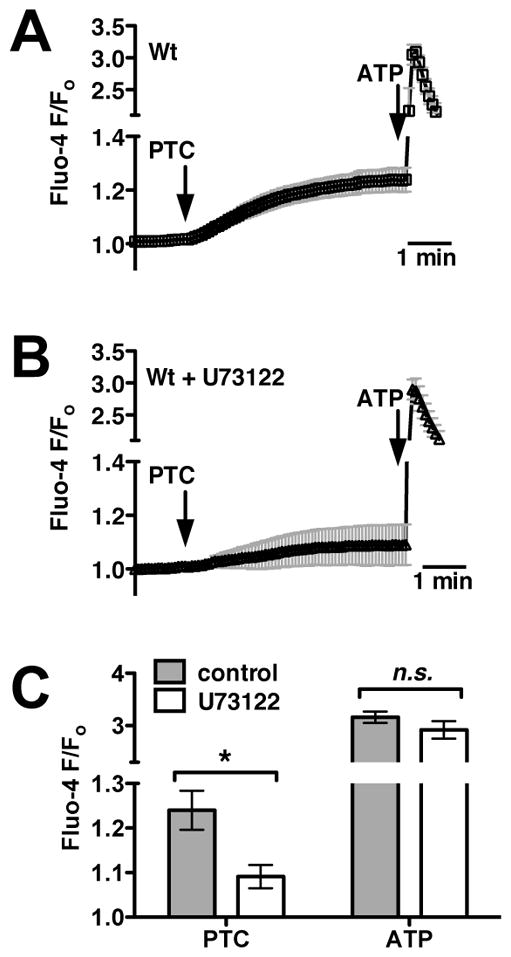
Fig. 1
Fig. 1
Mouse nasal septal epithelial cells respond to the bitter tastant PTC with an increase in intracellular calcium that is dependent upon the taste signaling component PLCβ2. (A) Average Fluo-4 trace (mean ± SEM) from mouse nasal septal ALIs (n = 5 cultures) during apical stimulation with 1 mM PTC and subsequent 100 μM ATP. Note the break in left y-axis because of the larger magnitude of the ATP response. (B) Average trace showing responses in the presence of the PLCβ2 inhibitor U73122 (5 μM; 10 min pre-incubation; apical side only; n = 5). (C) Bar graph of peak calcium responses (mean ± SEM from A–B) after 5 min stimulation with PTC (F/Fo = 1.24 ± 0.04 and 1.09 ± 0.03 in the absence and presence of U713122, respectively) and during ATP stimulation (F/Fo = 3.16 ± 0.1 and 2.92 ± 0.2, respectively). Symbols denote significance of indicated paired comparisons via 1-way ANOVA with Bonferroni post-test; *P <0.05, n.s. not significant.
Fig. 2
Fig. 2
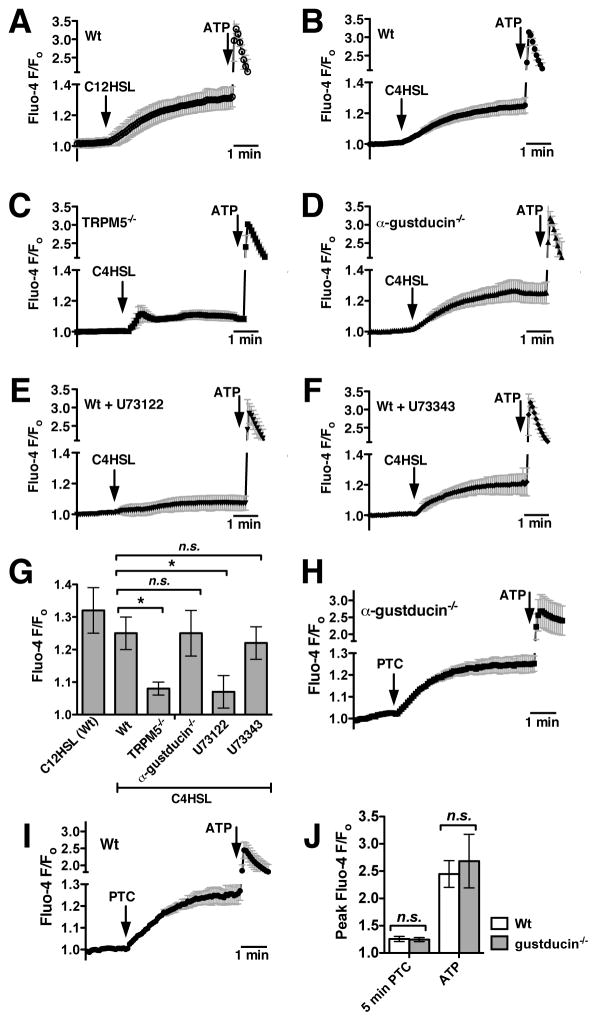
Pseudomonas aeruginosa AHLs stimulate mouse nasal calcium signaling that also requires components of taste signaling. (A–B) Average traces showing calcium responses in Wt cultures stimulated with 100 μM C12HSL (A; n = 3 cultures) or C4HSL (B; n = 5 cultures). (C–D) Traces showing calcium responses to C4HSL in TRPM5 knockout (TRPM5−/−; C, n = 7) and α-gustducin knockout (α-gustducin−/−; D, n = 3) ALIs. (D–E) Traces showing C4HSL-induced calcium responses in Wt cultures treated with the PLCβ2 inhibitor U73122 (D, n = 4) and the inactive U73343 (E, n = 4). (F) Bar graph showing calcium response after 5 min stimulation with C4HSL. Fluo-4 F/Fo values (mean ± SEM) after 5 min stimulation were 1.32 ± 0.07 (C12HSL; Wt), 1.25 ± 0.05 (C4HSL; Wt), 1.08 ± 0.02 (C4HSL; TRPM5−/−), 1.25 ± 0.07 (C4HSL; gustducin−/−), 1.07 ± 0.05 (C4HSL + U73122; Wt), and 1.22 ± 0.05 (C4HSL ± U73343). (H–I) To confirm the lack of role for α-gustducin, cultures from Wt (n = 5) and α-gustducin−/− (n = 5) mice were also stimulated with 1 mM PTC. (J) Bar graph showing calcium response after 5 min stimulation with PTC and peak calcium response after stimulation with ATP. Fluo-4 F/Fo values (mean ± SEM) after PTC were 1.26 ± 0.05 (Wt) and 1.24 ± 0.04 (α-gustducin−/−). Fluo-4 F/Fo values (mean ± SEM) after ATP were 2.45 ± 0.25 (Wt) and 2.68 ± 0.49 (α-gustducin−/−). Symbols denote significance determined by 1-way ANOVA with Dunnett’s (G) or Bonferroni (J) post-tests; *P <0.05, n.s. not significant.
Fig. 3
Fig. 3
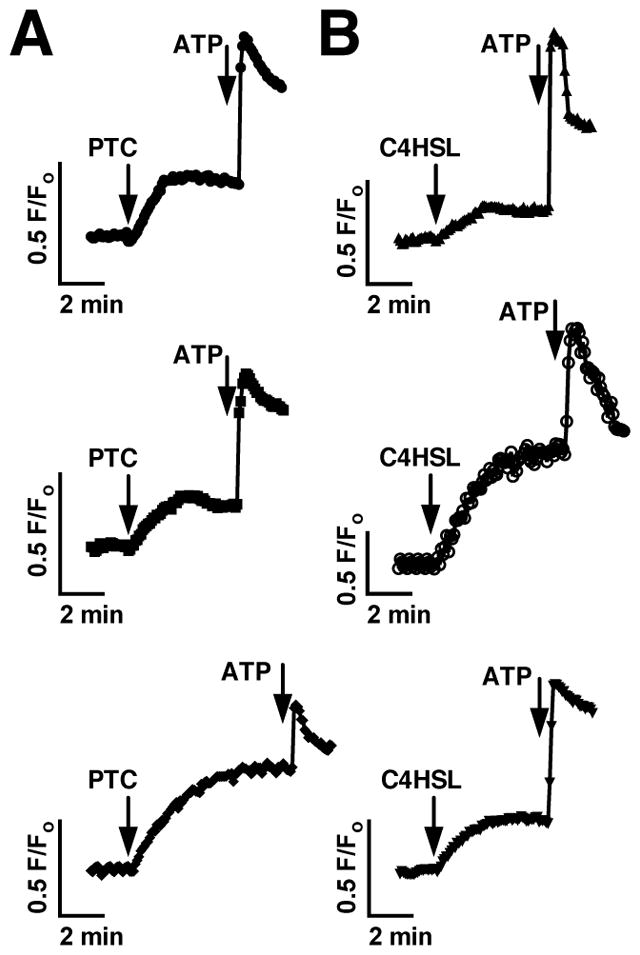
Dissociated mouse septal ciliated epithelial cells exhibit calcium responses to PTC and C4HSL. (A–B) Mouse septal ciliated epithelial cells were dissociated as previously described and stimulated with 1 mM PTC (A) or 150 μM C4HSL (B). Three responses from each condition are shown, representative of 5–7 experiments each.
Fig. 4
Fig. 4
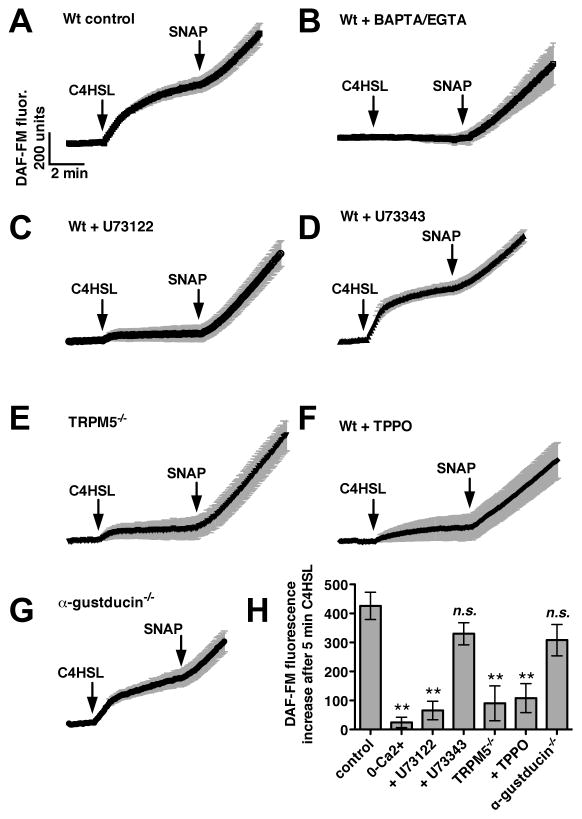
C4HSL stimulates mouse septal epithelial cell NO production that requires taste signaling components. (A) Average trace (n = 7 cultures) showing DAF-FM fluorescence (increase reflects reactive nitrogen species production) in Wt cultures during stimulation with 100 μM C4HSL as well as the non-specific NO donor SNAP (10 μM). (B–D) Average traces of C4HSL-stimulated fluorescence increases in Wt cultures under 0-calcium conditions (BAPTA/EGTA; n = 7, B), in the presence of U73122 (n = 5, C) and U73343 (n = 6, D). (E–F) Average traces of C4HSL-induced fluorescence increases in TRPM5−/− cultures Wt cultures in the presence of the TRPM5 inhibitor TPPO (n = 5 each). (G) Traces of DAF-FM fluorescence increase in α-gustducin−/− cultures (n = 7). (H) Bar graph of fluorescence changes after stimulation with C4HSL as shown in A-F. DAF-FM fluorescence increases were 426 ± 47 (Wt; control), 24 ± 18 (Wt with 0-Ca2+), 65 ± 32 (Wt + U73122), 330 ± 38 (Wt + U73343), 90 ± 60 (TRPM5−/−), 108 ± 50 (Wt + TPPO), 308 ± 54 (α-gustducin−/−). Symbols denote significance compared with control determined via 1-way ANOVA with Dunnett’s post-test; **P <0.01, n.s. not significant.
Fig. 5
Fig. 5
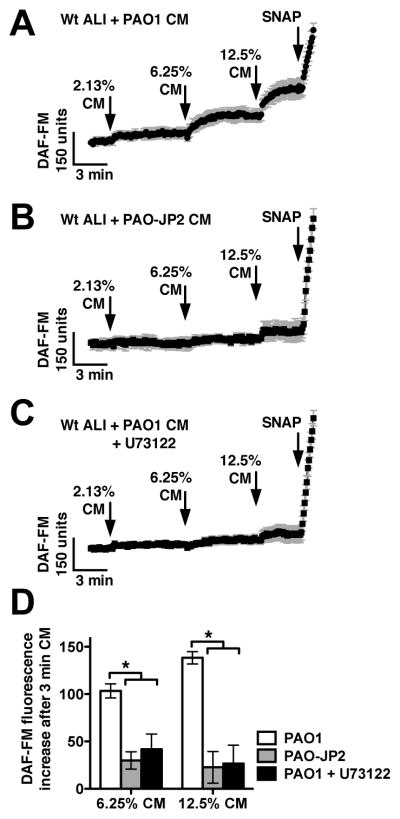
Conditioned medium from Wt but not AHL-deficient Pseudomonas aeruginosa stimulates taste-dependent NO production. (A–C) Traces of DAF-FM fluorescence from Wt mouse nasal septal ALI cultures stimulated with dilute conditioned medium (CM) from Wt P. aeruginosa (PAO1; A; n = 6 cultures), AHL-deficient P. aeruginosa (PAO-JP2; B; n = 7 cultures), and Wt P. aeruginosa in the presence of U73122 (C; n = 6 cultures). (D) Bar graph showing DAF-FM fluorescence increases (mean ± SEM) after 3 min stimulation with 6.25% CM and 12.5% CM. DAF-FM fluorescence increases were [6.25% CM] 103 ± 7 (PAO1), 33 ± 10 (PAO-JP2), 42 ± 16 (PAO1 + U73122) and [12.5% CM] 138 ± 7 (PAO1), 27 ± 20 (PAO-JP2), and 26 ± 20 (PAO1 + U73122). Asterisks indicate significance determined by 1-way ANOVA with Bonferroni post-test; *P <0.05.
Fig. 6
Fig. 6
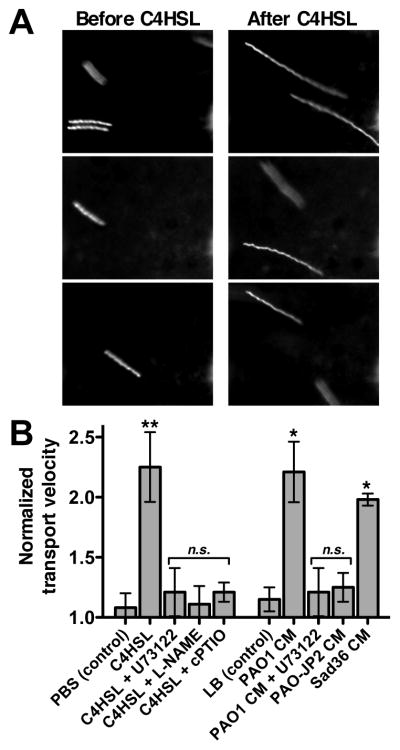
C4HSL and Wt Pseudomonas aeruginosa -conditioned medium stimulate an increase in mucociliary transport. (A) Representative images of one field of view showing streaks representing particle transport by a Wt mouse septal ALI culture before stimulation (left) and after 3 min stimulation with 100 μM C4HSL (right). (B) Graph showing mean ± SEM (n = ALI 3–5 cultures each) of normalized changes in particle transport after addition of PBS alone (reflecting the mechanical force of pipetting alone, 1.08 ± 0.12), C4HSL (2.25 ± 0.29), C4HSL + U73122 (1.21 ± 0.2), C4HSL + L-NAME (1.11 ± 0.15), C4HSL + cPTIO (1.21 ± 0.08), 12.5 % LB alone (1.15 ± 0.10), 12.5% PAO1 CM (2.21 ± 0.25), PAO1 CM + U73122 (1.21 ± 0.20), PAO-JP2 CM (1.25 ± 0.12), and Sad36 CM (1.98 ± 0.05). Symbols denote significance vs. appropriate control condition (PBS or LB alone) determined via 1-way ANOVA with Dunnett’s post-test; *P <0.05, **P <0.01.

References

    1. Satir P, Sleigh MA. The physiology of cilia and mucociliary interactions. Annu Rev Physiol. 1990;52:137–55. - PubMed
    1. Sleigh MA, Blake JR, Liron N. The propulsion of mucus by cilia. American Rev Respir Dis. 1988;137:726–41. - PubMed
    1. Eliezer N, Sade J, Silberberg A, Nevo AC. The role of mucus in transport by cilia. Am Rev Respir Dis. 1970;102:48–52. - PubMed
    1. Antunes MB, Gudis DA, Cohen NA. Epithelium, cilia, and mucus: their importance in chronic rhinosinusitis. Immunol Allergy Clin North Am. 2009;29:631–43. - PubMed
    1. Cohen NA. Sinonasal mucociliary clearance in health and disease. Ann Otol Rhinol Laryngol Suppl. 2006;196:20–6. - PubMed

Publication types

LinkOut - more resources