


Clinical characteristics of Dengue shock syndrome in Vietnamese children: a 10-year prospective study in a single hospital
- PMID: 24046311
- PMCID: PMC3814826
- DOI: 10.1093/cid/cit594
Clinical characteristics of Dengue shock syndrome in Vietnamese children: a 10-year prospective study in a single hospital
Abstract
Background: Dengue shock syndrome (DSS) is a severe manifestation of dengue virus infection that particularly affects children and young adults. Despite its increasing global importance, there are no prospective studies describing the clinical characteristics, management, or outcomes of DSS.
Methods: We describe the findings at onset of shock and the clinical evolution until discharge or death, from a comprehensive prospective dataset of 1719 Vietnamese children with laboratory-confirmed DSS managed on a single intensive care unit between 1999 and 2009.
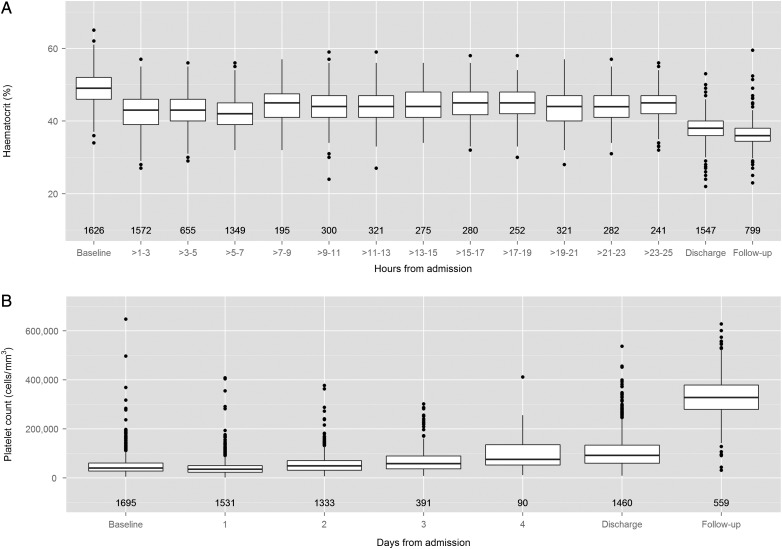
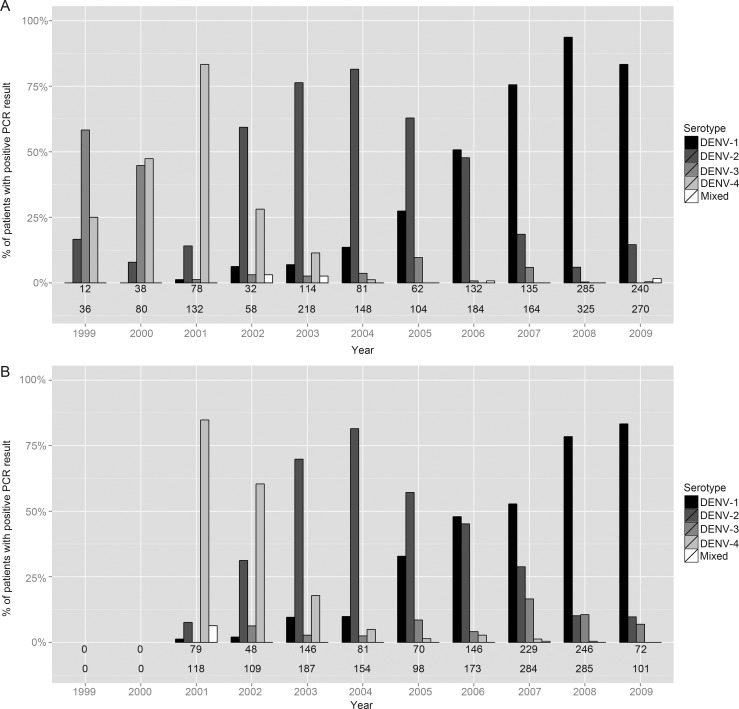
Results: The median age of patients was 10 years. Most cases had secondary immune responses, with only 6 clear primary infections, and all 4 dengue virus serotypes were represented during the 10-year study. Shock occurred commonly between days 4 and 6 of illness. Clinical signs and symptoms were generally consistent with empirical descriptions of DSS, although at presentation 153 (9%) were still febrile and almost one-third had no bleeding. Overall, 31 (2%) patients developed severe bleeding, primarily from the gastrointestinal tract, 26 of whom required blood transfusion. Only 8 patients died, although 123 of 1719 (7%) patients had unrecordable blood pressure at presentation and 417 of the remaining 1596 (26%) were hypotensive for age. The majority recovered well with standard crystalloid resuscitation or following a single colloid infusion. All cases were classified as severe dengue, while only 70% eventually fulfilled all 4 criteria for the 1997 World Health Organization classification of dengue hemorrhagic fever.
Conclusions: With prompt intervention and assiduous clinical care by experienced staff, the outcome of this potentially fatal condition can be excellent.
Keywords: Vietnam; dengue shock syndrome; pediatrics; prospective descriptive study.
Figures
Comment in
-
Dengue shock syndrome or dehydration? The importance of considering clinical severity when classifying patients with dengue.Clin Infect Dis. 2014 Apr;58(7):1038-9. doi: 10.1093/cid/ciu014. Epub 2014 Jan 7. Clin Infect Dis. 2014. PMID: 24403543 No abstract available.
-
Reply to Thomas et al.Clin Infect Dis. 2014 Apr;58(7):1039-40. doi: 10.1093/cid/ciu017. Epub 2014 Jan 7. Clin Infect Dis. 2014. PMID: 24403545 Free PMC article. No abstract available.
References
-
- Simmons CP, Farrar JJ, Nguyen VV, Wills B. Dengue. N Engl J Med. 2012;366:1423–32. - PubMed
-
- World Health Organization. 2012. Impact of dengue. Available at: http://www.who.int/csr/disease/dengue/impact/en/index.html. Accessed 2 April 2013.
-
- World Health Organization. Dengue guidelines for diagnosis, treatment, prevention and control. Geneva, Switzerland: WHO; 2009. - PubMed
Publication types
MeSH terms
Grants and funding
LinkOut - more resources
Full Text Sources
Other Literature Sources
Molecular Biology Databases
