


The molecular signal for the adaptation to cold temperature during early life on Earth
- PMID: 24046876
- PMCID: PMC3971708
- DOI: 10.1098/rsbl.2013.0608
The molecular signal for the adaptation to cold temperature during early life on Earth
Abstract
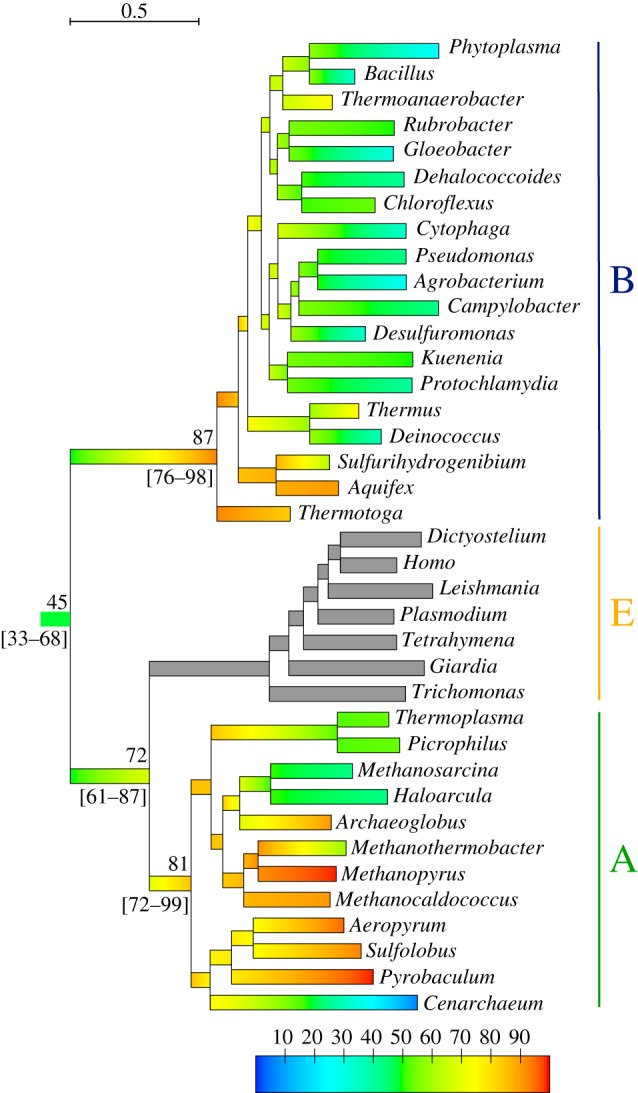
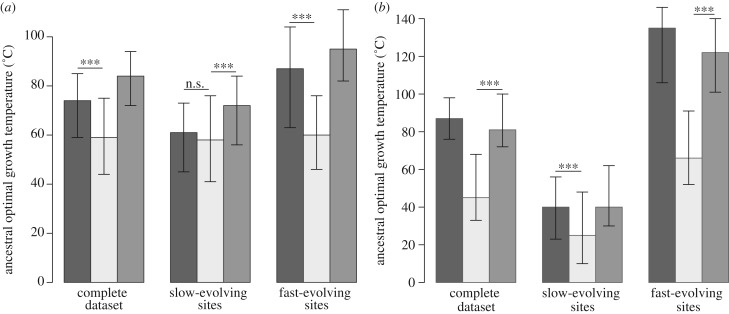
Several lines of evidence such as the basal location of thermophilic lineages in large-scale phylogenetic trees and the ancestral sequence reconstruction of single enzymes or large protein concatenations support the conclusion that the ancestors of the bacterial and archaeal domains were thermophilic organisms which were adapted to hot environments during the early stages of the Earth. A parsimonious reasoning would therefore suggest that the last universal common ancestor (LUCA) was also thermophilic. Various authors have used branch-wise non-homogeneous evolutionary models that better capture the variation of molecular compositions among lineages to accurately reconstruct the ancestral G + C contents of ribosomal RNAs and the ancestral amino acid composition of highly conserved proteins. They confirmed the thermophilic nature of the ancestors of Bacteria and Archaea but concluded that LUCA, their last common ancestor, was a mesophilic organism having a moderate optimal growth temperature. In this letter, we investigate the unknown nature of the phylogenetic signal that informs ancestral sequence reconstruction to support this non-parsimonious scenario. We find that rate variation across sites of molecular sequences provides information at different time scales by recording the oldest adaptation to temperature in slow-evolving regions and subsequent adaptations in fast-evolving ones.
Figures
References
-
- Stetter KO. 2006. Hyperthermophiles in the history of life. Phil. Trans. R. Soc. B 361, 1837–1843 (doi:10.1098/rstb.2006.1907) - DOI - PMC - PubMed
-
- Gaucher EA, Govindarajan S, Ganesh OK. 2008. Palaeotemperature trend for Precambrian life inferred from resurrected proteins. Nature 451, 704–707 (doi:10.1038/nature06510) - DOI - PubMed
-
- Brooks DJ, Fresco JR, Singh M. 2004. A novel method for estimating ancestral amino acid composition and its application to proteins of the last universal ancestor. Bioinformatics 20, 2251–2257 (doi:10.1093/bioinformatics/bth235) - DOI - PubMed
-
- Galtier N, Lobry JR. 1997. Relationships between genomic G+C content, RNA secondary structures, and optimal growth temperature in prokaryotes. J. Mol. Evol. 44, 632–636 (doi:10.1007/PL00006186) - DOI - PubMed
-
- Zeldovich KB, Berezovsky IN, Shakhnovich EI. 2007. Protein and DNA sequence determinants of thermophilic adaptation. PLoS Comput. Biol. 3, e5 (doi:10.1371/journal.pcbi.0030005) - DOI - PMC - PubMed
Publication types
MeSH terms
LinkOut - more resources
Full Text Sources
Other Literature Sources
