


Assessing the risks for poliovirus outbreaks in polio-free countries--Africa, 2012-2013
- PMID: 24048153
- PMCID: PMC4585360
Assessing the risks for poliovirus outbreaks in polio-free countries--Africa, 2012-2013
Abstract
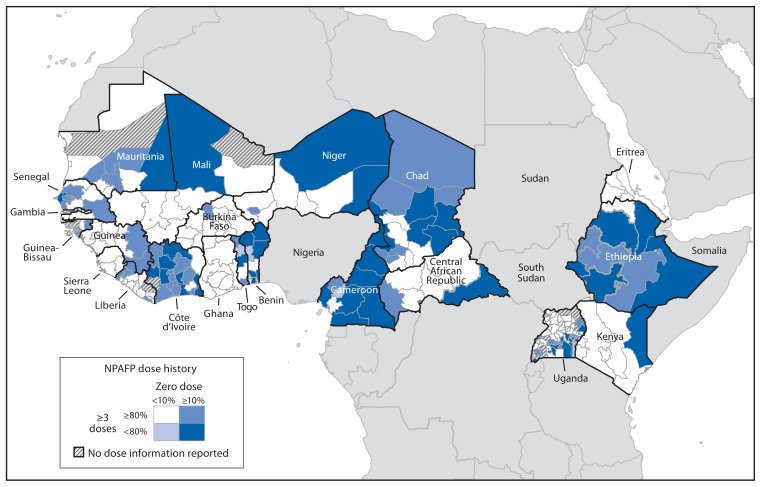
In 2012, the World Health Assembly of the World Health Organization (WHO) declared the completion of polio eradication a programmatic emergency. Indigenous wild poliovirus (WPV) transmission remains uninterrupted in Nigeria (in the WHO African Region [AFR]) and in Afghanistan and Pakistan (in the WHO Eastern Mediterranean Region [EMR]). In the WHO AFR, multiple WPV outbreaks have occurred since 2003 after importation of indigenous West African WPV into 21 previously polio-free countries in a "WPV importation belt"* that extends across the continent. The Global Polio Eradication Initiative (GPEI) and WHO regional offices have used indicators of population immunity, surveillance quality, and other factors (e.g., high-risk subpopulations and proximity to WPV-affected countries) to assess the risk for outbreaks in polio-free countries and guide the implementation of risk mitigation measures to limit poliovirus transmission after WPV importation and prevent the emergence of circulating vaccine-derived poliovirus (cVDPV). Despite risk mitigation efforts, a polio outbreak, first confirmed in May 2013, is ongoing; as of September 10, a total of 178 WPV type 1 (WPV1) cases have been reported in Somalia† (163 cases), Kenya (14 cases) and Ethiopia (1 case), after importation of WPV1 of West African origin. This report summarizes steps taken by the GPEI to assess and mitigate the risks for outbreaks after WPV importation or the emergence of cVDPV in polio-free countries within the WHO AFR's "WPV importation belt." All countries will continue to have some level of risk for WPV outbreaks as long as endemic circulation continues in Afghanistan, Nigeria, and Pakistan.
Figures
References
-
- Lowther SA, Roesel S, O’Connor P, et al. World Health Organization regional assessments of the risks of poliovirus outbreaks. Risk Analysis. 2013;33:664–79. - PubMed
-
- CDC. Outbreaks following wild poliovirus importations—Europe, Africa, and Asia, January 2009–September 2010. MMWR. 2010;59:1393–9. - PubMed
-
- CDC. Wild poliovirus type 1 and type 3 importations—15 countries, Africa, 2008–2009. MMWR. 2009;58:357–62. - PubMed
MeSH terms
Substances
LinkOut - more resources
Full Text Sources
Medical
