


Influence of body mass index on survival in veterans with multiple myeloma
- PMID: 24048366
- PMCID: PMC3805147
- DOI: 10.1634/theoncologist.2013-0015
Influence of body mass index on survival in veterans with multiple myeloma
Abstract
Purpose: We investigated the association between body mass index (BMI) at the time of multiple myeloma (MM) diagnosis and overall survival in a cohort of patients within the Veterans Health Administration system. We also evaluated the association between weight loss in the year prior to diagnosis and survival.
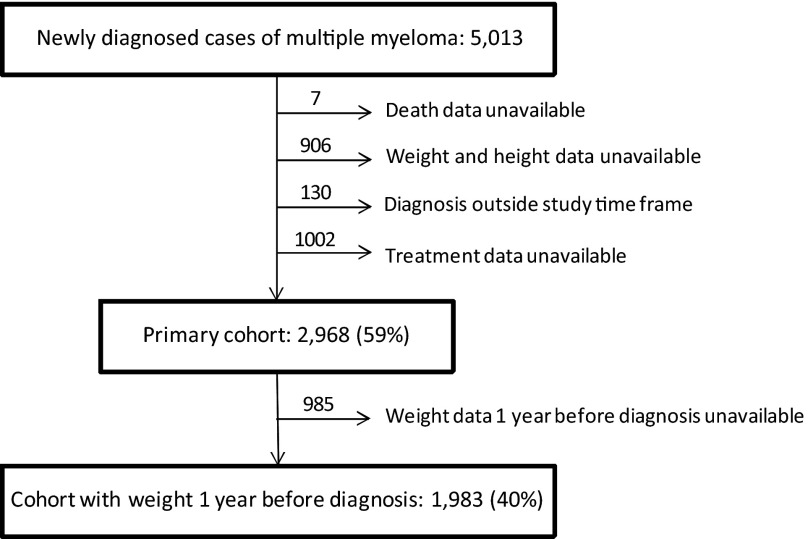
Patients and methods: Prospective analysis was performed on a retrospectively assembled cohort of 2,968 U.S. veterans diagnosed and treated for MM between September 1, 1999, and September 30, 2009, with follow-up information through October 22, 2011. Cox modeling controlling for patient- and disease-related prognostic variables was used to analyze the data.
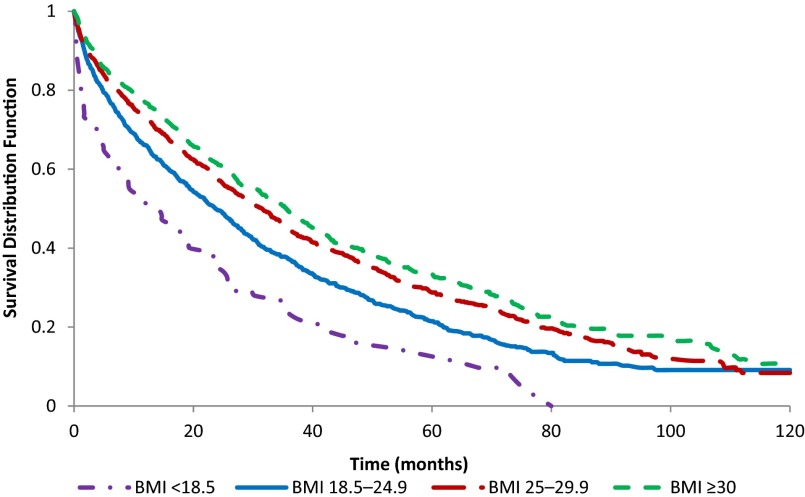
Results: Underweight patients (BMI <18.5 kg/m2) had increased mortality, whereas patients who were overweight (BMI 25-29.9 kg/m2) and obese (BMI ≥30 kg/m2) had lower mortality compared with healthy-weight patients (BMI 18.5-24.9 kg/m2). Weight loss ≥10% of baseline in the year before diagnosis was also associated with increased mortality and made the association between increased BMI and survival nonsignificant.
Conclusion: Disease-related weight loss may be an important and heretofore unknown indicator of poor prognosis in MM. Assessment of weight loss prior to MM diagnosis should become a standard component of the clinical history in patients with newly diagnosed MM. Further research may identify relationships between disease-related weight loss and currently used prognostic factors in MM, further defining the role of this clinical factor in prognostic stratification.
Keywords: Body mass index; Mortality; Multiple myeloma; Obesity; Overweight; Survival.
Conflict of interest statement
Disclosures of potential conflicts of interest may be found at the end of this article.
Figures
References
-
- Flegal KM, Carroll MD, Ogden CL, et al. Prevalence and trends in obesity among US adults, 1999–2008. JAMA. 2010;303:235–241. - PubMed
-
- Adams KF, Schatzkin A, Harris TB, et al. Overweight, obesity, and mortality in a large prospective cohort of persons 50 to 71 years old. N Engl J Med. 2006;355:763–778. - PubMed
-
- Calle EE, Rodriguez C, Walker-Thurmond K, et al. Overweight, obesity, and mortality from cancer in a prospectively studied cohort of U.S. adults. N Engl J Med. 2003;348:1625–1638. - PubMed
Publication types
MeSH terms
Grants and funding
LinkOut - more resources
Full Text Sources
Other Literature Sources
Medical
