Factors Affecting Perceptual Threshold in Argus II Retinal Prosthesis Subjects
- PMID: 24049718
- PMCID: PMC3763895
- DOI: 10.1167/tvst.2.4.1
Factors Affecting Perceptual Threshold in Argus II Retinal Prosthesis Subjects
Abstract
Purpose: The Argus II epiretinal prosthesis has been developed to provide partial restoration of vision to subjects blinded from outer retinal degenerative disease. Participants were surgically implanted with the system in the United States and Europe in a single arm, prospective, multicenter clinical trial. The purpose of this investigation was to determine which factors affect electrical thresholds in order to inform surgical placement of the device.
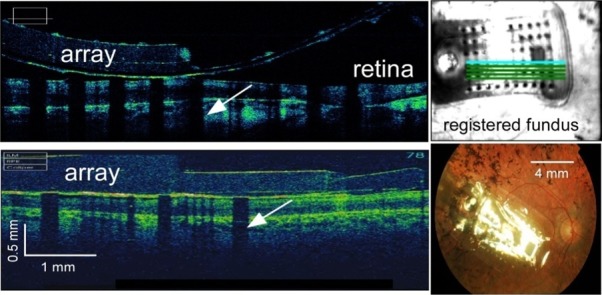
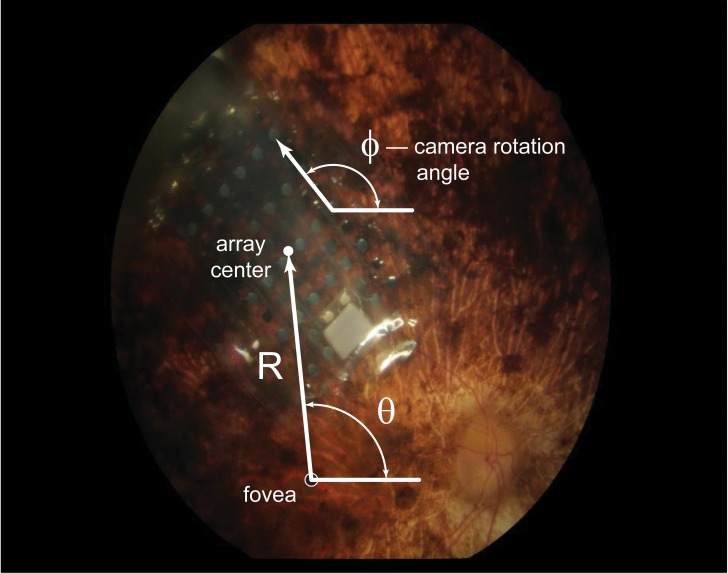
Methods: Electrode-retina and electrode-fovea distances were determined using SD-OCT and fundus photography, respectively. Perceptual threshold to electrical stimulation of electrodes was measured using custom developed software, in which current amplitude was varied until the threshold was found. Full field stimulus light threshold was measured using the Espion D-FST test. Relationships between electrical threshold and these three explanatory variables (electrode-retina distance, electrode-fovea distance, and monocular light threshold) were quantified using regression.
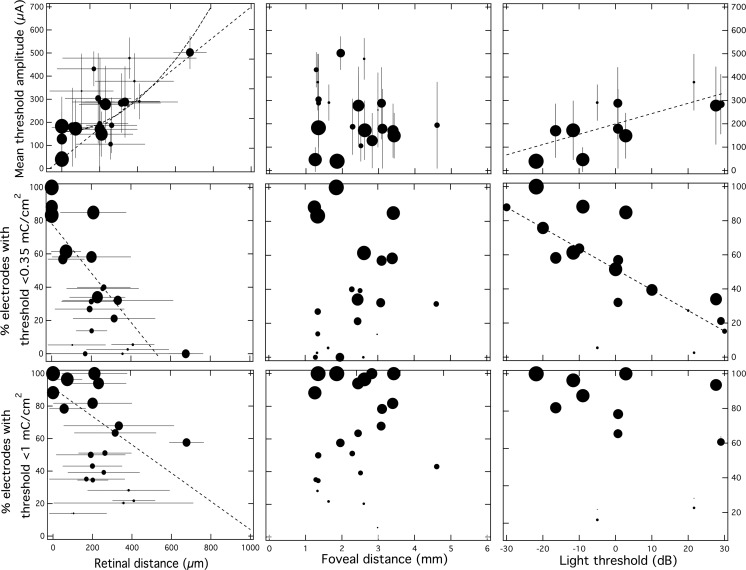
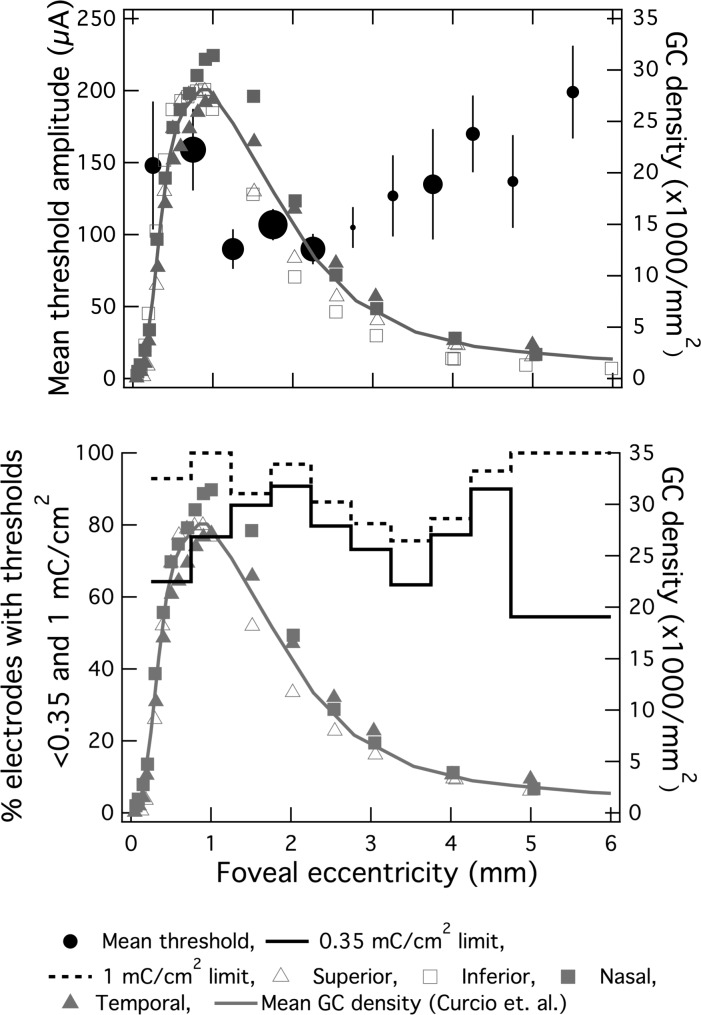
Results: Regression analysis showed a significant correlation between electrical threshold and electrode-retina distance (R2 = 0.50, P = 0.0002; n = 703 electrodes). 90.3% of electrodes in contact with the macula (n = 207) elicited percepts at charge densities less than 1 mC/cm2/phase. These threshold data also correlated well with ganglion cell density profile (P = 0.03). A weaker, but still significant, inverse correlation was found between light threshold and electrical threshold (R2 < 0.52, P = 0.01). Multivariate modeling indicated that electrode-retina distance and light threshold are highly predictive of electrode threshold (R2 = 0.87; P < 0.0005).
Conclusions: Taken together, these results suggest that while light threshold should be used to inform patient selection, macular contact of the array is paramount.
Translational relevance: Reported Argus II clinical study results are in good agreement with prior in vitro and in vivo studies, and support the development of higher-density systems that employ smaller diameter electrodes. (clinicaltrials.gov identifier: NCT00407602).
Keywords: retinal degeneration; retinal prosthesis; retinitis pigmentosa.
Figures
References
-
- Marc RE, Jones BW, Watt CB, Strettoi E. Neural remodeling in retinal degeneration. Prog Retin Eye Res. 2003;22(5):607–655. - PubMed
-
- Santos A, Humayun MS, de Juan E, Jr, et al. Preservation of the inner retina in retinitis pigmentosa. A morphometric analysis. Arch Ophthalmol. 1997;22(4):511–515. - PubMed
-
- Stone JL, Barlow WE, Humayun MS, de Juan E, Jr, Milam AH. Morphometric analysis of macular photoreceptors and ganglion cells in retinas with retinitis pigmentosa. Arch Ophthalmol. 1992;110(11):1634–1639. - PubMed
-
- Rizzo JF, 3rd, Wyatt J, Loewenstein J, Kelly S, Shire D. Perceptual efficacy of electrical stimulation of human retina with a microelectrode array during short-term surgical trials. Invest Ophthalmol Vis Sci. 2003;44(12):5362–5369. - PubMed
-
- Zrenner E, Stett A, Weiss S, et al. Can subretinal microphotodiodes successfully replace degenerated photoreceptors? Vision Res. 1999;39(15):2555–2567. - PubMed
Associated data
Grants and funding
LinkOut - more resources
Full Text Sources
Other Literature Sources
Medical
Miscellaneous