Review
. 2014:9:219-38.
doi: 10.1146/annurev-pathol-012513-104653. Epub 2013 Sep 16.

The intracellular life of Cryptococcus neoformans

Affiliations
Review

The intracellular life of Cryptococcus neoformans

Carolina Coelho et al. Annu Rev Pathol. 2014.

Abstract

Cryptococcus neoformans is a fungal pathogen with worldwide distribution. Serological studies of human populations show a high prevalence of human infection, which rarely progresses to disease in immunocompetent hosts. However, decreased host immunity places individuals at high risk for cryptococcal disease. The disease can result from acute infection or reactivation of latent infection, in which yeasts within granulomas and host macrophages emerge to cause disease. In this review, we summarize what is known about the cellular recognition, ingestion, and killing of C. neoformans and discuss the unique and remarkable features of its intracellular life, including the proposed mechanisms for fungal persistence and killing in phagocytic cells.


Figures

Figure 1
Figure 1
Histopathology of Cryptococcus neoformans lung infection. Photomicrographs of lung tissue from Balb/c mice infected with C. neoformans (blue arrowheads), stained with hematoxylin and eosin. (a) Initial infection, showing diffuse pneumonitis and infiltration of immune cells and yeast into the alveolar space (200×). (b) Typical granuloma formation 5 days postinfection (200×). (c) Typical granuloma formation 15 days postinfection (100×). (d) Magnification of panel c, showing the presence of histiocytes (red arrowheads) (400×). (e) At later stages of infection, giant cells (yellow arrowhead) contain C. neoformans (400×). (f) C. neoformans replicating within the alveolar space, visualized by periodic acid–Schiff stain (400×).
Figure 2
Figure 2
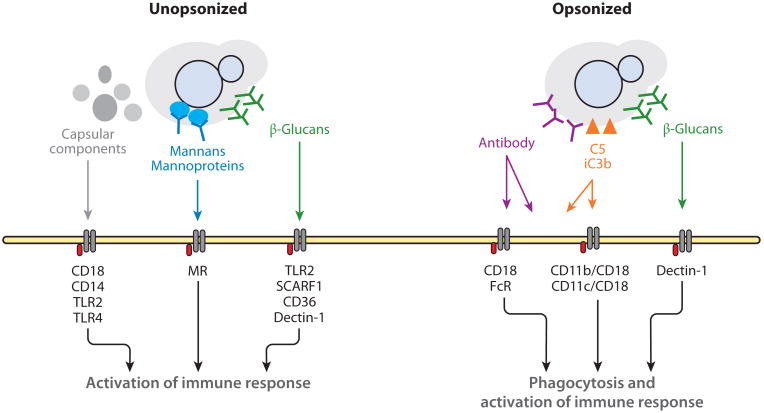
Schematic of recognition of Cryptococcus neoformans by immune cells. Recognition of C. neoformans by immune cells depends on several receptors and extensive cross talk between those receptors. Recognition of capsular components was determined in isolation and likely also occurs for the whole capsule. Most of these receptors are not opsonic, meaning they cannot mediate ingestion. The in vivo opsonins are thought to be serum components iC3b and C5, such that the yeast is ingested via cooperation between complement receptors, FcRs, and possibly Dectin-1. Abbreviations: FcR, Fc receptor; MR, mannose receptor; TLR, Toll-like receptor.
Figure 3
Figure 3
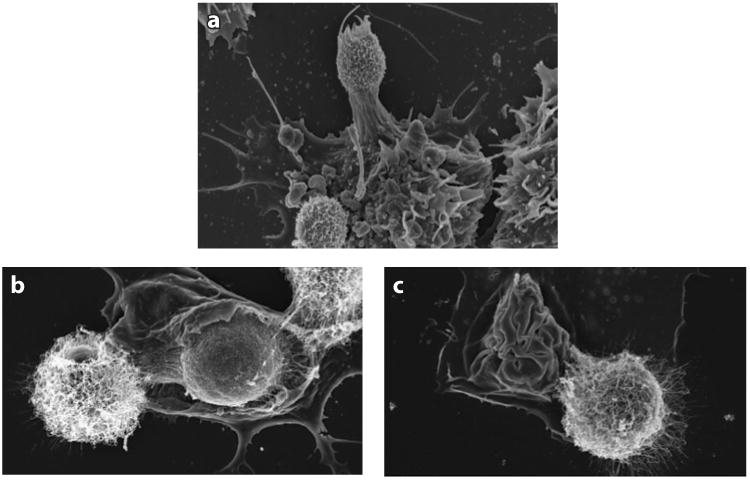
Scanning electron micrographs showing Cryptococcus neoformans and macrophage interaction in vitro. Bone marrow–derived macrophages were infected with antibody-opsonized C. neoformans, and macrophage membranes are shown interacting with yeast cells. (a) Yeast cells are recognized when macrophage membranes probe the extracellular environment around them. (b) Capsulated yeast cells are ingested as the macrophage membrane engulfs them. (c) Ingestion is finalized when the membrane closes upon the yeast cell; a neighboring extracellular yeast is also shown. Panel a courtesy of Sabriya Stukes; panels b and c acquired with the help of Julie M. Wolf.
Figure 4
Figure 4
Schematic of immune signaling cascades triggered by Cryptococcus neoformans recognition. (a) Dectin-1 signaling pathway. Dectin-1 can induce both Syk-dependent and Raf (Syk-independent) pathways. Dectin-1 can activate macrophages through the Syk pathway, triggering phagocytosis; following phagocytosis, Dectin-1 activation, coupled to ROS production, contributes to inflammasome activation or fungal killing and activates the transcription factor NF-κB through CARD9, triggering inflammatory cytokine production. The Raf-1 (Syk-independent) pathway enhances NF-κB and inflammatory cytokines. (b) Inflammasome pathway. The Syk-dependent pathway requires combination of two signals. The first signal, which can be mediated by TLR activation, together with a second signal, such as ROS production and/or lysosomal damage, induces the oligomerization of the NLRP3 complex, activation of caspase 1, and production of IL-1β. Abbreviations: ASC, apoptosis-associated speck-like protein containing a C-terminal CARD; Bcl10, B cell leukemia/lymphoma 10; CARD9, caspase recruitment domain–containing protein 9; CLR, C-type lectin receptor; IL, interleukin; MALT-1, mucosa-associated lymphoid tissue 1; NF-κB, nuclear factor κ-light-chain enhancer of activated B cells; NLRP3, Nod-like receptor family, pyrin domain–containing 3; PLCγ2, phospholipase Cγ2; ROS, reactive oxygen species; Syk, spleen tyrosine kinase; TLR, Toll-like receptor; TNF-α, tumor necrosis factor α
Figure 5
Figure 5
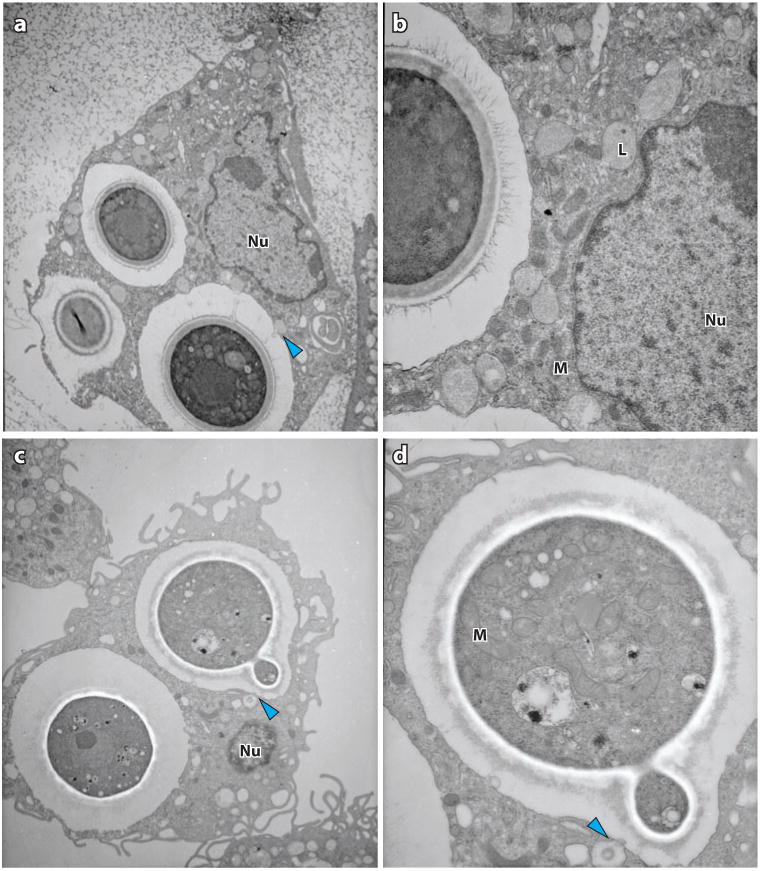
Transmission electron micrographs showing Cryptococcus neoformans and macrophage interaction in vitro. Blue arrowheads indicate possible lysosomal fusion events. (a) Macrophage with ingested C. neoformans. (b) Magnification of panel a, highlighting macrophage organelles, particularly lysosomes, in proximity with the phagosome. (c) C. neoformans budding within a phagosome. (d) Magnification of panel c, displaying C. neoformans organelles. Abbreviations: L, lysosome; M, mitochondrion; Nu, nucleus.
Figure 6
Figure 6
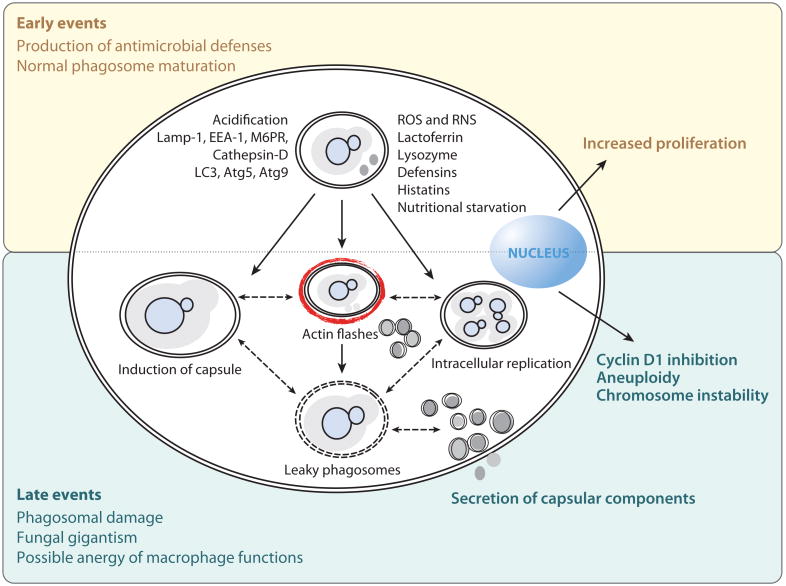
Phagocytic events upon Cryptococcus neoformans ingestion. To date, no manipulation of the phagocytic compartment by C. neoformans has been described. The interplay between macrophage fungicidal mechanisms and C. neoformans results in host damage, mainly to the phagosomal compartment and to the regulation of the host cell cycle. Abbreviations: ROS, reactive oxygen species; RNS, reactive nitrogen species.
Figure 7
Figure 7
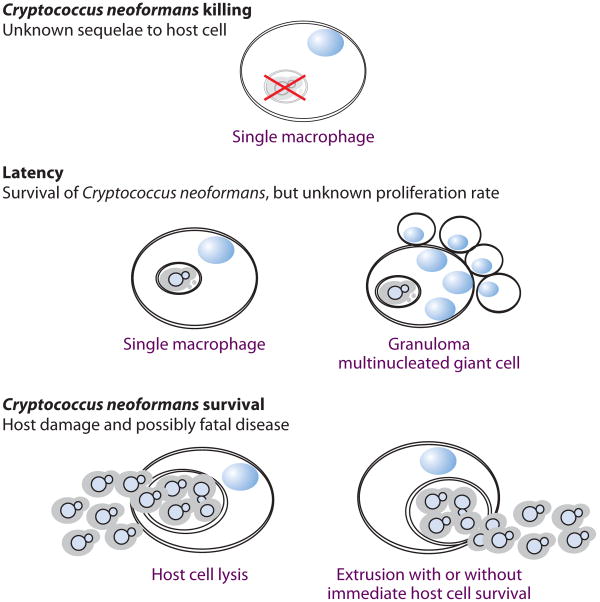
Possible outcomes for Cryptococcus neoformans infection of murine macrophages. The interaction between C. neoformans and host macrophages can result in different outcomes, and the frequency with which they occur influences the course of infection.

References

    1. Barnett JA. A history of research on yeasts 14: medical yeasts part 2, Cryptococcus neoformans. Yeast. 2010;27(11):875–904. - PubMed
    1. Lin X, Heitman J. The biology of the Cryptococcus neoformans species complex. Annu Rev Microbiol. 2006;60:69–105. - PubMed
    1. Lindell DM, Ballinger MN, McDonald RA, Toews GB, Huffnagle GB. Immunologic homeostasis during infection: coexistence of strong pulmonary cell–mediated immunity to secondary Cryptococcus neoformans infection while the primary infection still persists at low levels in the lungs. J Immunol. 2006;177(7):4652–61. - PubMed
    1. Goldman DL, Khine H, Abadi J, Lindenberg DJ, Pirofski La, et al. Serologic evidence for Cryptococcus neoformans infection in early childhood. Pediatrics. 2001;107(5):e66. - PubMed
    1. Garcia-Hermoso D, Janbon G, Dromer F. Epidemiological evidence for dormant Cryptococcus neoformans infection. J Clin Microbiol. 1999;37(10):3204–9. - PMC - PubMed

Publication types

LinkOut - more resources