. 2013 Oct;123(10):4283-93.
doi: 10.1172/JCI69854. Epub 2013 Sep 24.

CVID-associated TACI mutations affect autoreactive B cell selection and activation

CVID-associated TACI mutations affect autoreactive B cell selection and activation

Neil Romberg et al. J Clin Invest. 2013 Oct.

Abstract

Common variable immune deficiency (CVID) is an assorted group of primary diseases that clinically manifest with antibody deficiency, infection susceptibility, and autoimmunity. Heterozygous mutations in the gene encoding the tumor necrosis factor receptor superfamily member TACI are associated with CVID and autoimmune manifestations, whereas two mutated alleles prevent autoimmunity. To assess how the number of TACI mutations affects B cell activation and tolerance checkpoints, we analyzed healthy individuals and CVID patients carrying one or two TACI mutations. We found that TACI interacts with the cleaved, mature forms of TLR7 and TLR9 and plays an important role during B cell activation and the central removal of autoreactive B cells in healthy donors and CVID patients. However, only subjects with a single TACI mutation displayed a breached immune tolerance and secreted antinuclear antibodies (ANAs). These antibodies were associated with the presence of circulating B cell lymphoma 6-expressing T follicular helper (Tfh) cells, likely stimulating autoreactive B cells. Thus, TACI mutations may favor CVID by altering B cell activation with coincident impairment of central B cell tolerance, whereas residual B cell responsiveness in patients with one, but not two, TACI mutations enables autoimmune complications.


Figures
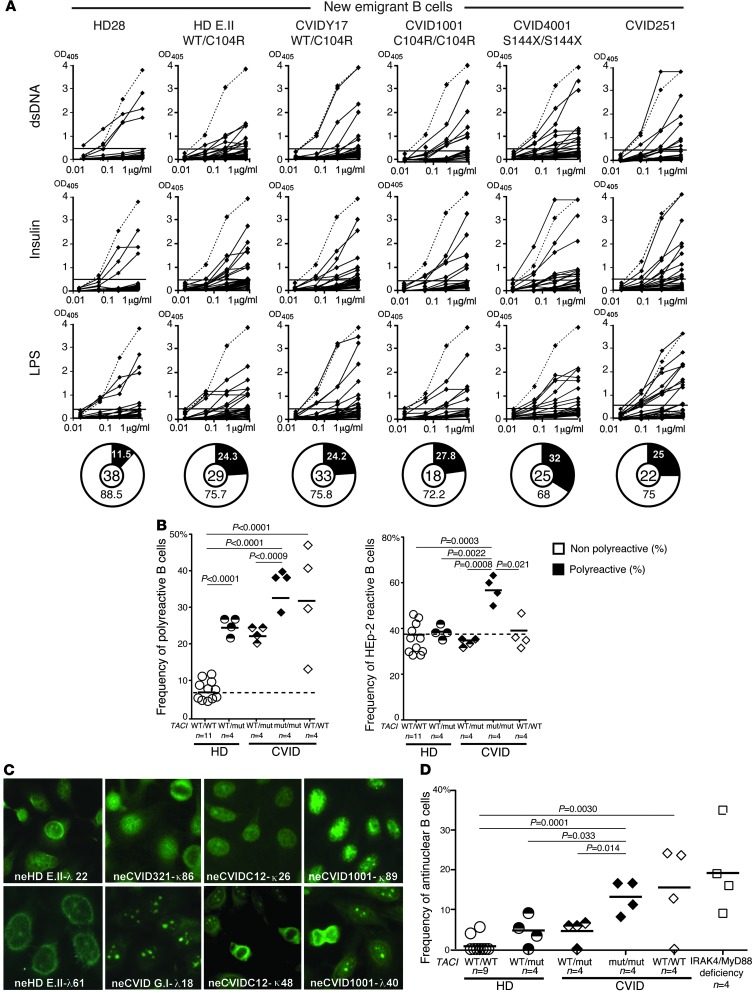
Figure 1
Figure 1. Defective central B cell tolerance checkpoint in individuals carrying TACI mutation(s).
(A) Recombinant antibodies derived from new emigrant/transitional B cells from representative individuals were tested by ELISA for reactivity against dsDNA, insulin, and LPS (21). Antibodies were considered polyreactive when they reacted against all three antigens. Dashed lines show ED38 antibody–positive control, and solid lines show binding for each cloned recombinant antibody. Horizontal lines define the cutoff OD405 for positive reactivity. For each individual, the frequency of polyreactive and nonpolyreactive clones is summarized in pie charts, with the total number of antibodies tested indicated in the center. (B) The frequency of polyreactive new emigrant/transitional B cells increased in all individuals carrying TACI mutation(s) and most CVID patients without TACI mutations, whereas the frequency of HEp-2–reactive new emigrant/transitional B cells only increased in patients with two mutated TACI alleles. (C) Autoreactive antibodies expressed by new emigrant/transitional B cells from individuals carrying TACI mutation(s) included clones with various nuclear staining patterns on HEp-2 cells. Original magnification, ×40. (D) The frequency of antinuclear new emigrant/transitional B cells in individuals carrying TACI mutation(s) was elevated compared with healthy controls and is reminiscent of patients with MyD88 and IRAK4 deficiency (white squares) (23). Statistical significance by an unpaired Student’s t test is indicated.
Figure 2
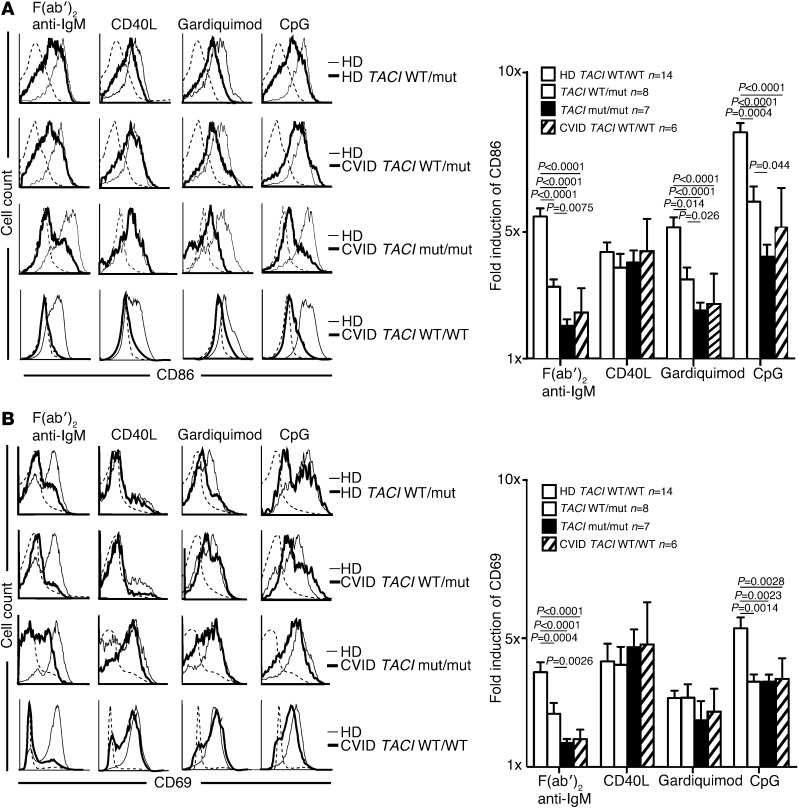
Figure 2. TACI mutation(s) result in selective defects for in vitro naive B cell activation.
Purified naive B cells from representative individuals with and without TACI mutation(s) (thick lines) displayed decreased CD86 (A) but mostly normal CD69 (B) induction compared with healthy controls (thin lines) after 48 hours of stimulation with F(ab′)2 anti-IgM, CpG, and gardiquimod, but not CD40L. CVID patients without TACI mutation(s) (thick lines) displayed more variable CD86 and CD69 induction under activating conditions. Unstimulated healthy controls (dashed line) are shown for comparison. CVID patients (n = 3) and healthy subjects (n = 5) with a single TACI mutation were pooled because they displayed similar decreased B cell responses. Bar graphs (right) represent the combined data from multiple B cell activation experiments. Error bars represent the mean ± SEM. Statistical significance is indicated by an unpaired Student’s t test.
Figure 3
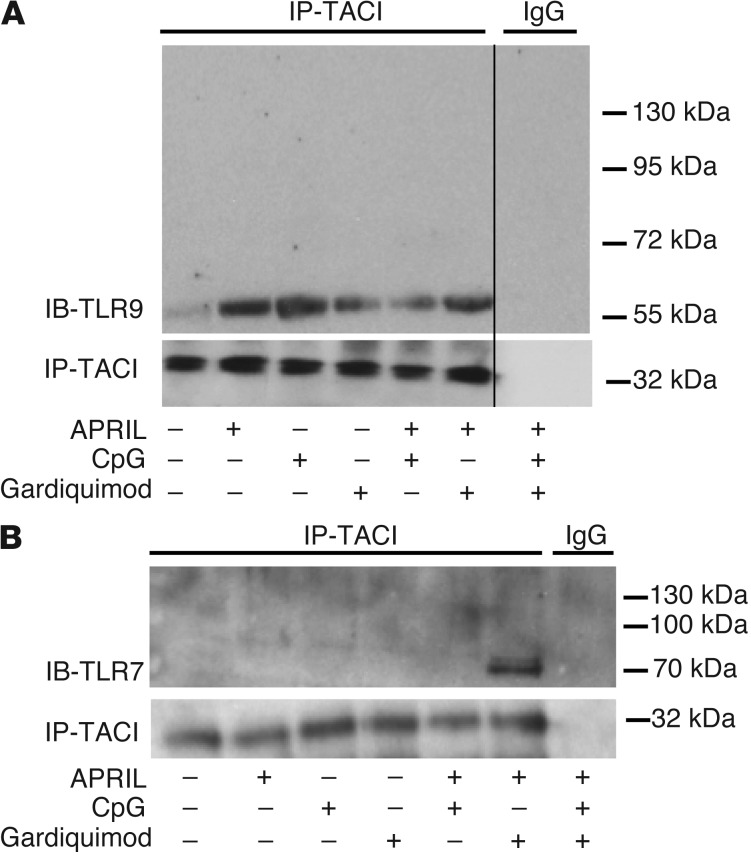
Figure 3. TACI interacts with activated/cleaved TLR7 and TLR9.
TACI associates with activated/cleaved 65-kDa TLR9 (A) or 75-kDa TLR7 (B) after the receptors triggered or cotriggered with their respective ligands. Immunoprecipitations were performed using human splenic B cells stimulated or not by the TACI ligand APRIL, TLR9 ligand CpG, and/or TLR7 ligand gardiquimod, as indicated below the blots. The thin black vertical line in A signifies the absence of a single lane from an otherwise contiguous blot that was removed, as it did not further clarify the TACI-TLR9 interaction.
Figure 4
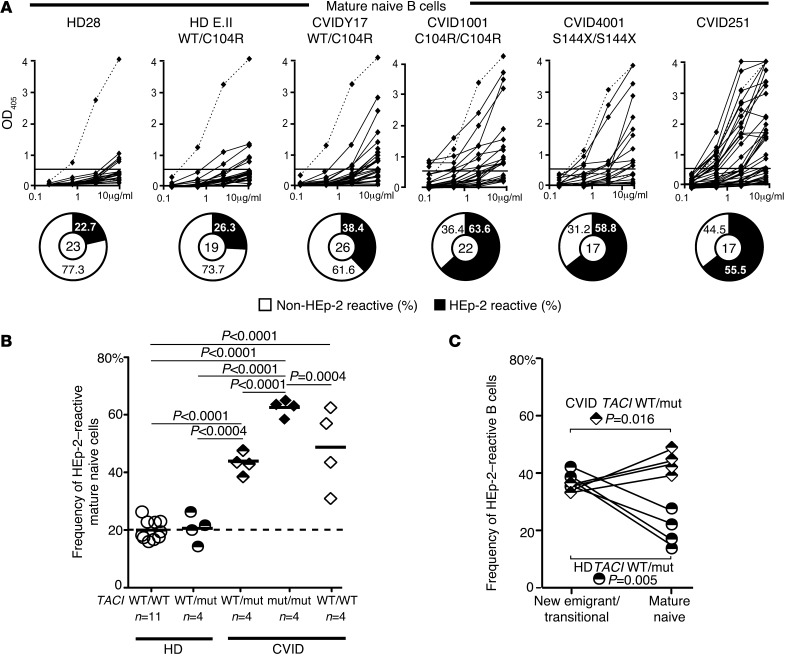
Figure 4. A defective peripheral B cell tolerance checkpoint in CVID patients.
(A) Recombinant antibodies derived from mature naive B cells from subjects or CVID patients with or without TACI mutation(s) were tested by ELISA for anti–HEp-2 cell reactivity. Dashed lines show the ED38-positive control (21). Horizontal lines define the cutoff OD405 for positive reactivity. For each individual, the frequencies of HEp-2–reactive and non–HEp-2–reactive clones are summarized in pie charts, with the number of antibodies tested indicated in the center. (B) The frequency of HEp-2–reactive mature naive B cells was higher in all CVID patients than was observed in healthy donors with or without one TACI mutation. (C) The frequency of HEp-2–reactive clones rose between the new emigrant/transitional and mature naive B cell stages in CVID patients with a TACI mutation, whereas it decreased in healthy carriers with one TACI mutation. Statistical significance is indicated by an unpaired or paired (for C) Student’s t test.
Figure 5
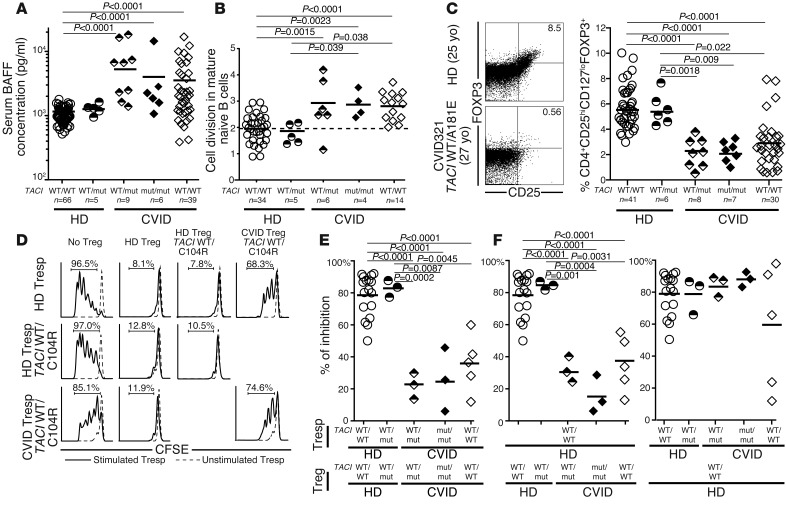
Figure 5. Increased plasma BAFF concentrations, homeostatic naive B cell proliferation, and an impaired Treg compartment are features common to CVID patients with and without TACI mutations.
TACI mutations did not affect plasma BAFF concentrations (pg/ml) measured by ELISA (A) or mature naive B cell expansion detected by KREC analysis (B). Both were greater in CVID patients compared with healthy controls. (CF) CVID status, but not TACI mutations, affected Treg frequency and function. (C) Dot plots represent CD4+ gated CD25hiFOXP3+ T cells of a healthy donor control and an age-matched CVID patient with one TACI mutation. Scatter plots reveal that decreased CD4+CD25hiCD127loFOXP3+ Treg frequency only correlated with CVID. yo, year-old. (D) Representative histograms of Treg-mediated suppression of autologous and heterologous CFSE-labeled Tresp cells on day 4.5 from a CVID patient and a healthy relative both carrying a TACI mutation were compared with a healthy control. Dashed lines display nonstimulated Tresp cells. The autologous and heterologous suppressive activities of Tregs from healthy donor controls, healthy carriers with a single TACI mutation, CVID patients with one or two mutated TACI alleles, as well as CVID patients without TACI mutations are summarized in E and F, respectively. Statistical significance is indicated by an unpaired Student’s t test.
Figure 6
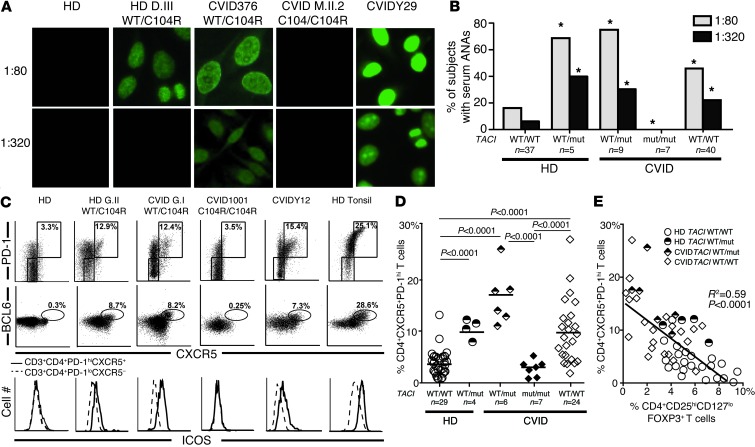
Figure 6. Heterozygous TACI mutations correlate with secreted ANAs and circulating Tfh cells.
(A and B) ANAs with diverse nuclear staining patterns at low (1:80) and high (1:320) dilutions were common in individuals with one TACI mutation, but were absent in patients with two mutated alleles. *P < 0.05 (statistical differences compared with healthy controls by χ2 testing). (C and D) Expanded CD4+PD-1hiCXCR5+ Tfh cells in the peripheral blood of individuals with one, but not two, TACI mutations and some CVID patients without TACI mutations. In addition to PD-1 and CXCR5 expression, Tfh cells in carriers of a single TACI mutation were further evidenced by increased intracellular BCL6 expression in and increased cell surface ICOS expression on CD4+PD-1hiCXCR5+ T cells (solid line in lower panel of C) compared with CD4+PD-1loCXCR5 T cells (dashed line in lower panel of C). (E) The frequency of circulating Tfh cells was inversely correlated with the frequency of circulating Tregs in enrolled subjects with or without single TACI mutations. Statistical significance is indicated using χ2 testing (B), an unpaired Student’s t test (D), or linear regression analysis (E).

Comment in

References

    1. Al-Herz W, et al. Primary immunodeficiency diseases: an update on the classification from the international union of immunological societies expert committee for primary immunodeficiency. Front Immunol. 2011;2:54. - PMC - PubMed
    1. Sanford JP, Favour CB, Tribeman MS. Absence of serum gamma globulins in an adult. N Engl J Med. 1954;250(24):1027–1029. doi: 10.1056/NEJM195406172502403. - DOI - PubMed
    1. Bryant A, Calver NC, Toubi E, Webster AD, Farrant J. Classification of patients with common variable immunodeficiency by B cell secretion of IgM and IgG in response to anti-IgM and interleukin-2. Clin Immunol Immunopathol. 1990;56(2):239–248. doi: 10.1016/0090-1229(90)90145-G. - DOI - PubMed
    1. Yu JE, et al. Toll-like receptor 7 and 9 defects in common variable immunodeficiency. J Allergy Clin Immunol. 2009;124(2):349–356. doi: 10.1016/j.jaci.2009.05.019. - DOI - PMC - PubMed
    1. Denz A, Eibel H, Illges H, Kienzle G, Schlesier M, Peter HH. Impaired up-regulation of CD86 in B cells of “type A” common variable immunodeficiency patients. Eur J Immunol. 2000;30(4):1069–1077. doi: 10.1002/(SICI)1521-4141(200004)30:4<1069::AID-IMMU1069>3.0.CO;2-M. - DOI - PubMed

Publication types

MeSH terms