


doi: 10.1016/j.ddmod.2011.09.001.
When host defense goes awry: Modeling sepsis-induced immunosuppression
Affiliations
- PMID: 24052802
- PMCID: PMC3775367
- DOI: 10.1016/j.ddmod.2011.09.001
Item in Clipboard
When host defense goes awry: Modeling sepsis-induced immunosuppression
Drug Discov Today Dis Models.
2012.
Abstract
Sepsis is associated with an initial hyperinflammatory state; however, therapeutic trials targeting the inflammatory response have yielded disappointing results. It is now appreciated that septic patients often undergo a period of relative immunosuppression, rendering them susceptible to secondary infections. Interest in this phenomenon has led to the development of animal models to study the immune dysfunction of sepsis. In this review, we analyze the available models of sepsis-induced immunosuppression.
Figures
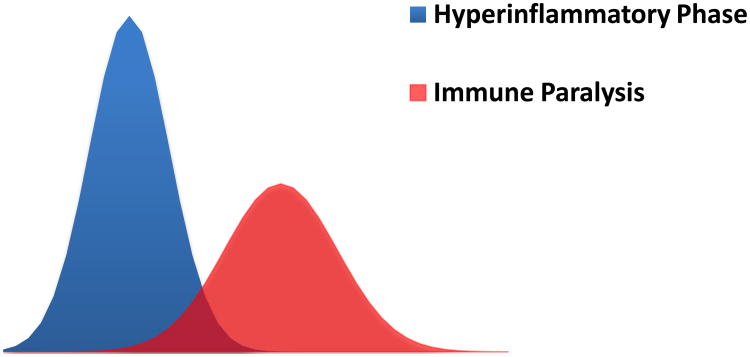
Evolution of sepsis. A state of relative immune paralysis often develops concurrently or subsequent to the initial inflammatory state of sepsis, resulting in increased susceptibility to secondary infections. Although most patients survive the initial insult of sepsis, they can succumb to a secondary infection if the balance between pro- and anti-inflammatory immune responses is dysregulated.
References
-
- Kochanek KD, et al. Deaths: Preliminary Data for 2009. National Vital Statistics Reports. 2011;59(4):1–51. - PubMed
-
- Rivers E, et al. Early goal-directed therapy in the treatment of severe sepsis and septic shock. The New England journal of medicine. 2001;345(19):1368–77. - PubMed
-
- Bernard GR, et al. Efficacy and safety of recombinant human activated protein C for severe sepsis. The New England journal of medicine. 2001;344(10):699–709. - PubMed
-
- Bone RC. Sir Isaac Newton, sepsis, SIRS, and CARS. Crit Care Med. 1996;24(7):1125–8. - PubMed
-
- Cronin L, et al. Corticosteroid treatment for sepsis: a critical appraisal and meta-analysis of the literature. Crit Care Med. 1995;23(8):1430–9. - PubMed
Grants and funding
LinkOut - more resources
Full Text Sources