Review
. 2014 Apr;20(4):214-23.
doi: 10.1016/j.molmed.2013.08.004. Epub 2013 Sep 18.

Redefining the gut as the motor of critical illness

Affiliations
Review

Redefining the gut as the motor of critical illness

Rohit Mittal et al. Trends Mol Med. 2014 Apr.

Abstract

The gut is hypothesized to play a central role in the progression of sepsis and multiple organ dysfunction syndrome. Critical illness alters gut integrity by increasing epithelial apoptosis and permeability and by decreasing epithelial proliferation and mucus integrity. Additionally, toxic gut-derived lymph induces distant organ injury. Although the endogenous microflora ordinarily exist in a symbiotic relationship with the gut epithelium, severe physiological insults alter this relationship, leading to induction of virulence factors in the microbiome, which, in turn, can perpetuate or worsen critical illness. This review highlights newly discovered ways in which the gut acts as the motor that perpetuates the systemic inflammatory response in critical illness.

Keywords: critical illness intestine; epithelium; gut; microbiome; sepsis.


Figures

Figure 1
Figure 1
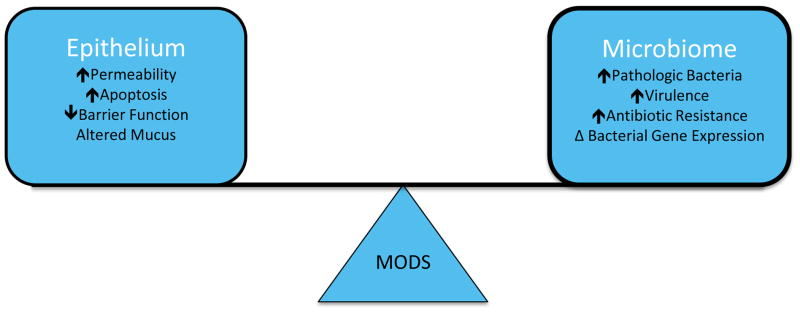
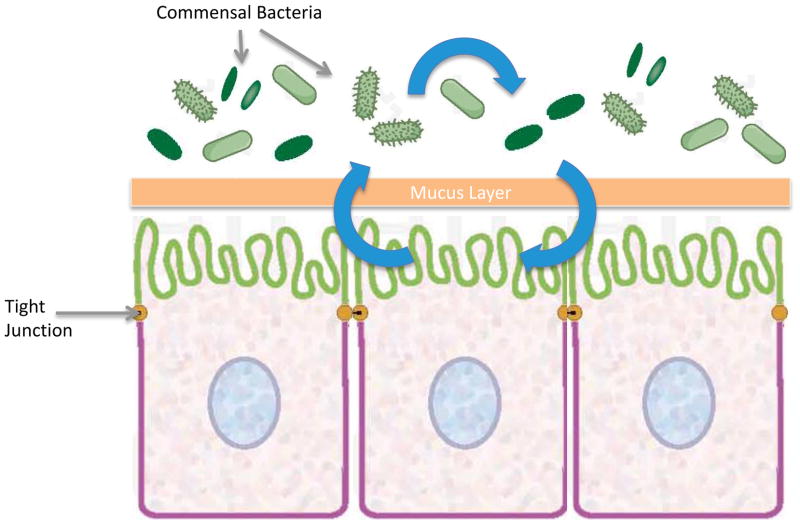
Relationship between the intestinal epithelium and microbiome. A complex but mutually beneficial relationship exists within the gut under homeostatic conditions. However, critical illness disrupts this balance, leading to pathologic changes in both the intestinal epithelium and microbiome, which can induce and perpetuate multiple organ dysfunction syndrome (MODS).
Figure 2
Figure 2
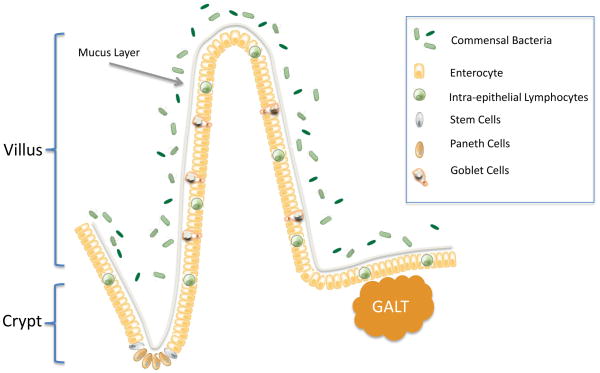
Anatomy of the intestine. Epithelial proliferation is initiated in the stem cells and is restricted to the crypt. Epithelial cells migrate upwards to the villus (enterocytes, goblet cells, enteroendocrine cells) or downwards to the crypt base (Paneth cells) where they differentiate. The epithelium is lined by a mucus layer acting as the first line of defense against the greater than 100 trillion commensal bacteria that reside within the gut lumen. The gut has a complex immune system including intra-epithelial lymphocytes and elements of the gut-associated lymphatic tissue (GALT) present in Peyer’s patches.
Figure 3
Figure 3
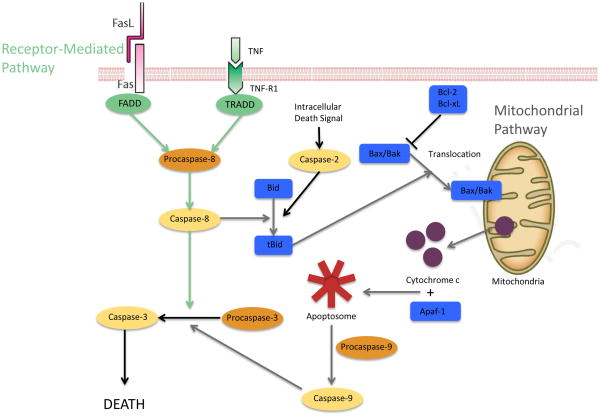
Pathways of apoptosis. Apoptosis occurs via the receptor-mediated pathway (green) or mitochondrial pathway (grey). Proapoptotic genes are shown in blue. Intracellular signals (black) activating caspase-2 may also initiate the mitochondrial pathway. Sepsis induces apoptosis in an organism and model-specific manner, in which multiple components of each pathway are affected. Both pathways converge at active caspase-3 which initiates cell death.
Figure 4
Figure 4
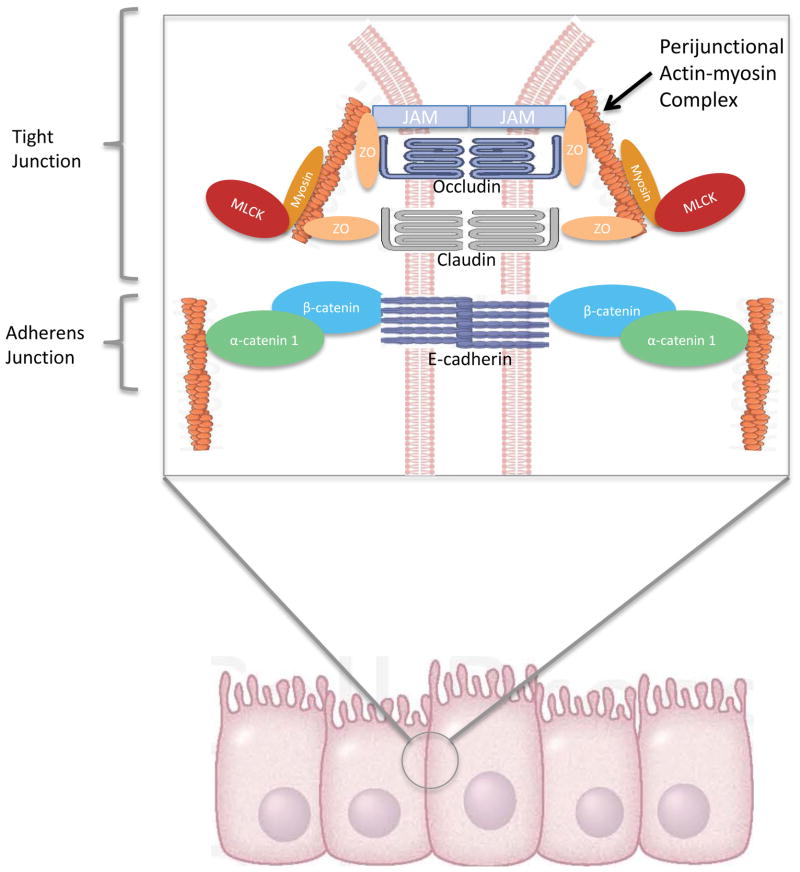
The gut barrier. The single layer of columnar cells in the intestinal epithelium are held together by tight junctions and adherens junctions (inset), which regulate the paracellular movement of intraluminal contents. Extracellular proteins, JAM, occludins, and claudins, interact with intracellular ZO proteins and the perijunctional actin-myosin ring to regulate permeability. MLCK modulates contraction of the actin-myosin ring. Extracellular cadherins along with intracellular catenins interact with the actin-myosin ring to form the adherens junction. Abbreviations: JAM: junctional adherens molecule; ZO: zonula occludens; MLCK: myosin light chain kinase.
Figure 5
Figure 5
Microbiome virulence induction. Commensal bacteria are able to sense the host microenvironment and other bacterial populations around them. Under basal conditions, the microbiome has a colonizing and/or symbiotic relationship with the host. During critical illness, microorganisms receive signals from both the host and surrounding bacteria that drive them to a virulent phenotype. Newly pathogenic bacteria can then further injure the already compromised host in a maladaptive positive feedback loop.

References

    1. Carrico CJ, et al. Multiple-organ-failure syndrome. The gastrointestinal tract: the “motor” of MOF. Arch Surg. 1986;121:196–208. - PubMed
    1. Clark JA, Coopersmith CM. Intestinal crosstalk: a new paradigm for understanding the gut as the “motor” of critical illness. Shock. 2007;28:384–393. - PMC - PubMed
    1. Coopersmith CM, et al. A comparison of critical care research funding and the financial burden of critical illness in the United States. Crit Care Med. 2012;40:1072–1079. - PubMed
    1. Gaieski DF, et al. Benchmarking the incidence and mortality of severe sepsis in the United States. Crit Care Med. 2013;41:1167–1174. - PubMed
    1. Deitch EA. Gut-origin sepsis: evolution of a concept. Surgeon. 2012;10:350–356. - PMC - PubMed

Publication types