Review
. 2013 Nov;13(11):402.
doi: 10.1007/s11910-013-0402-z.

Imaging psychogenic movement disorders

Affiliations
Review

Imaging psychogenic movement disorders

Arpan R Mehta et al. Curr Neurol Neurosci Rep. 2013 Nov.

Abstract

The neurobiological basis of psychogenic movement disorders (PMDs) has been elusive, and they remain difficult to treat. In the last few years, functional neuroimaging studies have provided insight into their pathophysiology and neural correlates. Here, we review the various methodological approaches that have been used in both clinical and research practice to address neural correlates of functional disorders. We then review the dominant hypotheses generated from the literature on psychogenic paralysis. Overall, these studies emphasize abnormalities in the prefrontal and anterior cingulate cortices. Recently, functional neuroimaging has been used to specifically examine PMDs. These studies have addressed a major point of controversy: whether higher frontal brain areas are directly responsible for inhibiting motor areas or whether they reflect modulation by attentional and/or emotional processes. In addition to elucidating the mechanism and cause, recent work has also explored the lack of agency that characterizes PMDs. We describe the results and implications of the results of these imaging studies and discuss possible interpretations.


Conflict of interest statement

Arpan R. Mehta and Anette E. Schrag declare that they have no conflict of interest.

James B. Rowe has received a consulting fee or honorarium from the Medical Research Council and the Wellcome Trust, and has received support for travel to meetings for the study or otherwise as part of the grants from the Wellcome Trust, the Medical Research Council and the James S. McDonnell Foundation. He receives honoraria for teaching from the University of Copenhagen; and he has received a Treaty of Windsor award from the British Council.

Figures
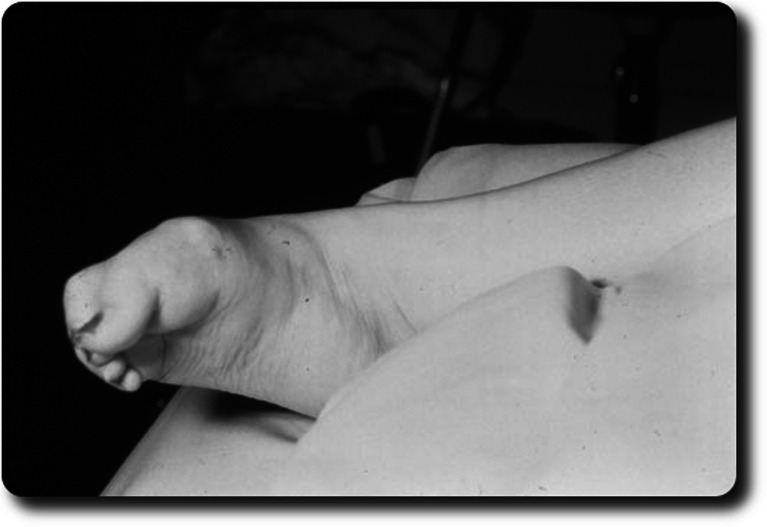
Fig. 1
Fig. 1
The syndrome of fixed dystonia of the lower limb. (Reproduced with permission of Oxford University Press from: Schrag et al. [12])
Fig. 2
Fig. 2
Statistical parametric maps showing differences in regional cerebral blood flow between organic (DYT1 gene mutation positive) and psychogenic (fixed) dystonia groups, averaged across all three tasks (resting, maintaining a posture, and moving the right lower limb, which was the affected body part in the patients). The statistical parametric maps show regions with relatively increased regional cerebral blood flow (p < 0.05, corrected for multiple independent comparisons) in either organic dystonia (a) or psychogenic dystonia (b) within the core motor network. Notably, organic dystonia showed predominantly enhanced cortical regional cerebral blood flow, whereas psychogenic dystonia showed predominantly enhanced subcortical regional cerebral blood flow when these groups were compared with each other. (Reproduced with permission of Oxford University Press from Schrag et al. [•])
Fig. 3
Fig. 3
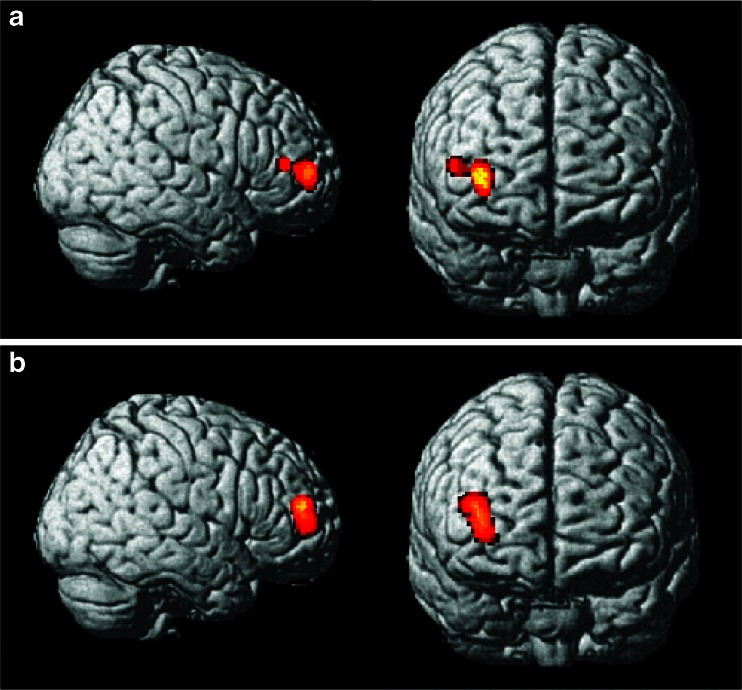
Statistical parametric maps showing abnormally increased regional cerebral blood flow in dorsolateral/polar prefrontal cortex in both organic dystonia (a) and psychogenic dystonia (b) versus control subjects during movement of the right foot compared with rest (illustrated p < 0.001, uncorrected). The differential activation in this region was significant (p < 0.05) when familywise-corrected within an a priori region of interest defined by Brodmann areas 10 and 46 bilaterally. (Reproduced with permission of Oxford University Press from Schrag et al. [•])
Fig. 4
Fig. 4
Possible neural networks involved in psychogenic movement disorders based on the latest advances from the neuroimaging literature. There is an overly sensitive emotional network, possibly conditioned by previous learning experiences, that feeds into the extended motor network via the striatum. In the presence of abnormal self-directed attention, mediated by abnormal prefrontal cortical activation that is functionally disconnected from the core motor network, these changes drive the production of aberrant movements that are not yoked to a normal sense of self-agency. This is because of hypoactivity of the supplementary motor area that normally provides the ‘corollary discharge’ signal that informs the temporoparietal junction (TPJ) ‘comparator’ what to expect in terms of sensory feedback as a result of internally generated, as opposed to externally generated, movements. As a consequence of the abnormal network activity, the movements are interpreted by patients as being involuntary. An interrupted line denotes a weakened network. (Reproduced with permission of Oxford University Press from Schrag et al. [•] and Voon et al. [•])

References

    1. Edwards MJ, Bhatia KP. Functional (psychogenic) movement disorders: merging mind and brain. Lancet Neurol. 2012;11(3):250–260. doi:10.1016/S1474-4422(11)70310-6. - PubMed
    1. Nowak DA, Fink GR. Psychogenic movement disorders: aetiology, phenomenology, neuroanatomical correlates and therapeutic approaches. Neuroimage. 2009;47(3):1015–1025. doi:10.1016/j.neuroimage.2009.04.082. - PubMed
    1. Ellenstein A, Kranick SM, Hallett M. An update on psychogenic movement disorders. Curr Neurol Neurosci Rep. 2011;11(4):396–403. doi:10.1007/s11910-011-0205-z. - PMC - PubMed
    1. Lang AE, Voon V. Psychogenic movement disorders: past developments, current status, and future directions. Mov Disord. 2011;26(6):1175–1186. doi:10.1002/mds.23571. - PubMed
    1. Batshaw ML, Wachtel RC, Deckel AW, et al. Munchausen's syndrome simulating torsion dystonia. N Engl J Med. 1985;312(22):1437–1439. doi:10.1056/NEJM198505303122207. - PubMed

Publication types

MeSH terms

LinkOut - more resources