


Risk factors for moderate and severe persistent pain in patients undergoing total knee and hip arthroplasty: a prospective predictive study
- PMID: 24058502
- PMCID: PMC3772812
- DOI: 10.1371/journal.pone.0073917
Risk factors for moderate and severe persistent pain in patients undergoing total knee and hip arthroplasty: a prospective predictive study
Abstract
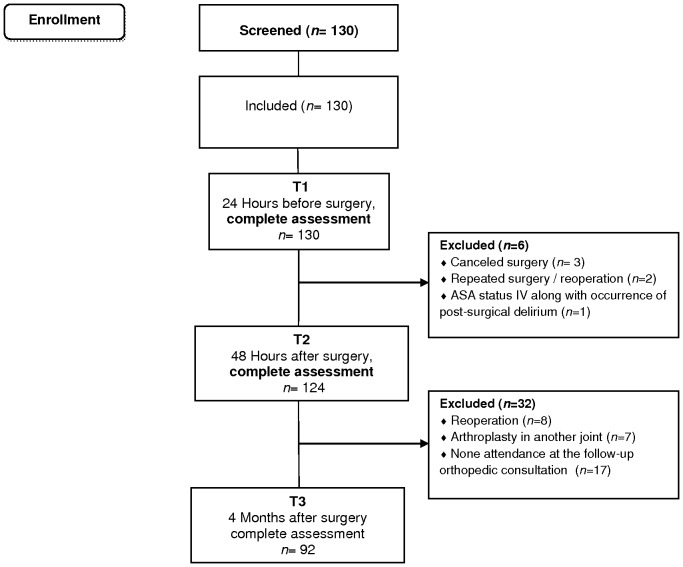
Persistent post-surgical pain (PPSP) is a major clinical problem with significant individual, social and health care costs. The aim of this study was to examine the joint role of demographic, clinical and psychological risk factors in the development of moderate and severe PPSP after Total Knee and Hip Arthroplasty (TKA and THA, respectively). This was a prospective study wherein a consecutive sample of 92 patients were assessed 24 hours before (T1), 48 hours after (T2) and 4-6 months (T3) after surgery. Hierarchical logistic regression analyses were performed to identify predictors of moderate and severe levels of PPSP. Four to six months after TKA and THA, 54 patients (58.7%) reported none or mild pain (Numerical Rating Scale: NRS ≤ 3), whereas 38 (41.3%) reported moderate to severe pain (NRS >3). In the final multivariate hierarchical logistic regression analyses, illness representations concerning the condition leading to surgery (osteoarthritis), such as a chronic timeline perception of the disease, emerged as a significant predictor of PPSP. Additionally, post-surgical anxiety also showed a predictive role in the development of PPSP. Pre-surgical pain was the most significant clinical predictive factor and, as expected, undergoing TKA was associated with greater odds of PPSP development than THA. The findings on PPSP predictors after major joint arthroplasties can guide clinical practice in terms of considering cognitive and emotional factors, together with clinical factors, in planning acute pain management before and after surgery.
Conflict of interest statement
Figures
References
-
- Kurtz S, Ong K, Lau E, Mowat F, Halpern M (2007) Projections of primary and revision hip and knee arthroplasty in the United States from 2005 to 2030. J Bone Joint Surg 89(4): 780–785. - PubMed
-
- Learmonth ID, Young C, Rorabeck C (2007) The operation of the century: total hip replacement. Lancet 370: 1508–1519. - PubMed
-
- Bachmeier CJM, March LM, Cross MJ, Lapsley HM, Tribe K, et al. (2001) A comparison of outcomes in osteoarthritis patients undergoing total hip and knee replacement surgery. Osteoarthritis and Cartilage 9: 137–146. - PubMed
-
- Hamel MB, Toth M, Legedza A, Rosen MP (2008) Joint replacement surgery in elderly patients with severe osteoarthritis of the hip or knee. Arch Intern Med 168: 1430–1440. - PubMed
Publication types
MeSH terms
LinkOut - more resources
Full Text Sources
Other Literature Sources
Medical
