Review
. 2012 Jan 1;1(1):23-33.
doi: 10.4161/jkst.19418.

Comparative evolutionary genomics of the STAT family of transcription factors

Affiliations
Review

Comparative evolutionary genomics of the STAT family of transcription factors

Yaming Wang et al. JAKSTAT. .

Abstract

The STAT signaling pathway is one of the seven common pathways that govern cell fate decisions during animal development. Comparative genomics revealed multiple incidences of stat gene duplications throughout metazoan evolutionary history. While pseudogenization is a frequent fate of duplicated genes, many of these STAT duplications evolved into novel genes through rapid sequence diversification and neofunctionalization. Additionally, the core of STAT gene regulatory networks, comprising stat1 through 4, stat5 and stat6, arose early in vertebrate evolution, probably through the two whole genome duplication events that occurred after the split of Cephalochordates but before the rise of Chondrichthyes. While another complete genome duplication event took place during the evolution of bony fish after their separation from the tetrapods about 450 million years ago (Mya), modern fish have only one set of these core stats, suggesting the rapid loss of most duplicated stat genes. The two stat5 genes in mammals likely arose from a duplication event in early Eutherian evolution, a period from about 310 Mya at the avian-mammal divergence to the separation of marsupials from other mammals about 130 Mya. These analyses indicate that whole genome duplications and gene duplications by unequal chromosomal crossing over were likely the major mechanisms underlying the evolution of STATs.

Keywords: STAT; domain accretion; evolution; gene duplication; genome sequencing.


Figures

None
Figure 1. Genomic structures of sta-1 locus. Exons are shown in boxes, with the same color shade for identical exons, based on comparison of cDNA and genomic sequences,. The left arrows indicate inverse duplications. Y51H4A.18, Y51H4A.19 and Y51H4A.20 are gene models annotated by Wormbase.org (release WS153). Corresponding exons are linked with dashed arrows. Scale: 1,000 bp.
None
Figure 2.C. elegans genome encodes a STAT-like protein, F58E6.1. (A) Genomic intron-exon structure of f58e6.1. (B) Predicted protein sequence of f58e6.1. (C) Limited sequence homology between STA-1 and F58E6.1. (D) Predicted structural similarity between F58E6.1 and mouse STAT5A. (E) Phylogenetic analysis of C. elegans and C. briggsae STA-1 and F58E6.1.
None
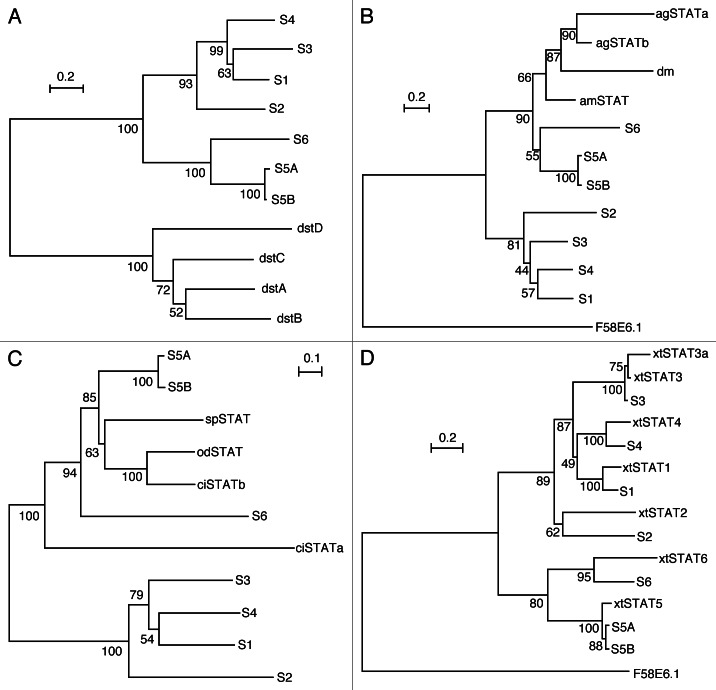
Figure 3. Phylogenetic relationships of STAT proteins. Phylogenetic trees are shown for (A) Dictyostelium, (B) arthropods, (C) deuterostomes and (D) Xenopus.
None
Figure 4. Phylogenetic relationships of fish STAT proteins. Phylogenetic trees are shown for Danio rerio, Fugu rubripes and Tetraodon nigroviridis STAT proteins.

References

    1. Davidson EH, Erwin DH. Gene regulatory networks and the evolution of animal body plans. Science. 2006;311:796–800. doi: 10.1126/science.1113832. - DOI - PubMed
    1. Birney E, Andrews D, Caccamo M, Chen Y, Clarke L, Coates G, et al. Ensembl 2006. Nucleic Acids Res. 2006;34(Database issue):D556–61. doi: 10.1093/nar/gkj133. - DOI - PMC - PubMed
    1. Flicek P, Amode MR, Barrell D, Beal K, Brent S, Carvalho-Silva D, et al. Ensembl 2012. Nucleic Acids Res. 2012;40(Database issue):D84–90. doi: 10.1093/nar/gkr991. - DOI - PMC - PubMed
    1. Gerhart J. 1998 Warkany lecture: signaling pathways in development. Teratology. 1999;60:226–39. doi: 10.1002/(SICI)1096-9926(199910)60:4<226::AID-TERA7>3.0.CO;2-W. - DOI - PubMed
    1. Pires-daSilva A, Sommer RJ. The evolution of signalling pathways in animal development. Nat Rev Genet. 2003;4:39–49. doi: 10.1038/nrg977. - DOI - PubMed