Review
. 2013 Jan 1;2(1):e23060.
doi: 10.4161/jkst.23060.

STAT heterodimers in immunity: A mixed message or a unique signal?

Affiliations
Review

STAT heterodimers in immunity: A mixed message or a unique signal?

Greg M Delgoffe et al. JAKSTAT. .

Abstract

Cytokine signals are essential for generating a robust and specialized immune response. These signals are typically transmitted via canonical STAT homodimers. However, the number of STAT molecules utilized by cytokine signaling cascades within immune cells are limited, and so the mechanism used to deliver complex signals remains elusive. Heterodimerization of STAT proteins is one potential mechanism for signals to be modified downstream of the receptor and may play an important role in dictating the targets of specific cytokine signaling. In this review, we discuss our current understanding of the prevalence of STAT heterodimers, how they are formed and what their physiologic role may be in vivo.

Keywords: STAT; cytokine; heterodimer; homodimer; signaling.


Figures

None
Figure 1. Anatomy of a STAT. STAT proteins in general consist of six domains. Post-translational modifications (PTM) that have been shown to have physiologic relevance are depicted. Note that some STATs (notably STAT5 and STAT6) lack a canonical phosphoserine site, but instead have several non-homologous serines that have varied functions in transcriptional regulation.
None
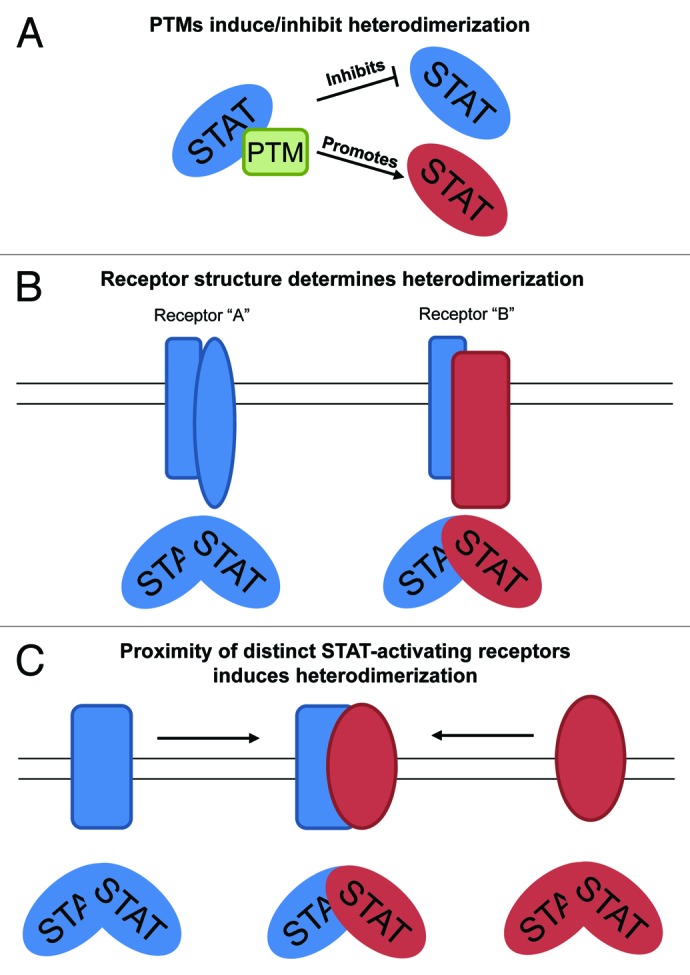
Figure 2. Potential mechanisms of STAT heterodimer formation. (A) As STATs can be extensively post-translationally modified, PTM of STAT proteins may act to inhibit a specific kind of dimerization or promote another. (B) The specific structure of particular cytokine receptors could favor the generation of heterodimers over homodimers. (C) Proximity of subunits that generate distinct STAT molecules could influence heterodimer formation. A cytokine or other cellular event bringing these subunits together could promote the formation of STAT heterodimers.
None
Figure 3. Potential mechanisms of STAT heterodimer function. (A) STAT heterodimers may act as a sink, reducing the pool of available STAT proteins able to homodimerize. (B) STAT heterodimers may act by binding a unique consensus site (green vs orange, in this model), allowing for transcription of alternative gene targets. (C) STAT heterodimers could also function through the recruitment of different transcriptional coactivators/repressors. In this model, the consensus site is not significantly altered, but rather homodimers recruit repressors while heterodimers recruit coactivators.

References

    1. Powell JD, Ragheb JA, Kitagawa-Sakakida S, Schwartz RH. Molecular regulation of interleukin-2 expression by CD28 co-stimulation and anergy. Immunol Rev. 1998;165:287–300. doi: 10.1111/j.1600-065X.1998.tb01246.x. - DOI - PubMed
    1. Ross JA, Nagy ZS, Cheng H, Stepkowski SM, Kirken RA. Regulation of T cell homeostasis by JAKs and STATs. Arch Immunol Ther Exp (Warsz) 2007;55:231–45. doi: 10.1007/s00005-007-0030-x. - DOI - PubMed
    1. Powell JD, Delgoffe GM. The mammalian target of rapamycin: linking T cell differentiation, function, and metabolism. Immunity. 2010;33:301–11. doi: 10.1016/j.immuni.2010.09.002. - DOI - PMC - PubMed
    1. Adamson AS, Collins K, Laurence A, O’Shea JJ. The Current STATus of lymphocyte signaling: new roles for old players. Curr Opin Immunol. 2009;21:161–6. doi: 10.1016/j.coi.2009.03.013. - DOI - PMC - PubMed
    1. Delgoffe GM, Murray PJ, Vignali DA. Interpreting mixed signals: the cell’s cytokine conundrum. Curr Opin Immunol. 2011;23:632–8. doi: 10.1016/j.coi.2011.07.013. - DOI - PMC - PubMed

LinkOut - more resources