. 2013 Sep 23:10:102.
doi: 10.1186/1742-4690-10-102.

HIV-1 envelope glycoprotein signatures that correlate with the development of cross-reactive neutralizing activity

Affiliations

HIV-1 envelope glycoprotein signatures that correlate with the development of cross-reactive neutralizing activity

Tom L G M van den Kerkhof et al. Retrovirology. .

Abstract

Background: Current HIV-1 envelope glycoprotein (Env) vaccines are unable to induce cross-reactive neutralizing antibodies. However, such antibodies are elicited in 10-30% of HIV-1 infected individuals, but it is unknown why these antibodies are induced in some individuals and not in others. We hypothesized that the Envs of early HIV-1 variants in individuals who develop cross-reactive neutralizing activity (CrNA) might have unique characteristics that support the induction of CrNA.

Results: We retrospectively generated and analyzed env sequences of early HIV-1 clonal variants from 31 individuals with diverse levels of CrNA 2-4 years post-seroconversion. These sequences revealed a number of Env signatures that coincided with CrNA development. These included a statistically shorter variable region 1 and a lower probability of glycosylation as implied by a high ratio of NXS versus NXT glycosylation motifs. Furthermore, lower probability of glycosylation at position 332, which is involved in the epitopes of many broadly reactive neutralizing antibodies, was associated with the induction of CrNA. Finally, Sequence Harmony identified a number of amino acid changes associated with the development of CrNA. These residues mapped to various Env subdomains, but in particular to the first and fourth variable region as well as the underlying α2 helix of the third constant region.

Conclusions: These findings imply that the development of CrNA might depend on specific characteristics of early Env. Env signatures that correlate with the induction of CrNA might be relevant for the design of effective HIV-1 vaccines.


Figures
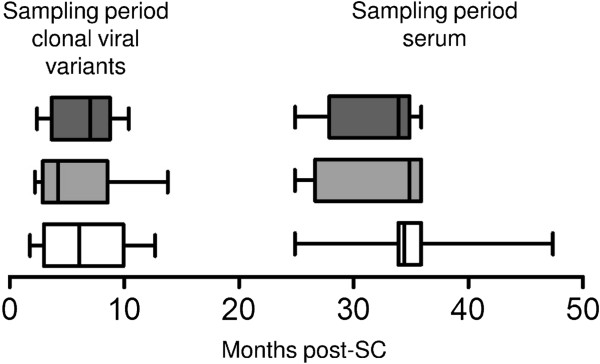
Figure 1
Figure 1
Sampling of viruses and sera. Time bars showing the period in which viruses were isolated and the period in which sera were obtained for assessment of neutralizing activity. The white, grey and dark grey bars represent the individuals with non-CrNA (n=9), intermediate CrNA (n=10) and CrNA (n=12), respectively. The x-axis represents the months post-SC. The box-plots represent the sampling periods with minimum and maximum time points indicated by whiskers. The median time points of virus and sera sampling for the 31 individuals are indicated by solid vertical lines in the boxes.
Figure 2
Figure 2
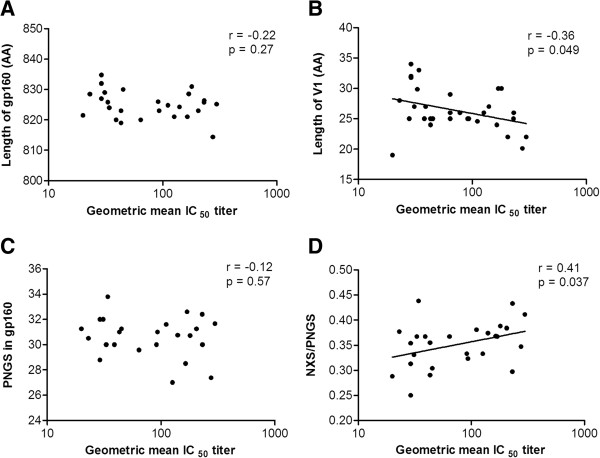
Short V1 sequences and lower probability of overall glycosylation correlate with the development of cross-reactive neutralizing activity. Scatter plots of individual’s geometric mean IC50 titer across the 6 virus panel (x-axis) versus sequence characteristics of the gp160s from clonal virus isolates on the y-axis. (A) length of gp160 in amino acids (AA); (B) length of variable region 1 (V1) in amino acids (AA); (C) total number of PNGS in gp160; (D) number of NXS motifs relative to the total number of PNGS.
Figure 3
Figure 3
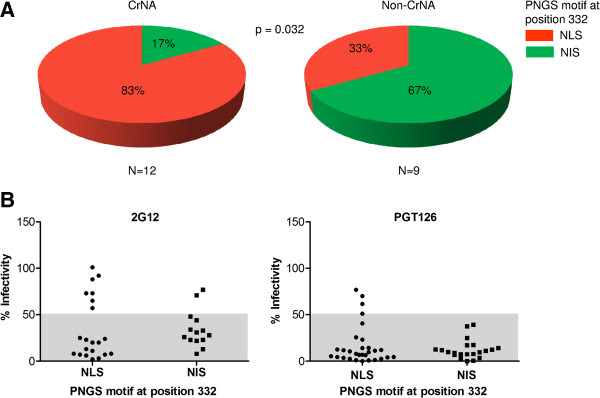
Lower probability of glycosylation at position 332 correlates with the induction of cross-reactive neutralizing activity. (A) Pie charts representing the distribution of NLS and NIS PNGS motifs at position 332 between 12 individuals who developed and 9 individuals who did not develop CrNA. Red and green represent NLS and NIS motifs, respectively. (B) Residual virus infectivity in the presence of high concentrations of 2G12 (25 μg/ml), excluding viruses lacking one or more of the essential 2G12 glycans 295, 332, 386 or 392 [61,62,85], for virus clones that have NLS or NIS motif. (C) Residual virus infectivity in the presence of high concentrations of PGT126 (5 μg/ml), for virus clones that have NLS or NIS motifs. Values in the gray area are considered sensitive, while values in the white area are considered resistant.
Figure 4
Figure 4
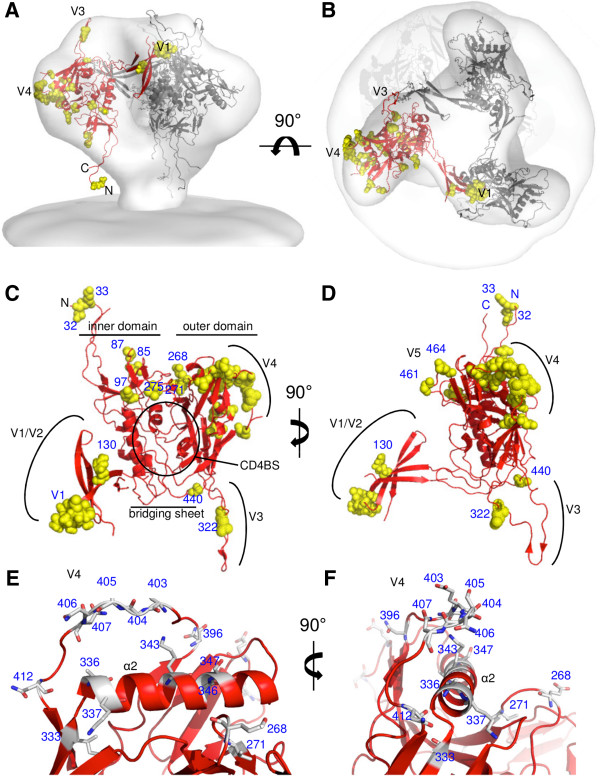
Three dimensional clustering of amino acid positions that differ between individuals that induce CrNA and those that do not. Side (A) and top (B) views of the Env spike. The structures of three gp120 protomers, including the entire gp120 sequence and modeled as described in the Methods section, were fitted into the cry-EM density of the virus-associated Env spike [87]. A backbone trace of one protomer is colored in red and the positions revealed by SH are indicated in yellow space filling in the same protomer. (C, D). Model of gp120 with the same color-code as in A and B. Various Env subdomains are indicated in black font. Residues identified by SH are labeled in blue. The views are from the approach of CD4 (C) or rotated by 90° over the y-axis (D). The viral membrane would be at the top and the target membrane at the bottom. (E, F). Details of the V4 domain and its association with the α2 helix of the C3 domain. The residues identified by SH are indicated in sticks.
Figure 5
Figure 5
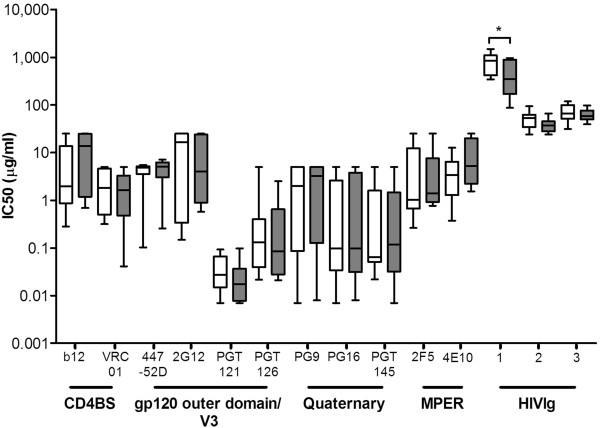
Sensitivity to bNAbs does not correlate with the induction of cross-reactive neutralizing activity. Sensitivity to neutralization by b12, VRC01, 447-52D, 2G12, PGT121, PGT126, PG9, PG16, PGT145, 2F5 and 4E10 and polyclonal HIVIg (three different sera pools) of viral variants obtained from 12 individuals who developed CrNA (grey bars) and 9 individuals who did not develop CrNA (white bars). Median IC50 values per individual per bNAb or HIVIg as determined by linear regression are used and differences were considered statistically significant when P values were ≤ 0.05, represented by an asterix. The bNAbs are ordered from left to right according to their epitope cluster.

References

    1. Kim JH, Rerks-Ngarm S, Excler JL, Michael NL. HIV vaccines: lessons learned and the way forward. Curr Opin HIV AIDS. 2010;5:428–434. - PMC - PubMed
    1. Belshe RB, Graham BS, Keefer MC, Gorse GJ, Wright P, Dolin R, Matthews T, Weinhold K, Bolognesi DP, Sposto R. et al. Neutralizing antibodies to HIV-1 in seronegative volunteers immunized with recombinant gp120 from the MN strain of HIV-1. NIAID AIDS Vaccine Clinical Trials Network. JAMA. 1994;272:475–480. - PubMed
    1. Mascola JR, Snyder SW, Weislow OS, Belay SM, Belshe RB, Schwartz DH, Clements ML, Dolin R, Graham BS, Gorse GJ. et al. Immunization with envelope subunit vaccine products elicits neutralizing antibodies against laboratory-adapted but not primary isolates of human immunodeficiency virus type 1. J Infect Dis. 1996;173:340–348. - PubMed
    1. Pitisuttithum P, Berman PW, Phonrat B, Suntharasamai P, Raktham S, Srisuwanvilai LO, Hirunras K, Kitayaporn D, Kaewkangwal J, Migasena S. et al. Phase I/II study of a candidate vaccine designed against the B and E subtypes of HIV-1. J Acquir Immune Defic Syndr. 2004;37:1160–1165. - PubMed
    1. Rerks-Ngarm S, Pitisuttithum P, Nitayaphan S, Kaewkungwal J, Chiu J, Paris R, Premsri N, Namwat C, de Souza M, Adams E. et al. Vaccination with ALVAC and AIDSVAX to Prevent HIV-1 Infection in Thailand. N Engl J Med. 2009;361:2209–2220. - PubMed

Publication types

MeSH terms

Substances

LinkOut - more resources