Housing stability, residential transience, and HIV testing among low-income urban African Americans
- PMID: 24059880
- PMCID: PMC4116750
- DOI: 10.1521/aeap.2013.25.5.430
Housing stability, residential transience, and HIV testing among low-income urban African Americans
Abstract
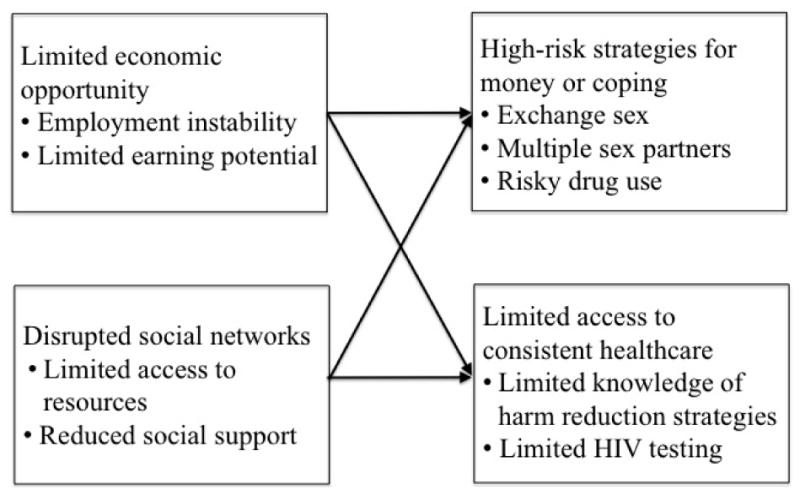
The association between housing and HIV has been widely demonstrated, although inquiry into HIV testing has been largely limited to the homeless. This study examines correlates of HIV testing within the past 6 months with housing stability and residential transience (moving two or more times in the past 6 months) among 620 low-income urban African Americans. Unstably housed and transient participants were more likely to participate in high-risk sex behaviors than stably housed participants and non-transient participants, respectively. In multivariate analyses, residential transience was positively associated with recent HIV testing; however, persons unstably housed were not more likely to have recently been tested for HIV despite their increased vulnerability and risk. While structural interventions are necessary to address the HIV disparities related to housing, increased community-based and mobile testing centers may be able to improve access to HIV testing among unstably housed.
Figures
References
-
- Aday L. At risk in America: The health and health needs of vulnerable populations in the United States. San Fransisco, CA: Jossey-Bass; 2001.
-
- Adimora AA, Schoenbach VJ. Social context, sexual networks, and racial disparities in rates of sexually transmitted infections. J Infect Dis. 2005;191(Suppl 1):S115–S122. - PubMed
-
- Aidala AA, Cross JE, Stall R, Harre D, Sumartojo E. Housing status and HIV risk behaviors: Implications for prevention and policy. AIDS & Behavior. 2005;9(3):251–256. - PubMed
-
- Aidala AA, Lee G, Garbers S, Chiasson MA. Sexual behaviors and sexual risk in a prospective cohort of HIV-positive men and women in New York City, 1994-2002: implications for prevention. AIDS Education and Prevention. 2006;18(1):12–32. - PubMed
-
- Aidala AA, Sumartojo E. Why housing? AIDS & Behavior. 2007;11(Suppl 2):S1–S6. - PubMed
Publication types
MeSH terms
Grants and funding
LinkOut - more resources
Full Text Sources
Other Literature Sources
Medical
Miscellaneous