


A non-pharmacologic approach to address challenging behaviors of Veterans with dementia: description of the tailored activity program-VA randomized trial
- PMID: 24060106
- PMCID: PMC3852524
- DOI: 10.1186/1471-2318-13-96
A non-pharmacologic approach to address challenging behaviors of Veterans with dementia: description of the tailored activity program-VA randomized trial
Abstract
Background: Behavioral symptoms accompanying dementia are associated with increased health care costs, reduced quality of life and daily functioning, heightened family caregiver burden, and nursing home placement. Standard care typically involves pharmacologic agents, but these are, at best, modestly effective, carry serious risks, including mortality, and do not address behavioral symptoms families consider most distressful and which may prompt nursing home placement. Given dementia's devastating effects and the absence of an imminent cure, the Veterans Administration has supported the development and testing of new approaches to manage challenging behaviors at home.
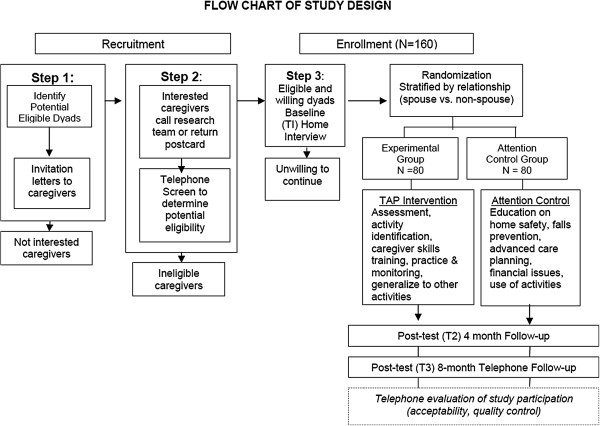
Methods/design: The Tailored Activity Program - Veterans Administration is a Phase III efficacy trial designed to reduce behavioral symptoms in Veterans with dementia living with their caregivers in the community. The study uses a randomized two-group parallel design with 160 diverse Veterans and caregivers. The experimental group receives a transformative patient-centric intervention designed to reduce the burden of behavioral symptoms in Veterans with dementia. An occupational therapist conducts an assessment to identify a Veteran's preserved capabilities, deficit areas, previous roles, habits, and interests to develop activities tailored to the Veteran. Family caregivers are then trained to incorporate activities into daily care. The attention-control group receives bi-monthly telephone contact where education on topics relevant to dementia is provided to caregivers. Key outcomes include reduced frequency and severity of behavioral symptoms using the 12-item Neuropsychiatric Inventory (primary endpoint), reduced caregiver burden, enhanced skill acquisition, efficacy using activities, and time spent providing care at 4 months; and long-term effects (8 months) on the Veteran's quality of life and frequency and severity of behavioral symptoms, and caregiver use of activities. The programs' impact of Veterans Administration cost is also examined. Study precision will be increased through face-to-face research team trainings with procedural manuals and review of audio-taped interviews and intervention sessions.
Discussion: The Tailored Activity Program - Veterans Administration is designed to improve the quality of life of Veterans with dementia and lessen the burden of care on caregivers. Activities are tailored to reflect the Veteran's preserved capabilities and interests to enhance active engagement, while not taxing areas of cognition that are most impaired.
Trial registration: ClinicalTrials.gov NCT01357564.
References
-
- Alzheimers Association. 2013 Alzheimer’s disease facts and figures. Retrieved May 28, 2013, from http://www.alz.org/documents_custom/2013_facts_figures_fact_sheet.pdf.
Publication types
MeSH terms
Associated data
LinkOut - more resources
Full Text Sources
Other Literature Sources
Medical
