


Proton pump inhibitors and risk for recurrent Clostridium difficile infection among inpatients
- PMID: 24060760
- PMCID: PMC3966060
- DOI: 10.1038/ajg.2013.333
Proton pump inhibitors and risk for recurrent Clostridium difficile infection among inpatients
Abstract
Objectives: Observational studies suggest that proton pump inhibitors (PPIs) are a risk factor for incident Clostridium difficile infection (CDI). Data also suggest an association between PPIs and recurrent CDI, although large-scale studies focusing solely on hospitalized patients are lacking. We therefore performed a retrospective cohort analysis of inpatients with incident CDI to assess receipt of PPIs as a risk factor for CDI recurrence in this population.
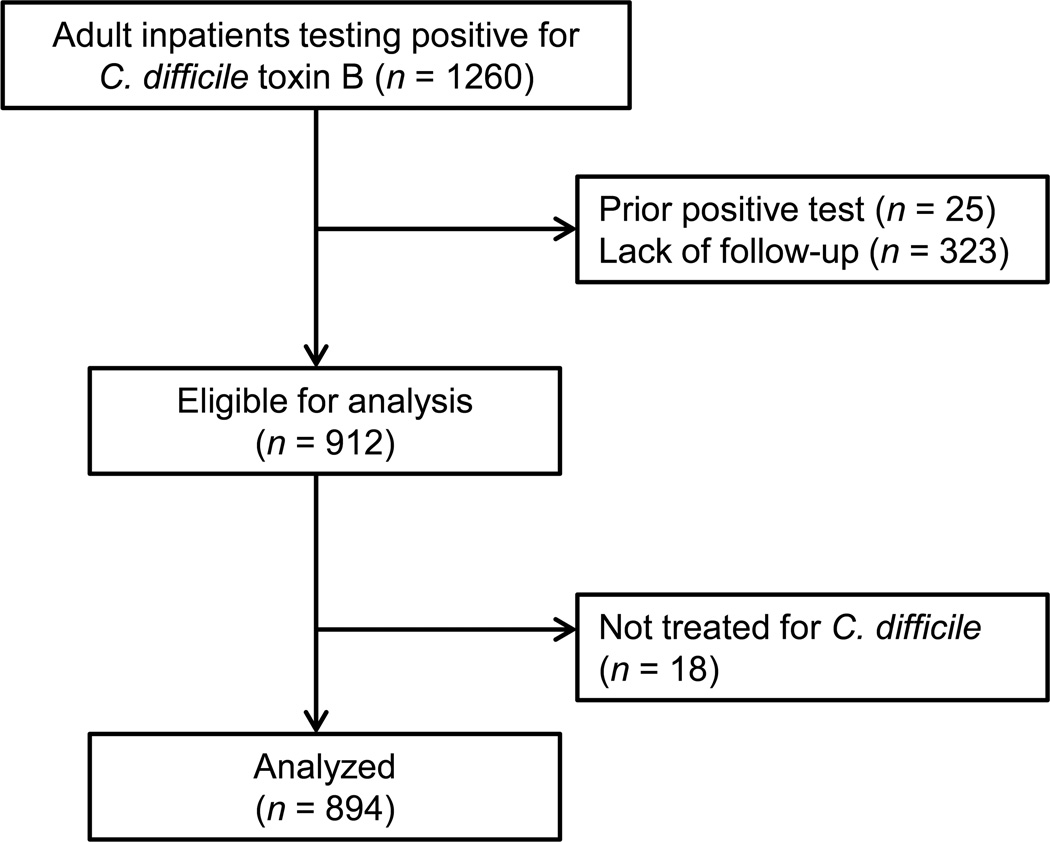
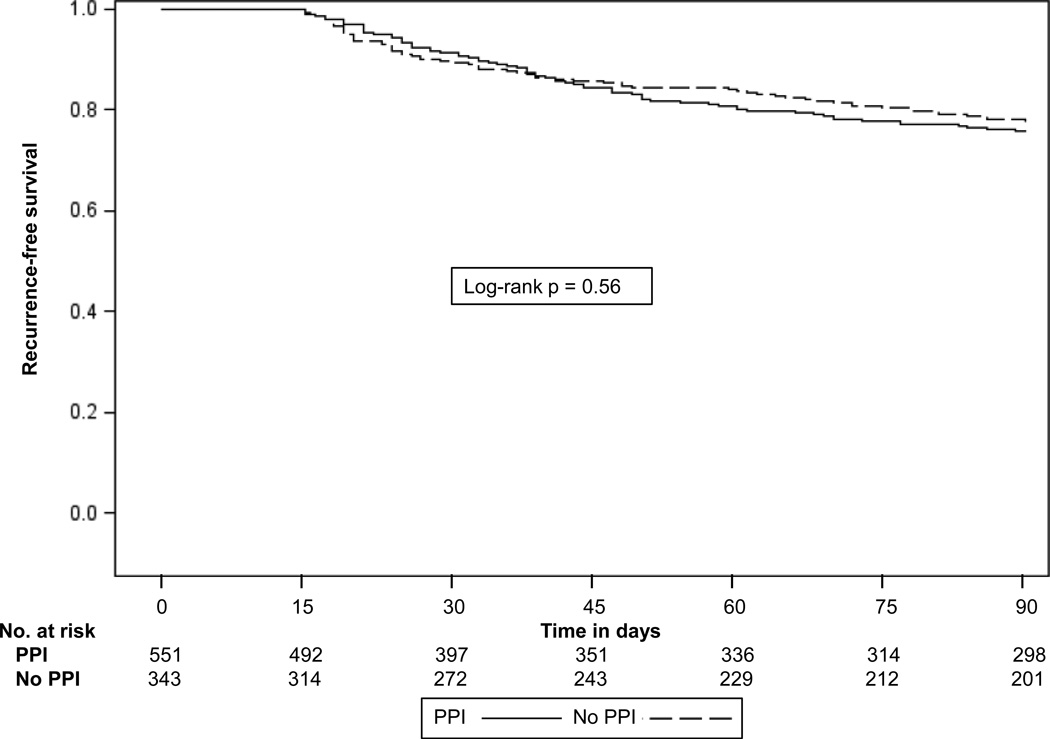
Methods: Using electronic medical records, we identified hospitalized adult patients between 1 December 2009 and 30 June 2012 with incident CDI, defined as a first positive stool test for C. difficile toxin B and who received appropriate treatment. Electronic records were parsed for clinical factors including receipt of PPIs, other acid suppression, non-CDI antibiotics, and comorbidities. The primary exposure was in-hospital PPIs given concurrently with C. difficile treatment. Recurrence was defined as a second positive stool test 15-90 days after the initial positive test. C. difficile recurrence rates in the PPI exposed and unexposed groups were compared with the log-rank test. Multivariable Cox proportional hazards modeling was performed to control for demographics, comorbidities, and other clinical factors.
Results: We identified 894 inpatients with incident CDI. The cumulative incidence of CDI recurrence in the cohort was 23%. Receipt of PPIs concurrent with CDI treatment was not associated with C. difficile recurrence (hazard ratio (HR)=0.82; 95% confidence interval (CI)=0.58-1.16). Black race (HR=1.66, 95% CI=1.05-2.63), increased age (HR=1.02, 95% CI=1.01-1.03), and increased comorbidities (HR=1.09, 95% CI=1.04-1.14) were associated with CDI recurrence. In light of a higher 90-day mortality seen among those who received PPIs (log-rank P=0.02), we also analyzed the subset of patients who survived to 90 days of follow-up. Again, there was no association between PPIs and CDI recurrence (HR=0.87; 95% CI=0.60-1.28). Finally, there was no association between recurrent CDI and increased duration or dose of PPIs.
Conclusions: Among hospitalized adults with C. difficile, receipt of PPIs concurrent with C. difficile treatment was not associated with CDI recurrence. Black race, increased age, and increased comorbidities significantly predicted recurrence. Future studies should test interventions to prevent CDI recurrence among high-risk inpatients.
Conflict of interest statement
Figures
Comment in
-
Editorial: PPIs and recurrent C. difficile infection: no association?Am J Gastroenterol. 2013 Nov;108(11):1802-3. doi: 10.1038/ajg.2013.365. Am J Gastroenterol. 2013. PMID: 24192949
-
Re: proton pump inhibitors and risk for recurrent Clostridium difficile infection among inpatients.Am J Gastroenterol. 2014 Apr;109(4):601-2. doi: 10.1038/ajg.2013.481. Am J Gastroenterol. 2014. PMID: 24698870 No abstract available.
-
Response to Abdallah et al.Am J Gastroenterol. 2014 Apr;109(4):602-3. doi: 10.1038/ajg.2013.483. Am J Gastroenterol. 2014. PMID: 24698871 No abstract available.
-
Aggression of C-difficile infections in PPI consumers.Am J Gastroenterol. 2014 Jun;109(6):922. doi: 10.1038/ajg.2014.87. Am J Gastroenterol. 2014. PMID: 24896760 No abstract available.
-
Response to Daniell.Am J Gastroenterol. 2014 Jun;109(6):922-3. doi: 10.1038/ajg.2014.91. Am J Gastroenterol. 2014. PMID: 24896761 No abstract available.
References
-
- Yang YX, Metz DC. Safety of proton pump inhibitor exposure. Gastroenterology. 2010;139:1115–1127. - PubMed
-
- Janarthanan S, Ditah I, Adler DG, et al. Clostridium difficile-associated diarrhea and proton pump inhibitor therapy: a meta-analysis. Am J Gastroenterol. 2012;107:1001–1010. - PubMed
-
- Kwok CS, Arthur AK, Anibueze CI, et al. Risk of Clostridium difficile infection with acid suppressing drugs and antibiotics: meta-analysis. Am J Gastroenterol. 2012;107:1011–1019. - PubMed
-
- IMS Health NSP. [Accessed January 24, 2013];2012 Feb 23; http://www.imshealth.com/ims/Global/Content/Corporate/Press%20Room/Top-L....
Publication types
MeSH terms
Substances
Grants and funding
LinkOut - more resources
Full Text Sources
Other Literature Sources
