Clinical Trial
. 2013 Dec;27(10):898-906.
doi: 10.1007/s12149-013-0768-7. Epub 2013 Sep 6.

Prediction of outcomes in MCI with (123)I-IMP-CBF SPECT: a multicenter prospective cohort study

Affiliations
Clinical Trial

Prediction of outcomes in MCI with (123)I-IMP-CBF SPECT: a multicenter prospective cohort study

Kengo Ito et al. Ann Nucl Med. 2013 Dec.

Abstract

Objective: The multicenter prospective cohort study (Japan Cooperative SPECT Study on Assessment of Mild Impairment of Cognitive Function: J-COSMIC) aimed to examine the value of (123)I-N-isopropyl-4-iodoamphetamine cerebral blood flow (IMP-CBF) SPECT in regards to early diagnosis of Alzheimer's disease (AD) in patients with mild cognitive impairment (MCI).

Methods: Three hundred and nineteen patients with amnestic MCI at 41 participating institutions each underwent clinical and neuropsychological examinations and (123)I-IMP-CBF SPECT at baseline. Subjects were followed up periodically for 3 years, and progression to dementia was evaluated. SPECT images were classified as AD/DLB (dementia with Lewy bodies) pattern and non-AD/DLB pattern by central image interpretation and automated region of interest (ROI) analysis, respectively. Logistic regression analyses were used to assess whether baseline (123)I-IMP-CBF SPECT was predictive of longitudinal clinical outcome.

Results: Ninety-nine of 216 amnestic MCI patients (excluding 3 cases with epilepsy (n = 2) or hydrocephalus (n = 1) and 100 cases with incomplete follow-up) converted to AD within the observation period. Central image interpretation and automated ROI analysis predicted conversion to AD with 56 and 58 % overall diagnostic accuracy (sensitivity, 76 and 81 %; specificity, 39 and 37 %), respectively. Multivariate logistic regression analysis identified SPECT as a predictor, which distinguished AD converters from non-converters. The odds ratio for a positive SPECT to predict conversion to AD with automated ROI analysis was 2.5 and combining SPECT data with gender and mini-mental state examination (MMSE) further improved classification (joint odds ratio 20.08).

Conclusions: (123)I-IMP-CBF SPECT with both automated ROI analysis and central image interpretation was sensitive but relatively nonspecific for prediction of clinical outcome during the 3-year follow-up in individual amnestic MCI patients. A combination of statistically significant predictors, both SPECT with automated ROI analysis and neuropsychological evaluation, may increase predictive utility.


Figures
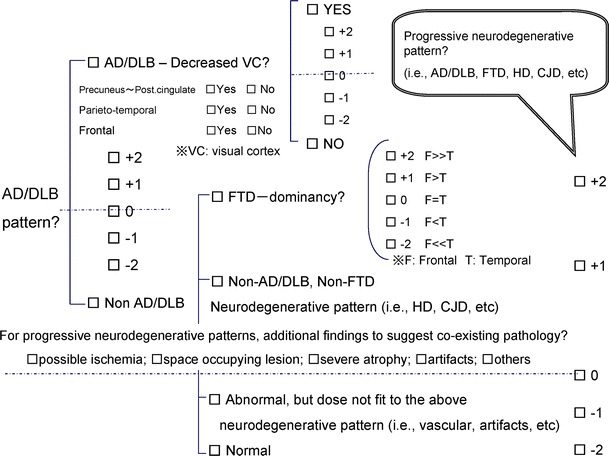
Fig. 1
Fig. 1
Check sheet used for the central image interpretation. Each expert was asked to report the findings on SPECT images and 3D-SSP Z score maps based on this diagnostic tree. First, the images were classified into AD/DLB pattern and non-AD/DLB pattern with confidence rating, and then sub-classified in each category. Additional findings to suggest co-existing pathology were also reported
Fig. 2
Fig. 2
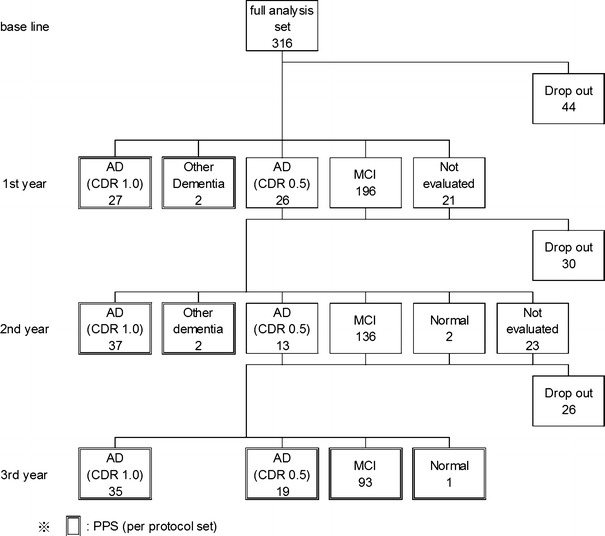
Schematic summary of clinical outcomes in all MCI cases. Originally, 316 patients with MCI were included. A total of 100 patients were dropped out during 3 years. Our final sample size for the analyses of SPECT images was 214 patients excluding 4 patients who converted to other dementia
Fig. 3
Fig. 3
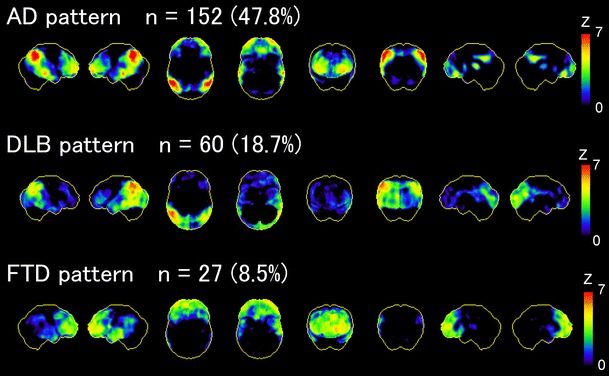
3D-SSP Z score maps showing hypoperfusion in the progressive neurodegenerative pattern groups (AD, DLB and FTD pattern groups) compared to the normal pattern group. Numbers of each pattern indicate number of cases classified by central image interpretation. From left to right: 3D-SSP maps are shown on the right and left lateral views, superior and inferior views, anterior and posterior views, and right and left middle views of a standardized brain image
Fig. 4
Fig. 4
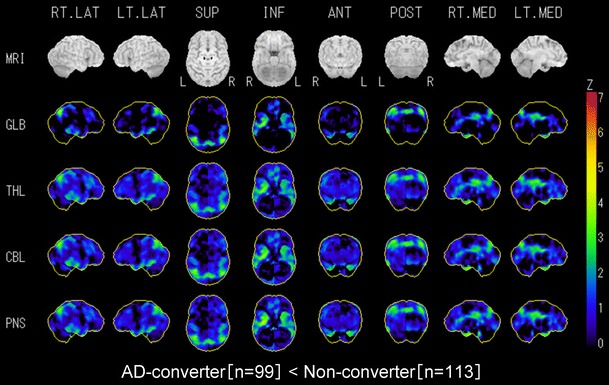
3D-SSP Z score maps showing hypoperfusion in AD converters compared to non-converters. Hypoperfusion is observed in the regions affected typically in AD, but not prominent. It may be caused by the existence of cases showing AD pattern in non-converters. From left to right: 3D-SSP maps are shown on the right and left lateral views, superior and inferior views, anterior and posterior views, and right and left middle views of a standardized brain image

References

    1. Doody RS, Ferris SH, Salloway S, Sun Y, Goldman R, Watkins WE, et al. Donepezil treatment of patients with MCI: a 48-week randomized, placebo-controlled trial. Neurology. 2009;72:1555–1561. doi: 10.1212/01.wnl.0000344650.95823.03. - DOI - PubMed
    1. Salloway S, Ferris S, Kluger A, Goldman R, Griesing T, Kumar D, et al. Efficacy of donepezil in mild cognitive impairment: a randomized placebo-controlled trial. Neurology. 2004;63:651–657. doi: 10.1212/01.WNL.0000134664.80320.92. - DOI - PubMed
    1. Petersen RC, Thomas RG, Grundman M, Bennett D, Doody R, Ferris S, et al. Vitamin E and donepezil for the treatment of mild cognitive impairment. N Engl J Med. 2005;352:2379–2388. doi: 10.1056/NEJMoa050151. - DOI - PubMed
    1. Petersen RC. Mild cognitive impairment as a diagnostic entity. J Intern Med. 2004;256:183–194. doi: 10.1111/j.1365-2796.2004.01388.x. - DOI - PubMed
    1. Luis CA, Lowenstein DA, Acevedo A, Barker WW, Duara R. Mild cognitive impairment: directions for future research. Neurology. 2003;61:438–444. doi: 10.1212/01.WNL.0000080366.90234.7F. - DOI - PubMed

LinkOut - more resources