


Development of deactivation of the default-mode network during episodic memory formation
- PMID: 24064072
- PMCID: PMC4175451
- DOI: 10.1016/j.neuroimage.2013.09.032
Development of deactivation of the default-mode network during episodic memory formation
Abstract
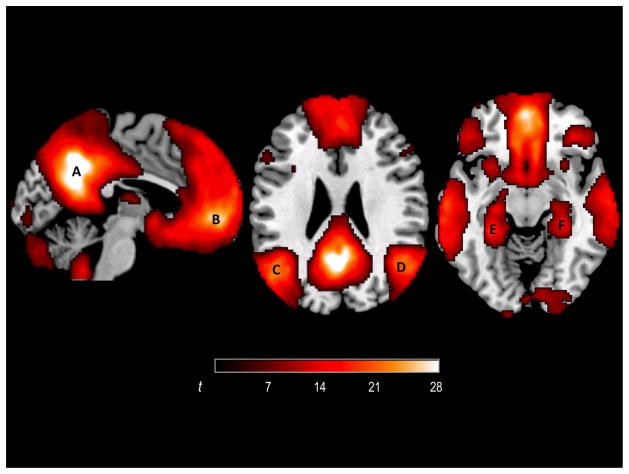
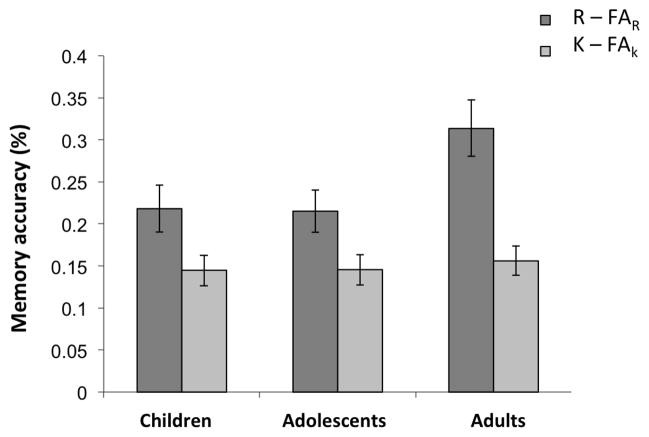
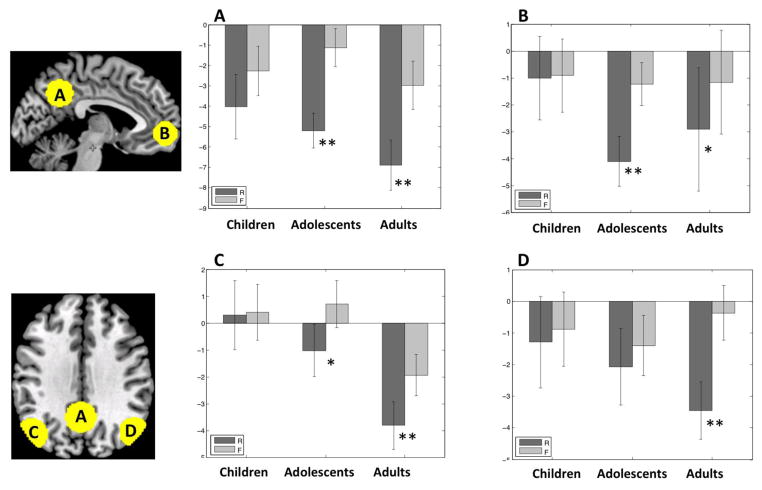
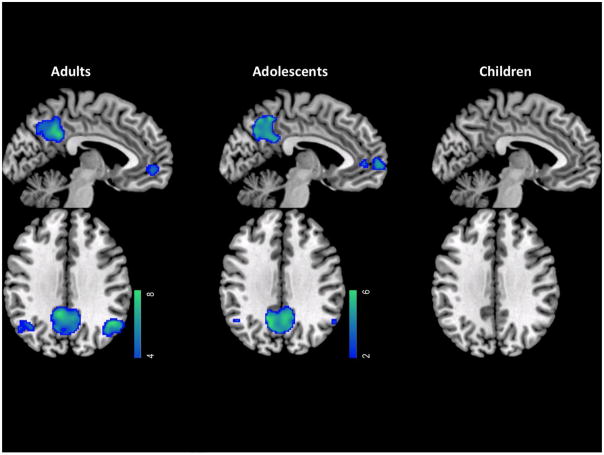
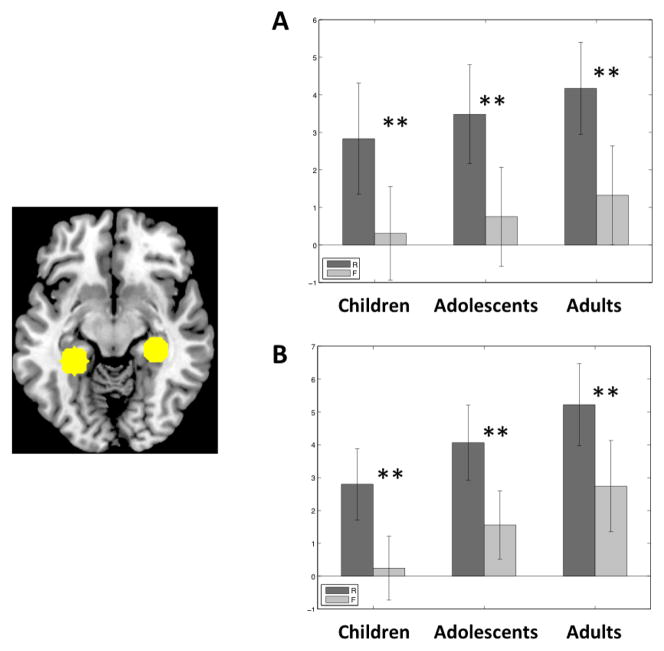
Task-induced deactivation of the default-mode network (DMN) has been associated in adults with successful episodic memory formation, possibly as a mechanism to focus allocation of mental resources for successful encoding of external stimuli. We investigated developmental changes of deactivation of the DMN (posterior cingulate, medial prefrontal, and bilateral lateral parietal cortices) during episodic memory formation in children, adolescents, and young adults (ages 8-24), who studied scenes during functional magnetic resonance imaging (fMRI). Recognition memory improved with age. We defined DMN regions of interest from a different sample of participants with the same age range, using resting-state fMRI. In adults, there was greater deactivation of the DMN for scenes that were later remembered than scenes that were later forgotten. In children, deactivation of the default-network did not differ reliably between scenes that were later remembered or forgotten. Adolescents exhibited a pattern of activation intermediate to that of children and adults. The hippocampal region, often considered part of the DMN, showed a functional dissociation with the rest of the DMN by exhibiting increased activation for later remembered than later forgotten scene that was similar across age groups. These findings suggest that development of memory ability from childhood through adulthood may involve increased deactivation of the neocortical DMN during learning.
Keywords: Children; Memory encoding; Resting-state fMRI; Task suppression; fMRI.
© 2013.
Figures
References
-
- Brewer JB, Zhao Z, Desmond JE, Glover GH, Gabrieli JD. Making memories: brain activity that predicts how well visual experience will be remembered. Science. 1998;281:1185–1187. - PubMed
-
- Buckner RL, Andrews-Hanna JR, Schacter DL. The brain’s default network: anatomy, function, and relevance to disease. Ann N Y Acad Sci. 2008;1124:1–38. - PubMed
Publication types
MeSH terms
Grants and funding
LinkOut - more resources
Full Text Sources
Other Literature Sources
