


Expanding assessments of translational research programs: supplementing metrics with value judgments
- PMID: 24064429
- PMCID: PMC4012871
- DOI: 10.1177/0163278713500984
Expanding assessments of translational research programs: supplementing metrics with value judgments
Abstract
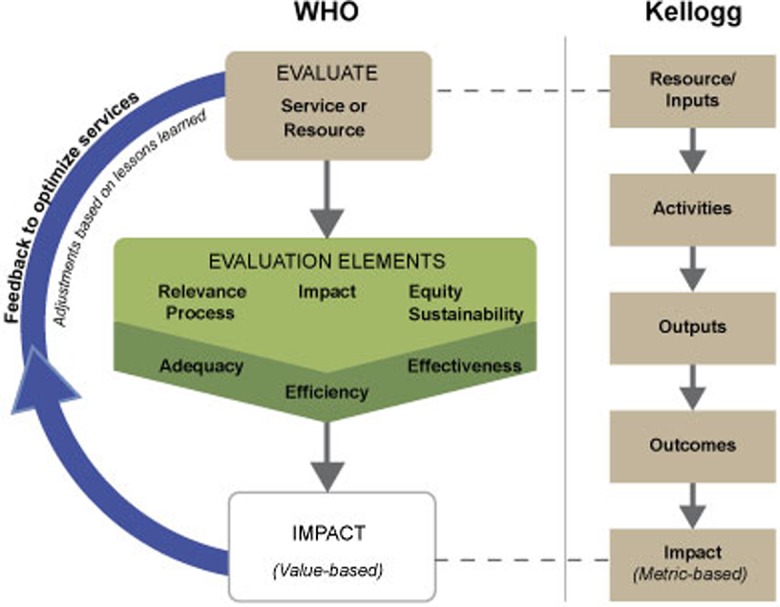
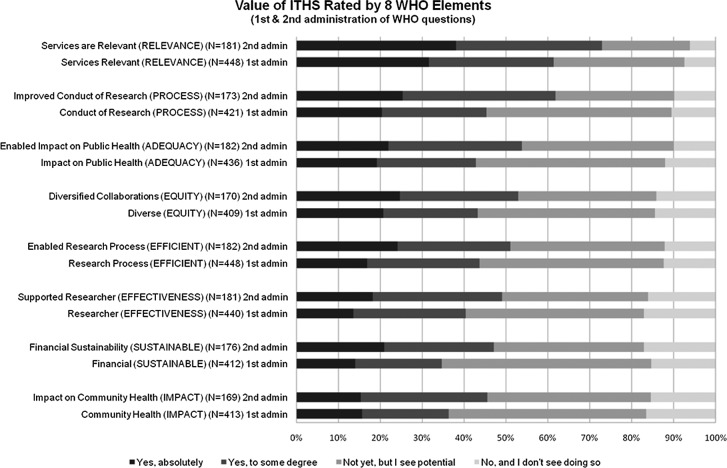
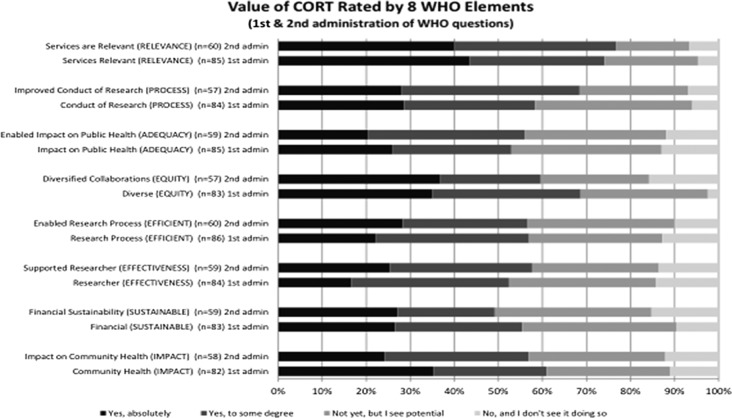
The University of Washington (UW) Institute for Translational Health Sciences (ITHS), funded by a Clinical and Translational Sciences Award program, has supplemented its initial Kellogg Logic Model-based program evaluation with the eight judgment-based evaluative elements of the World Health Organization's (WHO) Health Services Assessment Model. This article describes the relationship between the two models, the rationale for the decision to supplement the evaluation with WHO evaluative elements, the value-added results of the WHO evaluative elements, and plans for further developing the WHO assessments.
Keywords: CTSA program evaluation; WHO Health Services Assessment Model; WHO evaluative elements; health research; logic models; translational science.
Conflict of interest statement
Figures
References
-
- Carter R. K. (1971). Clients' resistance to negative findings and the latent conservative function of evaluation studies. The American Sociologist, 6, 118–124
-
- Drew C. H., Duivenboden J. V., Bonnefoy X. (2000). Environmental health services in Europe No. 5: Guidelines for evaluation of environmental health services (European Series, No. 90, 2000) Retrieved from http://www.euro.who.int/__data/assets/pdf_file/0003/98292/E71502.pdf - PubMed
Publication types
MeSH terms
Grants and funding
LinkOut - more resources
Full Text Sources
Other Literature Sources
Miscellaneous
