


Modulation of motor cortex excitability in obsessive-compulsive disorder: an exploratory study on the relations of neurophysiology measures with clinical outcome
- PMID: 24064461
- PMCID: PMC7325264
- DOI: 10.1016/j.psychres.2013.08.054
Modulation of motor cortex excitability in obsessive-compulsive disorder: an exploratory study on the relations of neurophysiology measures with clinical outcome
Abstract
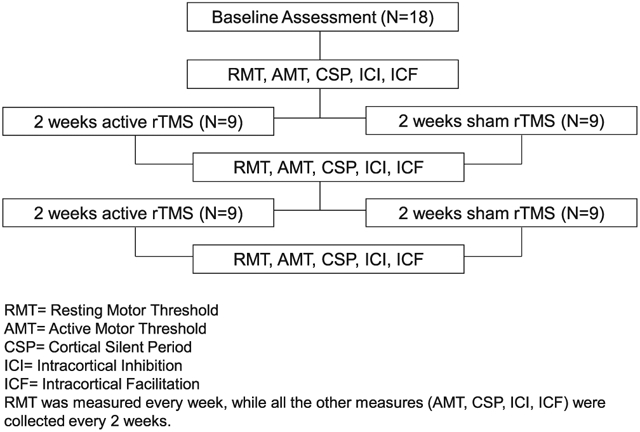
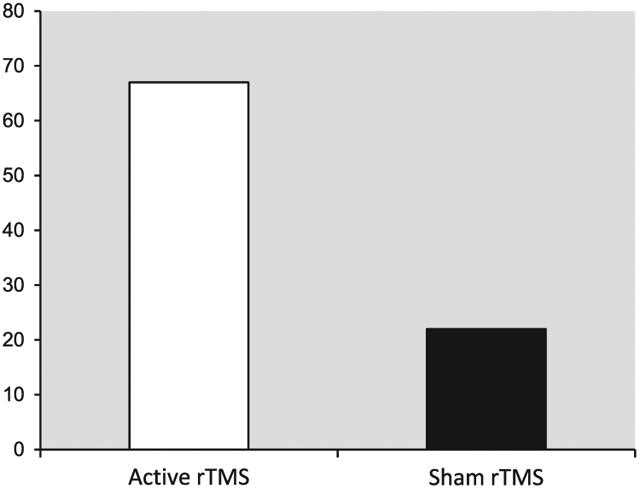
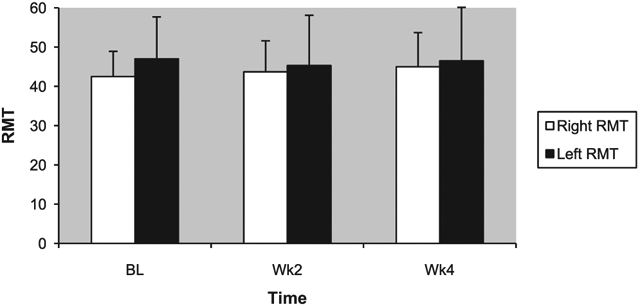
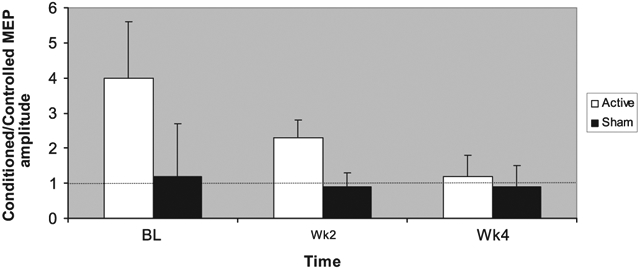
Low-frequency repetitive transcranial magnetic stimulation (rTMS) to supplementary motor area (SMA) showed clinical benefit in obsessive-compulsive disorder (OCD). Here we tested whether clinical improvement was associated with enhanced cortical inhibition as measured by single and paired-pulse TMS variables. In 18 OCD patients receiving 4 weeks of either active or sham rTMS in a double-blind randomized trial, we assessed bilateral resting and active motor thresholds (RMT and AMT), cortical silent period (CSP), short-interval intracortical inhibition (SICI) and intracortical facilitation (ICF). We tested correlations between changes in Yale-Brown Obsessive Compulsive Scale-Self-report (Y-BOCS-SR), Clinical Global Impression-Severity subscale (CGI-S) and cortical excitability measures. Active rTMS increased right hemisphere RMT whose change correlated with Y-BOCS-SR improvement. Baseline RMT hemispheric asymmetry, defined as the difference between left and right hemispheres RMT, and its normalization after active rTMS correlated with Y-BOCS-SR and CGI-S improvements. Active rTMS also increased right hemisphere SICI whose change correlated with Y-BOCS-SR and CGI-S at week 4, and with normalization of baseline RMT hemispheric asymmetry. Treatment-induced changes in cortical excitability measures are consistent with an inhibitory action of SMA rTMS on dysfunctional motor circuits in OCD. Correlations of neurophysiology measures with therapeutic outcome are supportive of the role of SMA in the modulation of OCD symptoms.
Keywords: Cortical silent period; Intracortical facilitation; Motor threshold; Obsessive-compulsive disorder; Short-interval intracortical inhibition; Supplementary motor area; Transcranial magnetic stimulation.
Copyright © 2013 Elsevier Ireland Ltd. All rights reserved.
Figures
References
-
- Baer L, Brown-Beasley MW, Sorce J, Henriques AI, 1993. Computer-assisted telephone administration of a structured interview for obsessive-compulsive disorder. American Journal of Psychiatry 150, 1737–1738. - PubMed
-
- Bäumer T, Schippling S, Kroeger J, Zittel S, Koch G, Thomalla G, Rothwell JC, Siebner HR, Orth M, Münchau A, 2009. Inhibitory and facilitatory connectivity from ventral premotor to primary motor cortex in healthy humans at rest—a bifocal TMS study. Clinical Neurophysiology 120, 1724–1731. - PubMed
-
- Bestmann S, Baudewig J, Siebner HR, Rothwell JC, Frahm J, 2005. BOLD MRI responses to repetitive TMS over human dorsal premotor cortex. Neuroimage 28, 22–29. - PubMed
-
- Brasil-Neto JP, Cammarota J, Valls-Sole J, Pascual-Leone A, Hallett M, Cohen LG, 1995. Role of intracortical mechanisms in the late part of the silent period to transcranial stimulation of the human motor cortex. Acta Neurologica Scandinavia 92, 383–386. - PubMed
Publication types
MeSH terms
Grants and funding
LinkOut - more resources
Full Text Sources
Other Literature Sources
Medical
Research Materials
