


RNAtomy of the Spliceosome's heart
- PMID: 24065126
- PMCID: PMC3817464
- DOI: 10.1038/emboj.2013.213
RNAtomy of the Spliceosome's heart
Abstract
The EMBO J 32: 2804–2818 ; DOI: 10.1038/emboj.2013.198; published online September 03 2013
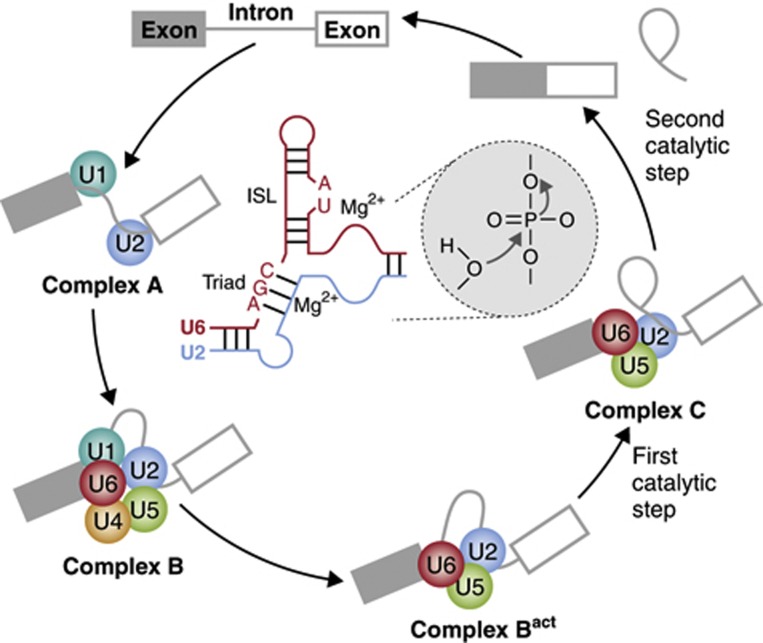
In his 1543 monumental work De humanis corpori fabrica, Andreas Vesalius used rigorous dissection practices and a mechanistic view of the organ’s function to provide the first accurate anatomical description of a human heart. Guided by similar principles of meticulous structural probing and mechanistic explanatory potential, Anokhina and colleagues in this issue of The EMBO Journal dissect the molecular topology of the RNA heart of the Spliceosome, the ribonucleoprotein machinery in charge of intron removal. Their findings reveal key structural features with important implications for understanding the mechanisms of pre-mRNA splicing catalysis.
Conflict of interest statement
The authors declare that they have no conflict of interest.
Figures
Comment on
-
RNA structure analysis of human spliceosomes reveals a compact 3D arrangement of snRNAs at the catalytic core.EMBO J. 2013 Oct 30;32(21):2804-18. doi: 10.1038/emboj.2013.198. Epub 2013 Sep 3. EMBO J. 2013. PMID: 24002212 Free PMC article.
References
-
- Madhani HD, Guthrie C (1992) A novel base-pairing interaction between U2 and U6 snRNAs suggests a mechanism for the catalytic activation of the spliceosome. Cell 71: 803–817 - PubMed
Publication types
MeSH terms
Substances
LinkOut - more resources
Full Text Sources
Other Literature Sources
