


Patterns of rotavirus vaccine uptake and use in privately-insured US infants, 2006-2010
- PMID: 24066076
- PMCID: PMC3774785
- DOI: 10.1371/journal.pone.0073825
Patterns of rotavirus vaccine uptake and use in privately-insured US infants, 2006-2010
Abstract
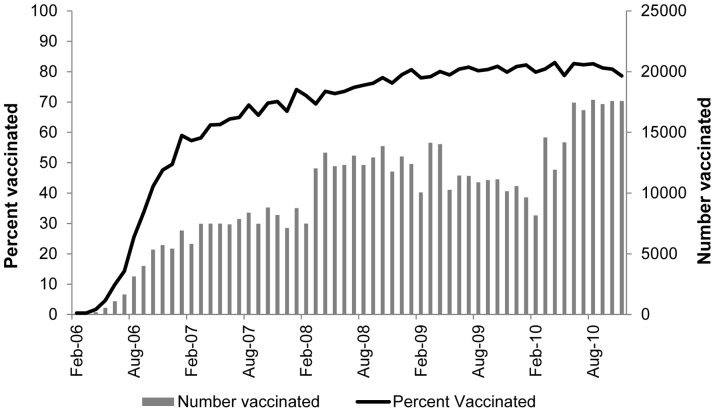
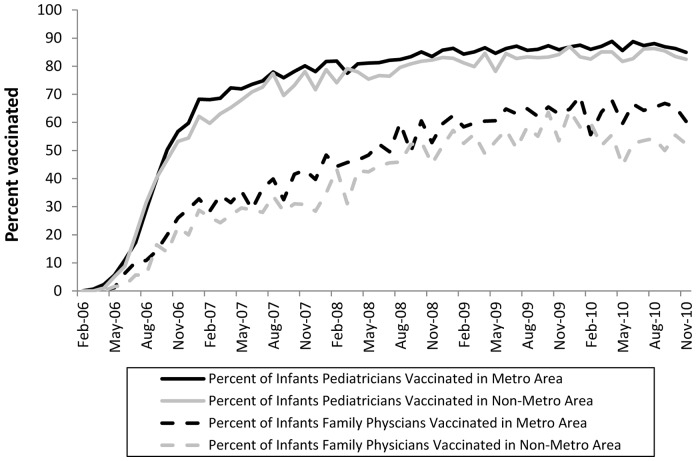
Rotavirus vaccines are highly effective at preventing gastroenteritis in young children and are now universally recommended for infants in the US. We studied patterns of use of rotavirus vaccines among US infants with commercial insurance. We identified a large cohort of infants in the MarketScan Research Databases, 2006-2010. The analysis was restricted to infants residing in states without state-funded rotavirus vaccination programs. We computed summary statistics and used multivariable regression to assess the association between patient-, provider-, and ecologic-level variables of rotavirus vaccine receipt and series completion. Approximately 69% of 594,117 eligible infants received at least one dose of rotavirus vaccine from 2006-2010. Most infants received the rotavirus vaccines at the recommended ages, but more infants completed the series for monovalent rotavirus vaccine than pentavalent rotavirus vaccine or a mix of the vaccines (87% versus 79% versus 73%, P<0.001). In multivariable analyses, the strongest predictors of rotavirus vaccine series initiation and completion were receipt of the diphtheria, tetanus and acellular pertussis vaccine (Initiation: RR = 7.91, 95% CI = 7.69-8.13; Completion: RR = 1.26, 95% CI = 1.23-1.29), visiting a pediatrician versus family physician (Initiation: RR = 1.51, 95% CI = 1.49-1.52; Completion: RR = 1.13, 95% CI = 1.11-1.14), and living in a large metropolitan versus smaller metropolitan, urban, or rural area. We observed rapid diffusion of the rotavirus vaccine in routine practice; however, approximately one-fifth of infants did not receive at least one dose of vaccine as recently as 2010. Interventions to increase rotavirus vaccine coverage should consider targeting family physicians and encouraging completion of the vaccine series.
Conflict of interest statement
Figures
Similar articles
-
Effectiveness of the pentavalent rotavirus vaccine in preventing gastroenteritis in the United States.Pediatrics. 2010 Feb;125(2):e208-13. doi: 10.1542/peds.2009-1246. Epub 2010 Jan 25. Pediatrics. 2010. PMID: 20100757
-
Uptake of rotavirus vaccine among US infants at Immunization Information System Sentinel Sites.Vaccine. 2016 Dec 7;34(50):6396-6401. doi: 10.1016/j.vaccine.2016.10.005. Epub 2016 Nov 1. Vaccine. 2016. PMID: 27810316
-
Effectiveness of an incomplete RotaTeq (RV5) vaccination regimen in preventing rotavirus gastroenteritis in the United States.Pediatr Infect Dis J. 2013 Mar;32(3):278-83. doi: 10.1097/INF.0b013e318275328f. Pediatr Infect Dis J. 2013. PMID: 23014356
-
Rotavirus vaccination in the US: a systematic review of vaccination coverage and completion.Hum Vaccin Immunother. 2021 Mar 4;17(3):872-879. doi: 10.1080/21645515.2020.1794440. Epub 2020 Aug 26. Hum Vaccin Immunother. 2021. PMID: 32845792 Free PMC article.
-
The future of rotavirus vaccines.Semin Pediatr Infect Dis. 2002 Jul;13(3):190-5. doi: 10.1053/spid.2002.125862. Semin Pediatr Infect Dis. 2002. PMID: 12199615 Review.
Cited by
-
Disease burden and seasonal impact of improving rotavirus vaccine coverage in the United States: A modeling study.PLoS One. 2020 Feb 14;15(2):e0228942. doi: 10.1371/journal.pone.0228942. eCollection 2020. PLoS One. 2020. PMID: 32059029 Free PMC article.
-
Rotavirus vaccine coverage and factors associated with uptake using linked data: Ontario, Canada.PLoS One. 2018 Feb 14;13(2):e0192809. doi: 10.1371/journal.pone.0192809. eCollection 2018. PLoS One. 2018. PMID: 29444167 Free PMC article.
-
Association between mixed rotavirus vaccination types of infants and rotavirus acute gastroenteritis.Vaccine. 2015 Oct 13;33(42):5670-5677. doi: 10.1016/j.vaccine.2015.08.027. Epub 2015 Aug 29. Vaccine. 2015. PMID: 26322843 Free PMC article.
-
Italian Physicians' Opinions on Rotavirus Vaccine Implementation.Pathogens. 2017 Nov 3;6(4):56. doi: 10.3390/pathogens6040056. Pathogens. 2017. PMID: 29099756 Free PMC article.
-
A decade of experience with rotavirus vaccination in the United States - vaccine uptake, effectiveness, and impact.Expert Rev Vaccines. 2018 Jul;17(7):593-606. doi: 10.1080/14760584.2018.1489724. Epub 2018 Jul 2. Expert Rev Vaccines. 2018. PMID: 29909693 Free PMC article. Review.
References
-
- Dennehy PH (2005) Acute diarrheal disease in children: Epidemiology, prevention, and treatment. Infect Dis Clin North Am 19: 585–602 doi:10.1016/j.idc.2005.05.003 - DOI - PubMed
-
- Cortes JE, Curns AT, Tate JE, Cortese MM, Patel MM, et al. (2011) Rotavirus vaccine and health care utilization for diarrhea in U.S. children. N Engl J Med 365: 1108–1117 doi:10.1056/NEJMoa1000446 - DOI - PubMed
-
- Parashar UD, Alexander JP, Glass RI, Advisory Committee on Immunization Practices (ACIP), Centers for Disease Control and Prevention (CDC) (2006) Prevention of rotavirus gastroenteritis among infants and children. recommendations of the advisory committee on immunization practices (ACIP). MMWR Recomm Rep 55: 1–13. - PubMed
-
- Cortese MM, Parashar UD, Centers for Disease Control and Prevention (CDC) (2009) Prevention of rotavirus gastroenteritis among infants and children: Recommendations of the advisory committee on immunization practices (ACIP). MMWR Recomm Rep 58: 1–25. - PubMed
-
- Centers for Disease Control and Prevention (CDC) (2012) National, state, and local area vaccination coverage among children aged 19–35 months – United States, 2011. MMWR Morb Mortal Wkly Rep 61: 689–696. - PubMed
Publication types
MeSH terms
Substances
Grants and funding
LinkOut - more resources
Full Text Sources
Other Literature Sources
Medical
