Lower extremity muscle strength after anterior cruciate ligament injury and reconstruction
- PMID: 24067150
- PMCID: PMC3784362
- DOI: 10.4085/1062-6050-48.3.23
Lower extremity muscle strength after anterior cruciate ligament injury and reconstruction
Abstract
Context: Quadriceps and hamstrings weakness occurs frequently after anterior cruciate ligament (ACL) injury and reconstruction. Evidence suggests that knee injury may precipitate hip and ankle muscle weakness, but few data support this contention after ACL injury and reconstruction.
Objective: To determine if hip, knee, and ankle muscle weakness present after ACL injury and after rehabilitation for ACL reconstruction.
Design: Case-control study.
Setting: University research laboratory.
Patients or other participants: Fifteen individuals with ACL injury (8 males, 7 females; age = 20.27 ± 5.38 years, height = 1.75 ± 0.10 m, mass = 74.39 ± 13.26 kg) and 15 control individuals (7 men, 8 women; age = 24.73 ± 3.37 years, height = 1.75 ± 0.09 m, mass = 73.25 ± 13.48 kg).
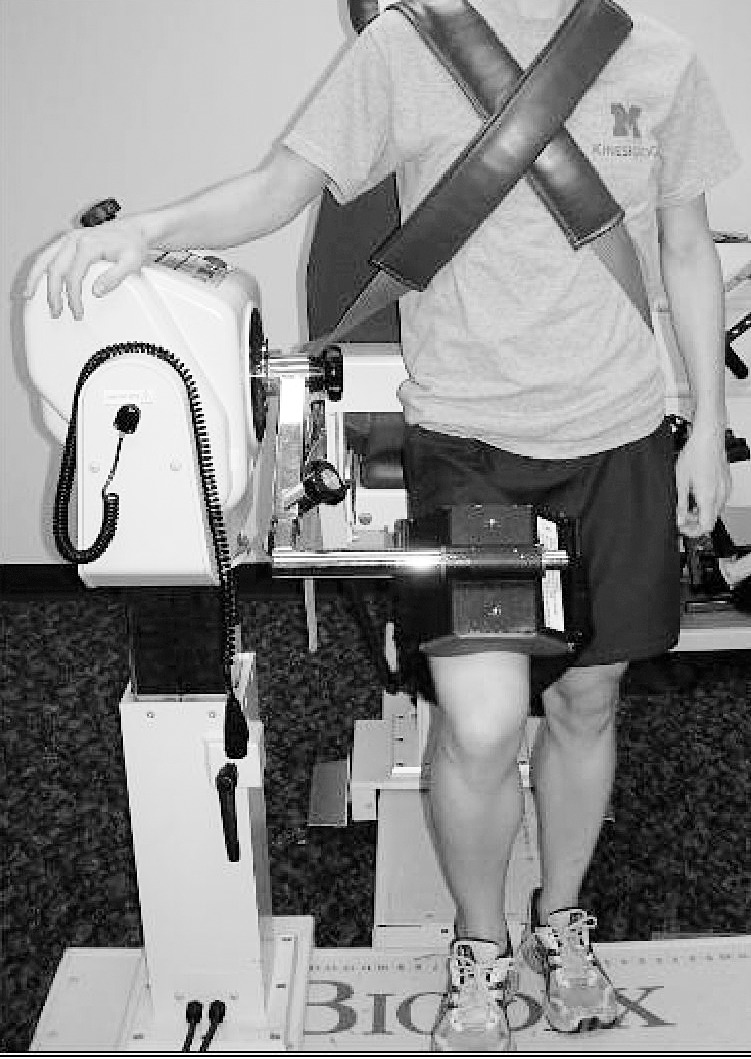
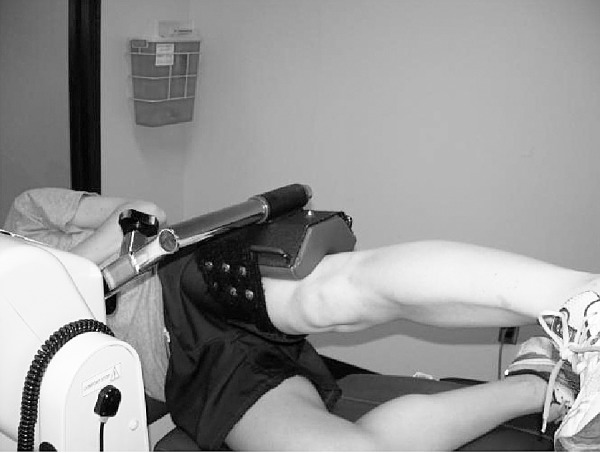
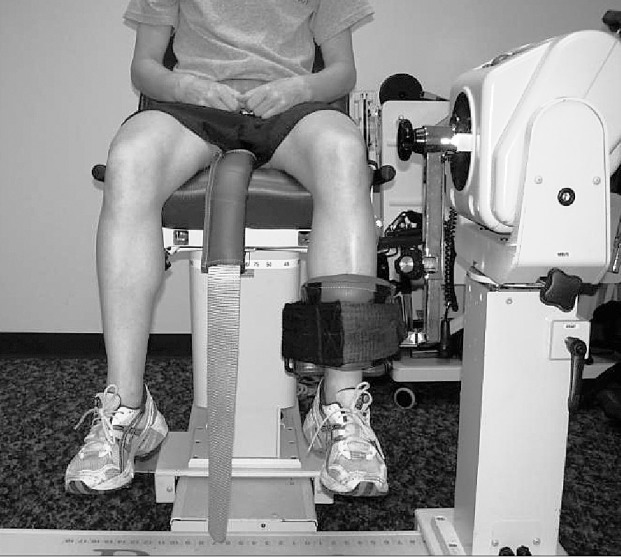
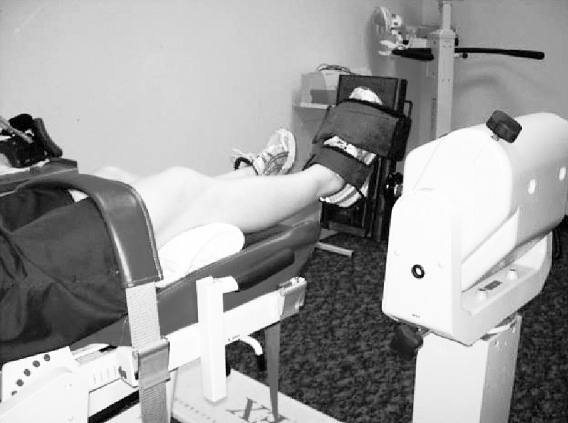
Intervention(s): Bilateral concentric strength was assessed at 60°/s on an isokinetic dynamometer. The participants with ACL injury were tested preoperatively and 6 months postoperatively. Control participants were tested on 1 occasion.
Main outcome measures: Hip-flexor, -extensor, -abductor, and -adductor; knee-extensor and -flexor; and ankle-plantar-flexor and -dorsiflexor strength (Nm/kg).
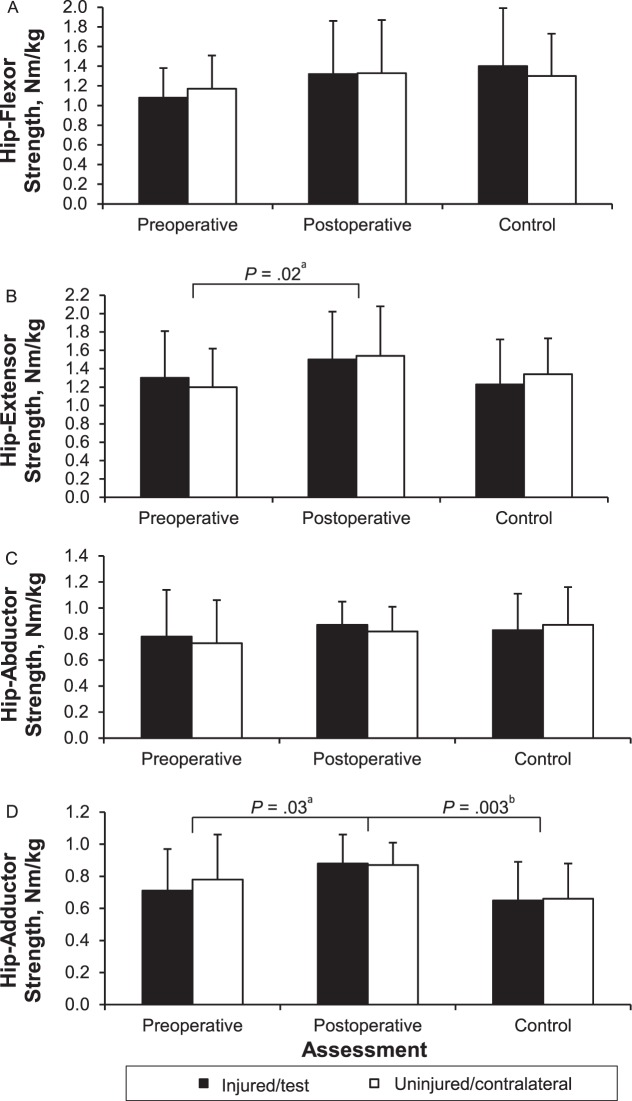
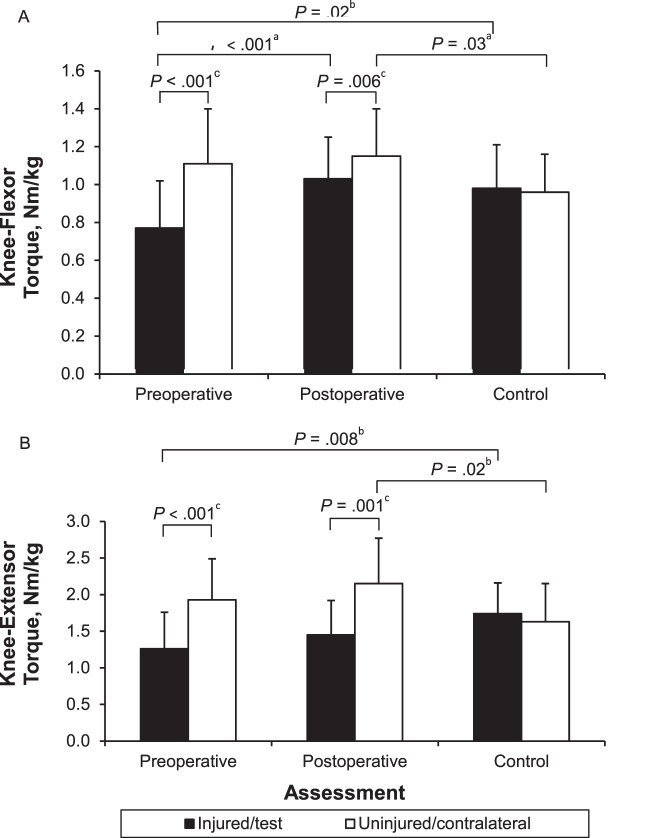
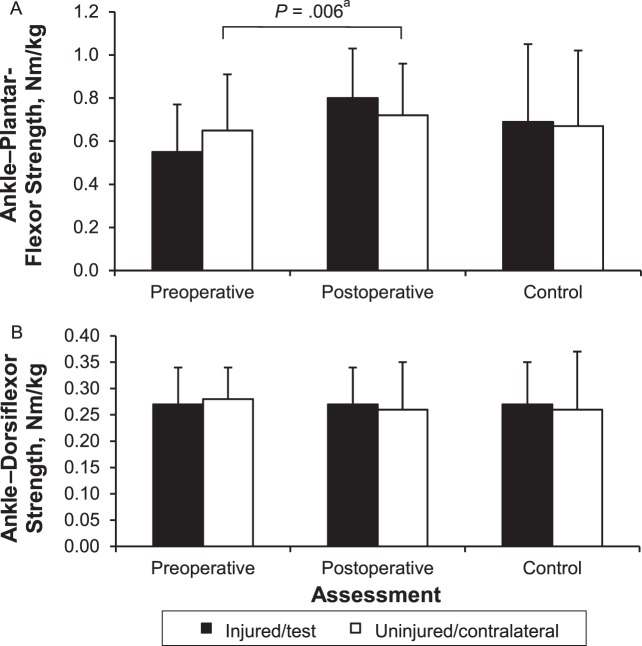
Results: The ACL-injured participants demonstrated greater hip-extensor (percentage difference = 19.7, F1,14 = 7.28, P = .02) and -adductor (percentage difference = 16.3, F1,14 = 6.15, P = .03) weakness preoperatively than postoperatively, regardless of limb, and greater postoperative hip-adductor strength (percentage difference = 29.0, F1,28 = 10.66, P = .003) than control participants. Knee-extensor and -flexor strength were lower in the injured than in the uninjured limb preoperatively and postoperatively (extensor percentage difference = 34.6 preoperatively and 32.6 postoperatively, t14 range = -4.59 to -4.23, P ≤ .001; flexor percentage difference = 30.6 preoperatively and 10.6 postoperatively, t14 range = -6.05 to -3.24, P < .05) with greater knee-flexor (percentage difference = 25.3, t14 = -4.65, P < .001) weakness preoperatively in the injured limb of ACL-injured participants. The ACL-injured participants had less injured limb knee-extensor (percentage difference = 32.0, t28 = -2.84, P = .008) and -flexor (percentage difference = 24.0, t28 = -2.44, P = .02) strength preoperatively but not postoperatively (extensor: t28 = -1.79, P = .08; flexor: t28 = 0.57, P = .58) than control participants. Ankle-plantar-flexor weakness was greater preoperatively than postoperatively in the ACL-injured limb (percentage difference = 31.9, t14 = -3.20, P = .006).
Conclusions: The ACL-injured participants presented with hip-extensor, -adductor, and ankle-plantar-flexor weakness that appeared to be countered during postoperative rehabilitation. Our results confirmed previous findings suggesting greater knee-extensor and -flexor weakness postoperatively in the injured limb than the uninjured limb. The knee extensors and flexors are important dynamic stabilizers; weakness in these muscles could impair knee joint stability. Improving rehabilitation strategies to better target this lingering weakness seems imperative.
Figures
References
-
- Lohmander LS, Ostenberg A, Englund M, Roos H. High prevalence of knee osteoarthritis, pain, and functional limitations in female soccer players twelve years after anterior cruciate ligament injury. Arthritis Rheum. 2004;50(10):3145–3152. - PubMed
-
- de Jong SN, van Caspel DR, van Haeff MJ, Saris DB. Functional assessment and muscle strength before and after reconstruction of chronic anterior cruciate ligament lesions. Arthroscopy. 2007;23(1):21–28. 28.e1–28.e3. - PubMed
-
- Yasuda K, Ohkoshi Y, Tanabe Y, Kaneda K. Muscle weakness after anterior cruciate ligament reconstruction using patellar and quadriceps tendons. Bull Hosp Jt Dis Orthop Inst. 1991;51(2):175–185. - PubMed
-
- Drechsler WI, Cramp MC, Scott OM. Changes in muscle strength and EMG median frequency after anterior cruciate ligament reconstruction. Eur J Appl Physiol. 2006;98(6):613–623. - PubMed
-
- Hiemstra LA, Webber S, MacDonald PB, Kriellaars DJ. Contralateral limb strength deficits after anterior cruciate ligament reconstruction using a hamstring tendon graft. Clin Biomech (Bristol, Avon) 2007;22(5):543–550. - PubMed
Publication types
MeSH terms
Grants and funding
LinkOut - more resources
Full Text Sources
Other Literature Sources
Medical
Research Materials