Different modes of feedback and peak vertical ground reaction force during jump landing: a systematic review
- PMID: 24067153
- PMCID: PMC3784371
- DOI: 10.4085/1062-6050-48.3.02
Different modes of feedback and peak vertical ground reaction force during jump landing: a systematic review
Abstract
Context: Excessive ground reaction force when landing from a jump may result in lower extremity injuries. It is important to better understand how feedback can influence ground reaction force (GRF) and potentially reduce injury risk.
Objective: To determine the effect of expert-provided (EP), self-analysis (SA), and combination EP and SA (combo) feedback on reducing peak vertical GRF during a jump-landing task.
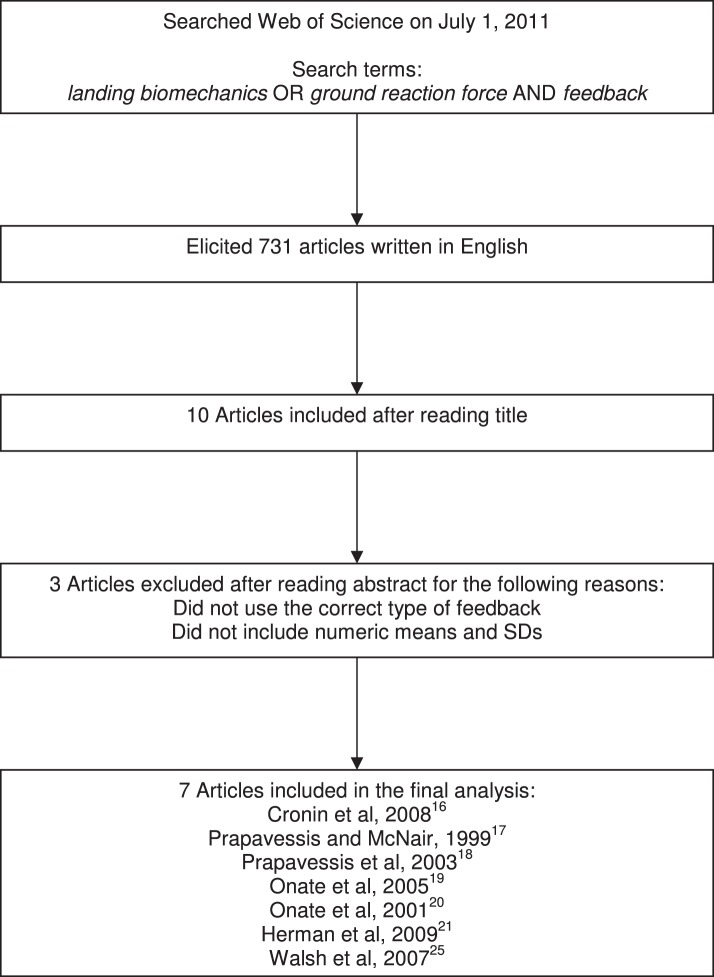
Data sources: We searched the Web of Science database on July 1, 2011; using the search terms ground reaction force, landing biomechanics, and feedback elicited 731 initial hits.
Study selection: Of the 731 initial hits, our final analysis included 7 studies that incorporated 32 separate data comparisons.
Data extraction: Standardized effect sizes and 95% confidence intervals (CIs) were calculated between pretest and posttest scores for each feedback condition.
Data synthesis: We found a homogeneous beneficial effect for combo feedback, indicating a reduction in GRF with no CIs crossing zero. We also found a homogeneous beneficial effect for EP feedback, but the CIs from 4 of the 10 data comparisons crossed zero. The SA feedback showed strong, definitive effects when the intervention included a videotape SA, with no CIs crossing zero.
Conclusions: Of the 7 studies reviewed, combo feedback seemed to produce the greatest decrease in peak vertical GRF during a jump-landing task.
Figures
References
-
- Hrysomallis C. Relationship between balance ability, training and sports injury risk. Sports Med. 2007;37(6):547–556. - PubMed
-
- Dufek JS, Bates BT. Biomechanical factors associated with injury during landing in jump sports. Sports Med. 1991;12(5):326–337. - PubMed
-
- Yeow CH, Lee PV, Goh JC. Regression relationships of landing height with ground reaction forces, knee flexion angles, angular velocities and joint powers during double-leg landing. Knee. 2009;16(5):381–386. - PubMed
-
- Podraza JT, White SC. Effect of knee flexion angle on ground reaction forces, knee moments and muscle co-contraction during an impact-like deceleration landing: implications for the non-contact mechanism of ACL injury. Knee. 2010;17(4):291–295. - PubMed
Publication types
MeSH terms
LinkOut - more resources
Full Text Sources
Other Literature Sources
Medical