. 2013 Jul 15;12(14):2291-6.
doi: 10.4161/cc.25369.

CUL3 and protein kinases: insights from PLK1/KLHL22 interaction

Affiliations

CUL3 and protein kinases: insights from PLK1/KLHL22 interaction

Thibaud Metzger et al. Cell Cycle. .

Abstract

Posttranslational mechanisms drive fidelity of cellular processes. Phosphorylation and ubiquitination of substrates represent very common, covalent, posttranslational modifications and are often co-regulated. Phosphorylation may play a critical role both by directly regulating E3-ubiquitin ligases and/or by ensuring specificity of the ubiquitination substrate. Importantly, many kinases are not only critical regulatory components of these pathways but also represent themselves the direct ubiquitination substrates. Recent data suggest the role of CUL3-based ligases in both proteolytic and non-proteolytic regulation of protein kinases. Our own recent study identified the mitotic kinase PLK1 as a direct target of the CUL3 E3-ligase complex containing BTB-KELCH adaptor protein KLHL22. (1) In this study, we aim at gaining mechanistic insights into CUL3-mediated regulation of the substrates, in particular protein kinases, by analyzing mechanisms of interaction between KLHL22 and PLK1. We find that kinase activity of PLK1 is redundant for its targeting for CUL3-ubiquitination. Moreover, CUL3/KLHL22 may contact 2 distinct motifs within PLK1 protein, consistent with the bivalent mode of substrate targeting found in other CUL3-based complexes. We discuss these findings in the context of the existing knowledge on other protein kinases and substrates targeted by CUL3-based E3-ligases.

Keywords: BTB proteins; CUL3; KLHL22; PLK1; kinases; ubiquitin.


Figures
None
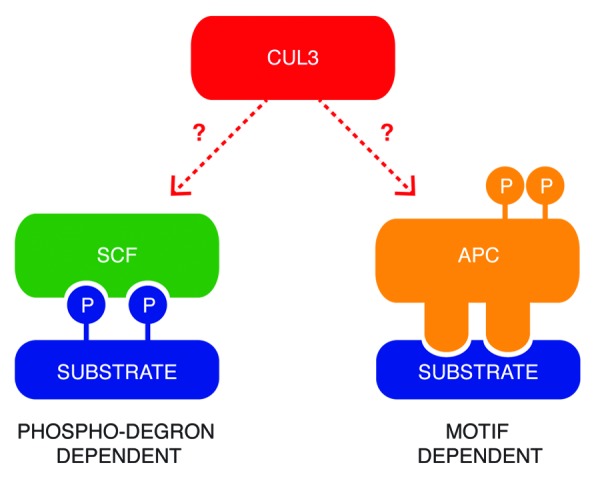
Figure 1. Two common models of substrates recognition by E3-ligase complexes. SCF ligases interact with the phosphorylated residues on the substrates, which create a so-called “phosphodegron”. The APC/C complex recognizes specific short motifs within the amino acid sequence of the targeted proteins, and its activity is regulated by phosphorylation. Little is known about mechanisms of substrate targeting by CUL3-based E3-ligases.
None
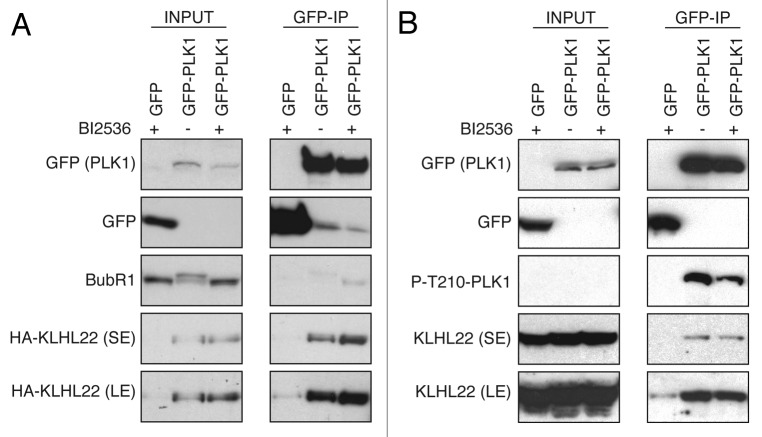
Figure 2. Catalytic activity of PLK1 is not required for its interaction with KLHL22-adaptor protein. (A) Cells expressing GFP alone and GFP-PLK1 were transfected with HA-KLHL22 and synchronized in mitosis using Taxol or PLK1 inhibitor BI2536. Extracts were immunoprecipitated using GFP-Trap beads. Inputs and immunoprecipitates were analyzed by western blot. (B) Cells expressing GFP alone and GFP-PLK1 only were synchronized and analyzed as in (A). The short (SE) and long (LE) exposures of the representative blots are shown.
None
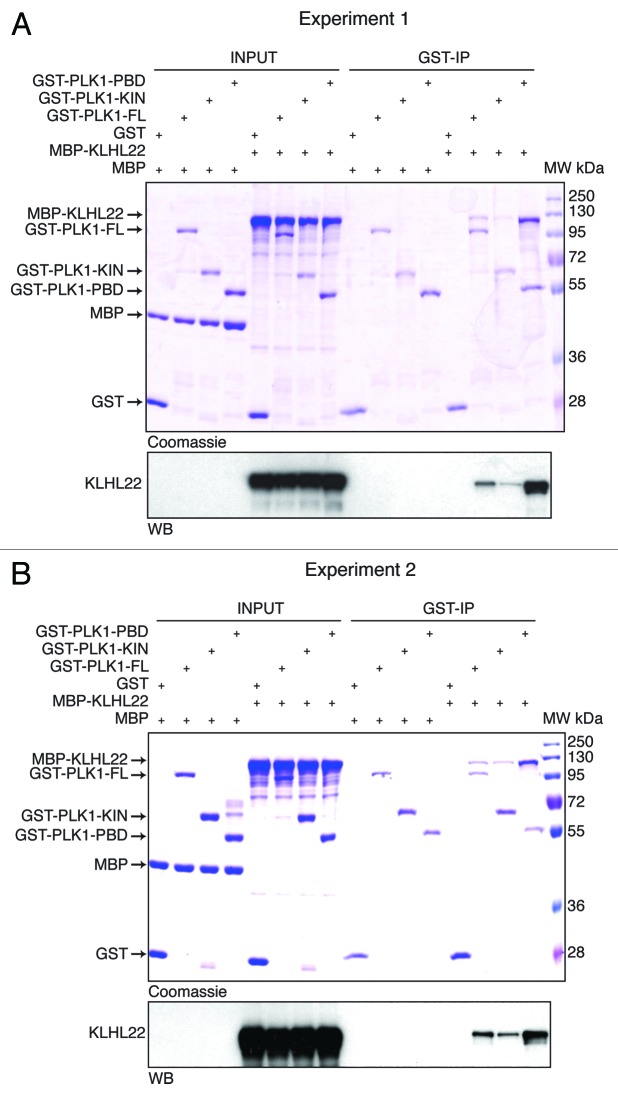
Figure 3. KLHL22 interacts with 2 domains of PLK1 in vitro. (A and B) Recombinant GST or GST fused to full-length PLK1 (GST-PLK1), kinase domain fragment (GST-PLK1-KIN), and PBD fragment (GST-PLK1-PBD) were incubated with recombinant MBP or MBP fused to full-length KLHL22 (MBP-KLHL22), and immunoprecipitated using glutathione-sepharose beads. Immunoprecipitates (GST-IP) were analyzed by coomassie blue staining and western blot. (A and B) represent 2 independent experiments.
None
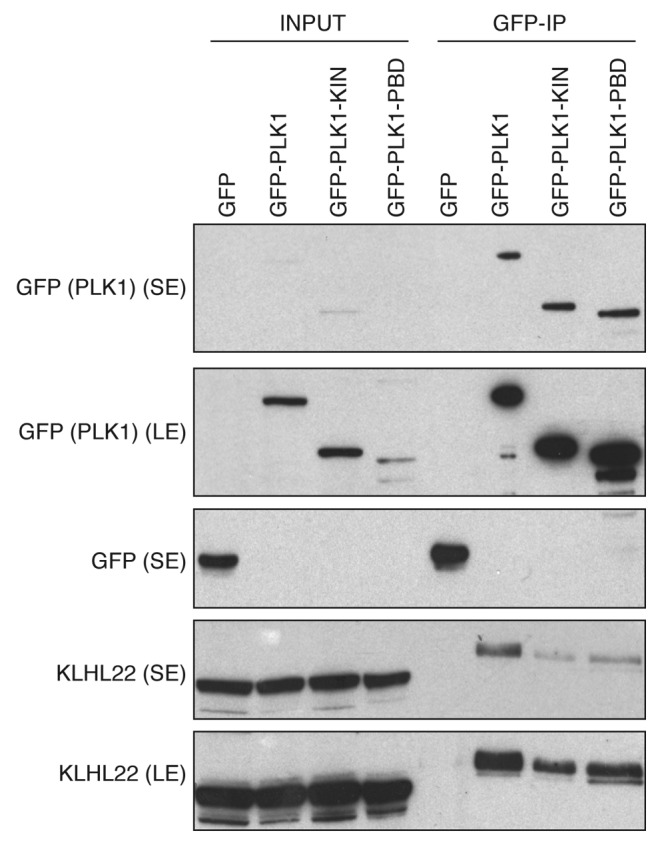
Figure 4. KLHL22 interacts with 2 domains of PLK1 in cells. Cells expressing GFP alone, GFP fused to full-length PLK1 (GFP-PLK1), kinase domain fragment (GFP-PLK1-KIN), and PBD fragment (GFP-PLK1-PBD) were synchronized in mitosis using Taxol. Extracts were immunoprecipitated using GFP-Trap beads. Inputs and immunoprecipitates were analyzed by western blot. The short (SE) and long (LE) exposures of the representative blots are shown.
None
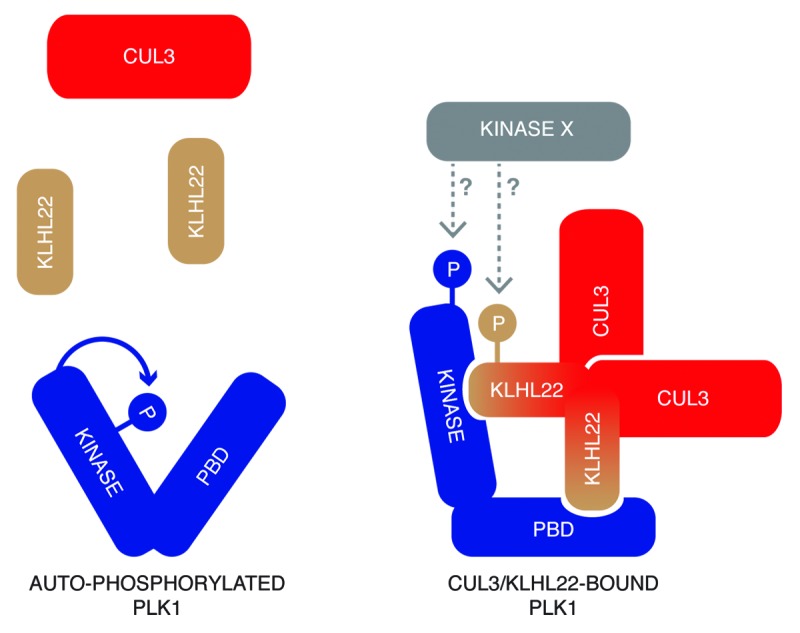
Figure 5. A hypothetical model of the architecture of CUL3/KLHL22 in a complex with PLK1. PLK1 interacts with the substrate specific adaptor protein KLHL22 independent of its kinase activity. It is possible that specific conformational change or modifications by unidentified factors, including upstream kinases (Kinase X), regulate affinity of PLK1 to KLHL22. KLHL22 binds to 2 distinct domains of PLK1 and may utilize 2 similar or different motifs within its primary sequence.

References

    1. Beck J, Maerki S, Posch M, Metzger T, Persaud A, Scheel H, et al. Ubiquitylation-dependent localization of PLK1 in mitosis. Nat Cell Biol. 2013;15:430–9. doi: 10.1038/ncb2695. - DOI - PMC - PubMed
    1. Nigg EA. Mitotic kinases as regulators of cell division and its checkpoints. Nat Rev Mol Cell Biol. 2001;2:21–32. doi: 10.1038/35048096. - DOI - PubMed
    1. Komander D, Rape M. The ubiquitin code. Annu Rev Biochem. 2012;81:203–29. doi: 10.1146/annurev-biochem-060310-170328. - DOI - PubMed
    1. Willems AR, Schwab M, Tyers M. A hitchhiker’s guide to the cullin ubiquitin ligases: SCF and its kin. Biochim Biophys Acta. 2004;1695:133–70. doi: 10.1016/j.bbamcr.2004.09.027. - DOI - PubMed
    1. Stogios PJ, Privé GG. The BACK domain in BTB-kelch proteins. Trends Biochem Sci. 2004;29:634–7. doi: 10.1016/j.tibs.2004.10.003. - DOI - PubMed

Publication types

MeSH terms

LinkOut - more resources