


Rehabilitation impact indices and their independent predictors: a systematic review
- PMID: 24068767
- PMCID: PMC3787469
- DOI: 10.1136/bmjopen-2013-003483
Rehabilitation impact indices and their independent predictors: a systematic review
Abstract
Objectives: To (1) identify all available rehabilitation impact indices (RIIs) based on their mathematical formula, (2) assess the evidence for independent predictors of each RII and (3) propose a nomenclature system to harmonise the names of RIIs.
Design: Systematic review.
Data sources: PubMed and references in primary articles.
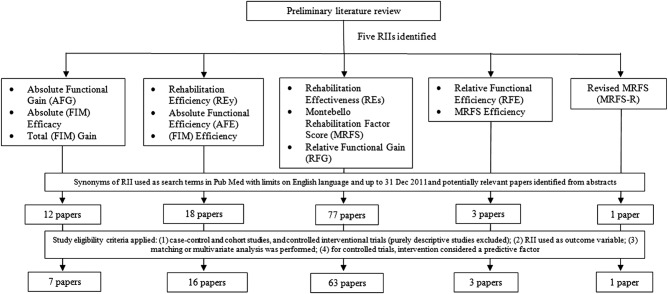
Study selection: First, we identified all available RII through preliminary literature review. Then, various names of the same formula were used to identify studies, limited to articles in English and up to 31 December 2011, including case-control and cohort studies, and controlled interventional trials where RIIs were outcome variable and matching or multivariate analysis was performed.
Results: The five RIIs identified were (1) absolute functional gain (AFG)/absolute efficacy/total gain, (2) rehabilitation effectiveness (REs)/Montebello Rehabilitation Factor Score (MRFS)/relative functional gain (RFG), (3) rehabilitation efficiency (REy)/length of stay-efficiency (LOS-EFF)/efficiency, (4) relative functional efficiency (RFE)/MRFS efficiency and (5) revised MRFS (MRFS-R). REy/LOS-EFF/efficiency had the most number of supporting studies, followed by REs and AFG. Although evidence for different predictors of RIIs varied according to the RII and study population, there is good evidence that older age, lower prerehabilitation functional status and cognitive impairment are predictive of poorer AFG, REs and REy.
Conclusions: 5 RIIs have been developed in the past two decades as composite rehabilitation outcome measures controlling premorbid and prerehabilitation functional status, rate of functional improvement, each with varying levels of evidence for its predictors. To address the issue of multiple names for the same RII, a new nomenclature system is proposed to harmonise the names based on common mathematical formula and a first-named basis.
Figures
References
-
- Heinemann AW, Roth EJ, Cichowski K, et al. Multivariate analysis of improvement and outcome following stroke rehabilitation. Arch Neurol 1987;44:1167–72 - PubMed
-
- Pronovost PJ, Miller M, Wachter RM. The GAAP in quality measurement and reporting. JAMA 2007;298:1800–2 - PubMed
-
- Hayward RA. Performance measurement in search of a path. N Engl J Med 2007;356:951–3 - PubMed
LinkOut - more resources
Full Text Sources
Other Literature Sources
Medical
Miscellaneous
