. 2013;9(9):e1003194.
doi: 10.1371/journal.pcbi.1003194. Epub 2013 Sep 19.

Using biological pathway data with paxtools

Affiliations

Using biological pathway data with paxtools

Emek Demir et al. PLoS Comput Biol. 2013.

Abstract

A rapidly growing corpus of formal, computable pathway information can be used to answer important biological questions including finding non-trivial connections between cellular processes, identifying significantly altered portions of the cellular network in a disease state and building predictive models that can be used for precision medicine. Due to its complexity and fragmented nature, however, working with pathway data is still difficult. We present Paxtools, a Java library that contains algorithms, software components and converters for biological pathways represented in the standard BioPAX language. Paxtools allows scientists to focus on their scientific problem by removing technical barriers to access and analyse pathway information. Paxtools can run on any platform that has a Java Runtime Environment and was tested on most modern operating systems. Paxtools is open source and is available under the Lesser GNU public license (LGPL), which allows users to freely use the code in their software systems with a requirement for attribution. Source code for the current release (4.2.0) can be found in Software S1. A detailed manual for obtaining and using Paxtools can be found in Protocol S1. The latest sources and release bundles can be obtained from biopax.org/paxtools.


Conflict of interest statement

The authors have declared that no competing interests exist.

Figures
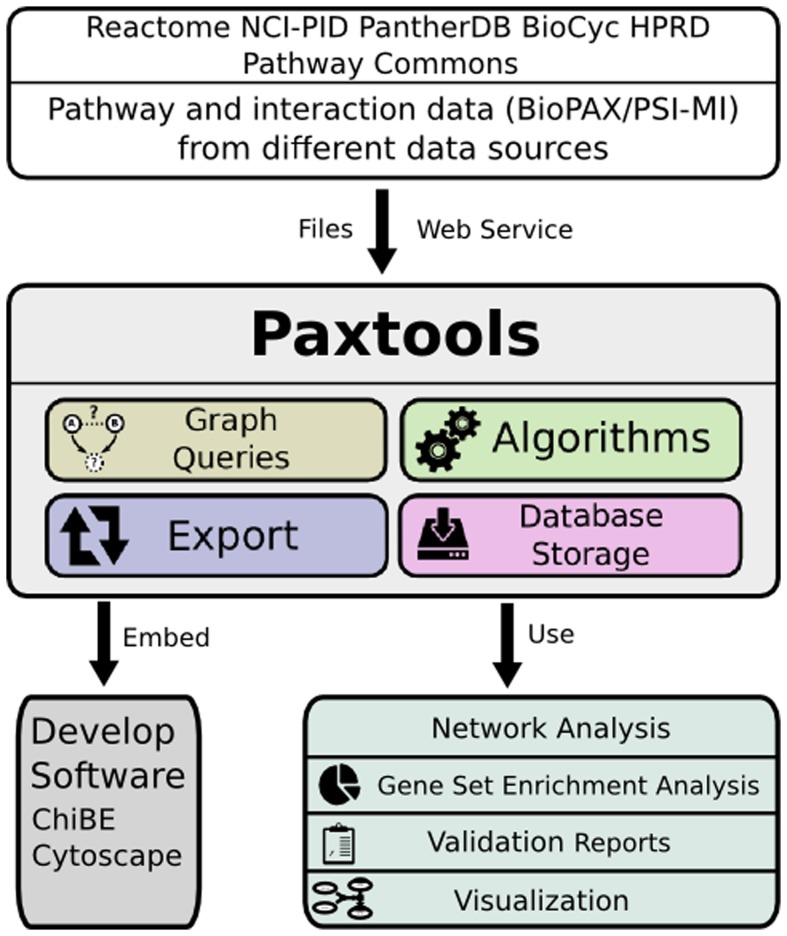
Figure 1
Figure 1. Paxtools can be used to obtain pathway data from different sources and use the data to answer a wide range of biological questions.
Paxtools facilitates working with pathway information by removing technical barriers and acts as a common development platform for other tools and algorithms.
Figure 2
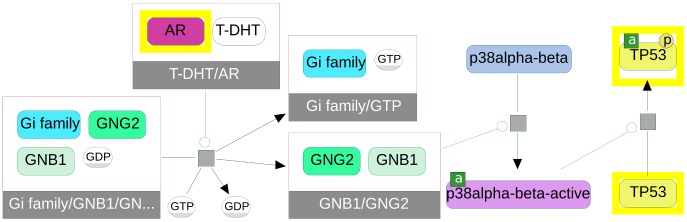
Figure 2. A plausible signaling path (yellow) between the androgen receptor (AR, top) and the TP53 protein (p53, right) is found by a Paxtools “paths-between” query and visualized in the Chisio BioPAX Editor.
These cross-talks are difficult to find manually without a graph search because of the large number of connections to/from AR and p53 and because of fragmentation of data across multiple pathway data sources.
Figure 3
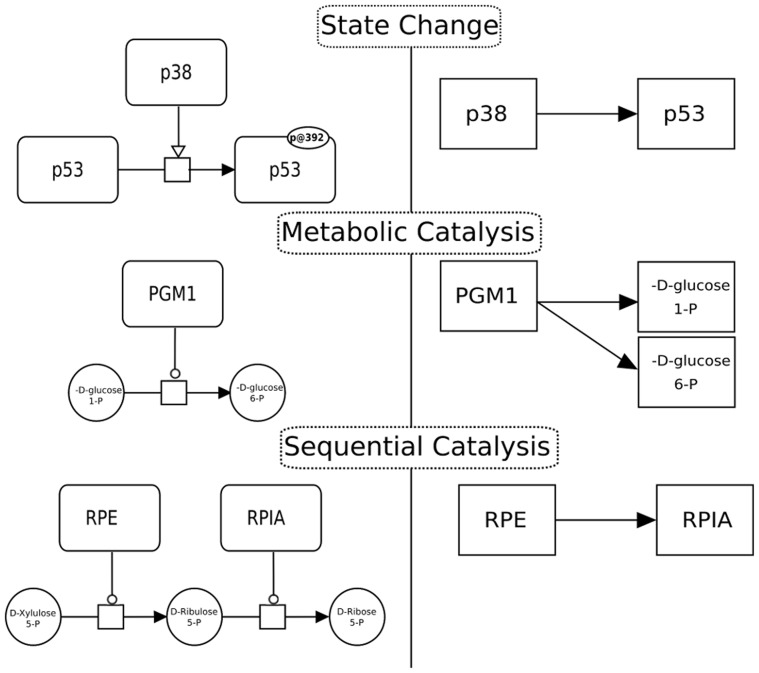
Figure 3. A Sif (Simple Interaction Format) rule reduces mechanistic BioPAX interactions (left column) to simpler binary interactions (right column) based on the pattern defined in the rule.
Different rules should be used dependent on the biological question at hand. For example a State Change interaction is inferred when the rule detects phosphorylation of p53 by p38. This is a useful relationship that can be applied to protein signaling cascade analysis from proteomics data. “Sequential Catalysis” rule on the other hand links entities that are responsible for catalyzing subsequent reactions. This is a relationship that frequently occurs in metabolic pathways and is useful for metabolomic studies where changes in the concentration of substrates are observed.

References

    1. Bader GD, Cary MP, Sander C (2006) Pathguide: a pathway resource list. Nucleic acids research 34: D504–6. - PMC - PubMed
    1. Network TCGA (2008) Comprehensive genomic characterization defines human glioblastoma genes and core pathways. Nature 455: 1061–8. - PMC - PubMed
    1. Jones S, Zhang X, Parsons DW, Lin JCH, Leary RJ, et al. (2008) Core signaling pathways in human pancreatic cancers revealed by global genomic analyses. Science (New York, NY) 321: 1801–6. - PMC - PubMed
    1. Hu P, Bader G, Wigle DA, Emili A (2007) Computational prediction of cancer-gene function. Nature reviews Cancer 7: 23–34. - PubMed
    1. Chuang HY, Lee E, Liu YT, Lee D, Ideker T (2007) Network-based classification of breast cancer metastasis. Molecular systems biology 3: 140. - PMC - PubMed

Publication types

LinkOut - more resources