Common variants in left/right asymmetry genes and pathways are associated with relative hand skill
- PMID: 24068947
- PMCID: PMC3772043
- DOI: 10.1371/journal.pgen.1003751
Common variants in left/right asymmetry genes and pathways are associated with relative hand skill
Abstract
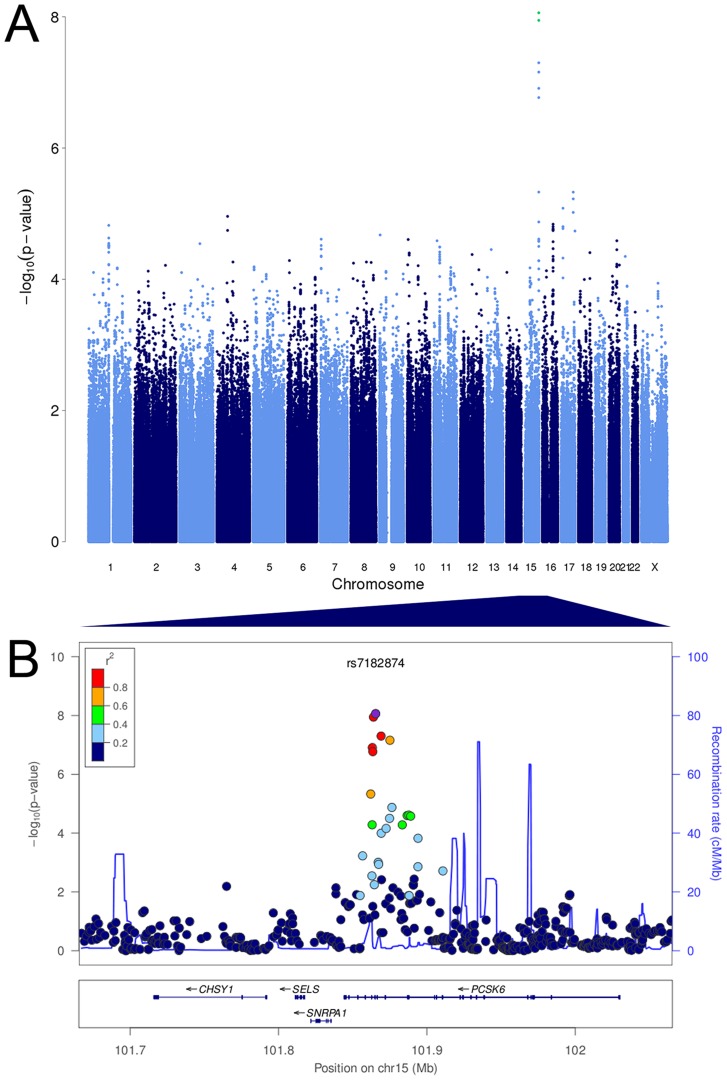
Humans display structural and functional asymmetries in brain organization, strikingly with respect to language and handedness. The molecular basis of these asymmetries is unknown. We report a genome-wide association study meta-analysis for a quantitative measure of relative hand skill in individuals with dyslexia [reading disability (RD)] (n = 728). The most strongly associated variant, rs7182874 (P = 8.68 × 10(-9)), is located in PCSK6, further supporting an association we previously reported. We also confirmed the specificity of this association in individuals with RD; the same locus was not associated with relative hand skill in a general population cohort (n = 2,666). As PCSK6 is known to regulate NODAL in the development of left/right (LR) asymmetry in mice, we developed a novel approach to GWAS pathway analysis, using gene-set enrichment to test for an over-representation of highly associated variants within the orthologs of genes whose disruption in mice yields LR asymmetry phenotypes. Four out of 15 LR asymmetry phenotypes showed an over-representation (FDR ≤ 5%). We replicated three of these phenotypes; situs inversus, heterotaxia, and double outlet right ventricle, in the general population cohort (FDR ≤ 5%). Our findings lead us to propose that handedness is a polygenic trait controlled in part by the molecular mechanisms that establish LR body asymmetry early in development.
Conflict of interest statement
The authors have declared that no competing interests exist.
Figures
References
-
- Corballis MC (1993) The lopsided ape: Evolution of the generative mind: Oxford University Press, USA.
-
- Marchant LF, McGrew WC (1998) Human handedness: an ethological perspective. Human Evolution 13: 221–228.
-
- Raymond M, Pontier D (2004) Is there geographical variation in human handedness? Laterality 9: 35–51. - PubMed
-
- Mcgrew WC, Marchant LF (1997) On the other hand: Current issues in and meta-analysis of the behavioral laterality of hand function in nonhuman primates. Yearbook of Physical Anthropology, Vol 40 - 1997 40: 201–232.
-
- Cashmore L, Uomini N, Chapelain A (2008) The evolution of handedness in humans and great apes: a review and current issues. Journal of Anthropological Sciences 86: 7–35. - PubMed
Publication types
MeSH terms
Substances
Grants and funding
- 098017/WT_/Wellcome Trust/United Kingdom
- MC_UP_A320_1004/MRC_/Medical Research Council/United Kingdom
- 092731/WT_/Wellcome Trust/United Kingdom
- MC_UU_12013/4/MRC_/Medical Research Council/United Kingdom
- G0800523/MRC_/Medical Research Council/United Kingdom
- 090532/WT_/Wellcome Trust/United Kingdom
- 090532/Z/09/Z/WT_/Wellcome Trust/United Kingdom
- MC_UU_12021/4/MRC_/Medical Research Council/United Kingdom
- 083431MA/WT_/Wellcome Trust/United Kingdom
- 092731/MRC_/Medical Research Council/United Kingdom
- G0900747 91070/MRC_/Medical Research Council/United Kingdom
- 075491/WT_/Wellcome Trust/United Kingdom
- G0900747/MRC_/Medical Research Council/United Kingdom
- G9815508/MRC_/Medical Research Council/United Kingdom
- G0800523/86473/MRC_/Medical Research Council/United Kingdom
LinkOut - more resources
Full Text Sources
Other Literature Sources
Research Materials
Miscellaneous