. 2013 Sep 24:7:53.
doi: 10.3389/fnsys.2013.00053. eCollection 2013.

Pain predictability reverses valence ratings of a relief-associated stimulus

Affiliations

Pain predictability reverses valence ratings of a relief-associated stimulus

Marta Andreatta et al. Front Syst Neurosci. .

Abstract

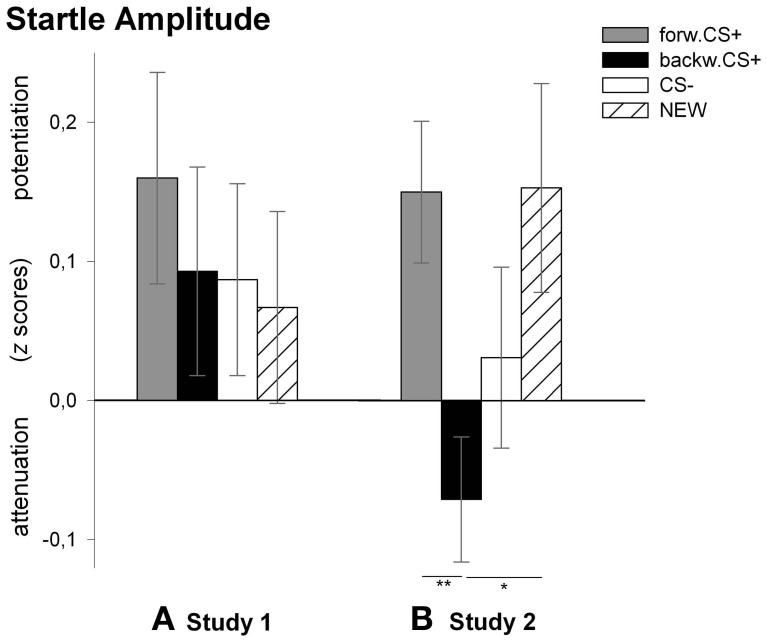
Relief from pain is positively valenced and entails reward-like properties. Notably, stimuli that became associated with pain relief elicit reward-like implicit responses too, but are explicitly evaluated by humans as aversive. Since the unpredictability of pain makes pain more aversive, this study examined the hypotheses that the predictability of pain also modulates the valence of relief-associated stimuli. In two studies, we presented one conditioned stimulus (FORWARDCS+) before a painful unconditioned stimulus (US), another stimulus (BACKWARDCS+) after the painful US, and a third stimulus (CS-) was never associated with the US. In Study 1, FORWARDCS+ predicted half of the USs while the other half was delivered unwarned and followed by BACKWARDCS+. In Study 2, all USs were predicted by FORWARDCS+ and followed by BACKWARDCS+. In Study 1 both FORWARDCS+ and BACKWARDCS+ were rated as negatively valenced and high arousing after conditioning, while BACKWARDCS+ in Study 2 acquired positive valence and low arousal. Startle amplitude was significantly attenuated to BACKWARDCS+ compared to FORWARDCS+ in Study 2, but did not differ among CSs in Study 1. In summary, predictability of aversive events reverses the explicit valence of a relief-associated stimulus.

Keywords: backward conditioning; forward conditioning; implicit and explicit responses; pain relief; threat unpredictability.


Figures
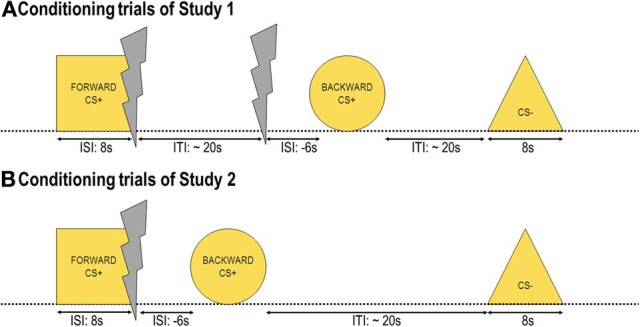
Figure 1
Figure 1
Conditioning trials. Three out of four yellow geometrical shapes were presented during conditioning as conditioned stimuli (CS). One shape (FORWARDCS+) was presented before a painful electric shock (unconditioned stimulus, US), one shape (BACKWARDCS+) was presented after the US, and another shape (CS−) was never associated with the US. In Study 1 (A) 16 USs out of 32 were predicted by the FORWARDCS+, whereas the other 16 USs were delivered unwarned before the BACKWARDCS+. In Study 2 (B) all USs were preceded by the FORWARDCS+ and followed by the BACKWARDCS+.
Figure 2
Figure 2
Ratings of valence (A) and arousal (B) for the visual stimuli. Participants rated the valence (upper panel) and the arousal (botton panel) of the FORWARDCS+ (light gray bars), the BACKWARDCS+ (black bars), the CS− (white bars), and the NEW (striped bars) before and after the conditioning as well as after the test phase. In Study 1 (left panels), both the FORWARDCS+ and the BACKWARDCS+ were rated as negatively valenced and arousing. On the contrary, in Study 2 (right panels) the FORWARDCS+ was rated as negatively valenced and high arousing, whereas the BACKWARDCS+ as positively valenced and low arousing (+p < 0.06; *p < 0.05; ***p < 0.001).
Figure 3
Figure 3
Startle amplitudes to the visual stimuli during the test phase. Bars (with standard errors) depict the startle amplitude in z scores in response to the FORWARDCS+ (light gray), the BACKWARDCS+ (black), the CS− (white), and the NEW (striped). Startle responses did not differ among CSs after conditioning in Study 1 (A). On the contrary, startle response was significantly attenuated (i.e., reward-like conditioned responses) by the BACKWARDCS+ as compared to the FORWARDCS+ and the NEW after conditioning in Study 2 (B) (*p < 0.05; **p < 0.01).
Figure 4
Figure 4
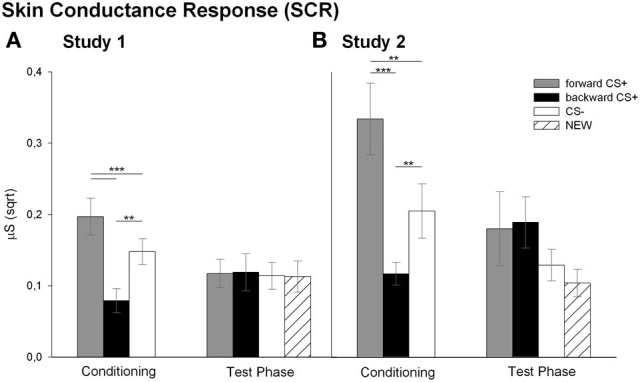
Skin conductance responses (SCRs) to the visual stimuli. Bars (with standard errors) depict the SCR (sqrt transformed) in response to the FORWARDCS+ (light gray), the BACKWARDCS+ (black), the CS− (white) and the NEW (striped) either during the conditioning or during the test phase. In both Study 1 (A) and Study 2 (B) the SCR to the BACKWARDCS+ was significantly lower compared to the FORWARDCS+ and the CS− (**p < 0.01; ***p < 0.001).

References

    1. Alvarez R. P., Chen G., Bodurka J., Kaplan R., Grillon C. (2011). Phasic and sustained fear in humans elicits distinct patterns of brain activity. Neuroimage 55, 389–400 10.1016/j.neuroimage.2010.11.057 - DOI - PMC - PubMed
    1. Andreatta M., Fendt M., Mühlberger A., Wieser M. J., Imobersteg S., Yarali A., et al. (2012). Onset and offset of aversive events establish distinct memories requiring fear- and reward network. Learn. Mem. 19, 518–526 10.1101/lm.026864.112 - DOI - PubMed
    1. Andreatta M., Mühlberger A., Yarali A., Gerber B., Pauli P. (2010). A rift between implicit and explicit conditioned valence after pain-relief learning in humans. Proc. Biol. Sci. 277, 2411–2416 10.1098/rspb.2010.0103 - DOI - PMC - PubMed
    1. Baratta M. V., Christianson J. P., Gomez D. M., Zarza C. M., Amat J., Masini C. V., et al. (2007). Controllable versus uncontrollable stressors bi-directionally modulate conditioned but not innate fear. Neuroscience 146, 1495–1503 10.1016/j.neuroscience.2007.03.042 - DOI - PMC - PubMed
    1. Barlow D. H. (2000). Unraveling the mysteries of anxiety and its disorders from the perspective of emotion theory. Am. Psychol. 55, 1247–1263 10.1037/0003-066X.55.11.1247 - DOI - PubMed

LinkOut - more resources