


Human pancreatic cancer contains a side population expressing cancer stem cell-associated and prognostic genes
- PMID: 24069258
- PMCID: PMC3775803
- DOI: 10.1371/journal.pone.0073968
Human pancreatic cancer contains a side population expressing cancer stem cell-associated and prognostic genes
Abstract
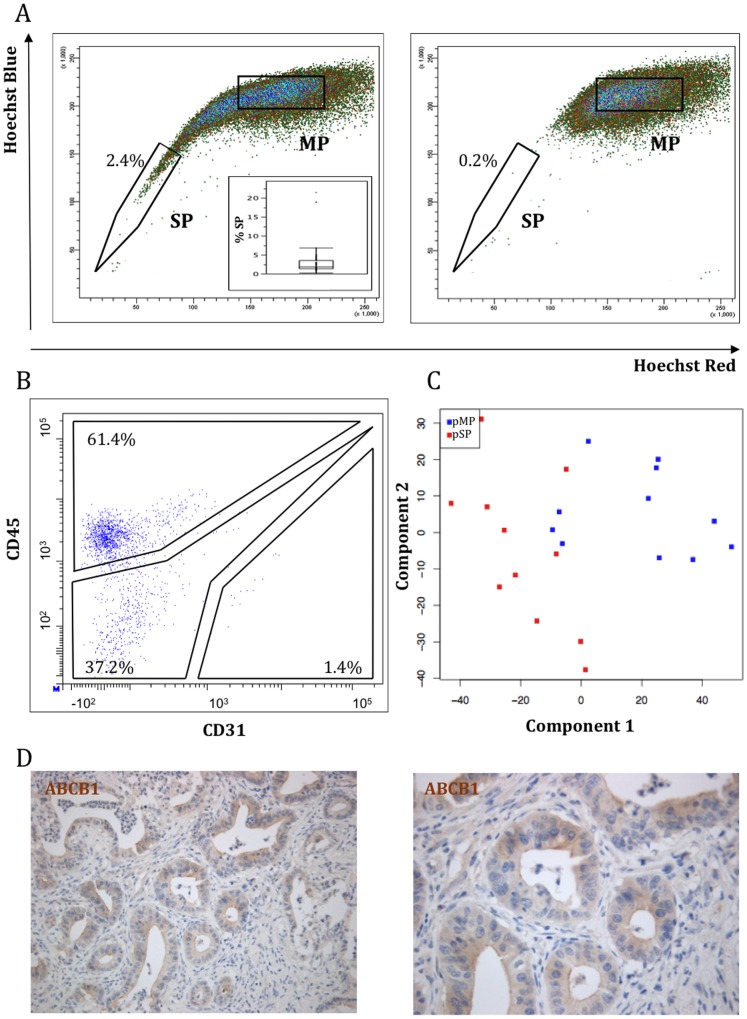
In many types of cancers, a side population (SP) has been identified based on high efflux capacity, thereby enriching for chemoresistant cells as well as for candidate cancer stem cells (CSC). Here, we explored whether human pancreatic ductal adenocarcinoma (PDAC) contains a SP, and whether its gene expression profile is associated with chemoresistance, CSC and prognosis. After dispersion into single cells and incubation with Hoechst dye, we analyzed human PDAC resections specimens using flow cytometry (FACS). We identified a SP and main population (MP) in all human PDAC resection specimens (n = 52) analyzed, but detected immune (CD45(+)) and endothelial (CD31(+)) cells in this fraction together with tumor cells. The SP and MP cells, or more purified fractions depleted from CD31(+)/CD45(+) cells (pSP and pMP), were sorted by FACS and subjected to whole-genome expression analysis. This revealed upregulation of genes associated with therapy resistance and of markers identified before in putative pancreatic CSC. pSP gene signatures of 32 or 10 up- or downregulated genes were developed and tested for discriminatory competence between pSP and pMP in different sets of PDAC samples. The prognostic value of the pSP genes was validated in a large independent series of PDAC patients (n = 78) using nCounter analysis of expression (in tumor versus surrounding pancreatic tissue) and Cox regression for disease-free and overall survival. Of these genes, expression levels of ABCB1 and CXCR4 were correlated with worse patient survival. Thus, our study for the first time demonstrates that human PDAC contains a SP. This tumor subpopulation may represent a valuable therapeutic target given its chemoresistance- and CSC-associated gene expression characteristics with potential prognostic value.
Conflict of interest statement
Figures
References
-
- Jemal A, Bray F (2011) Center MM, Ferlay J, Ward E, et al (2011) Global cancer statistics. CA Cancer J Clin 61: 69–90. - PubMed
-
- Chen J, Hersmus N, Van Duppen V, Caesens P, Denef C, et al. (2005) The adult pituitary contains a cell population displaying stem/progenitor cell and early embryonic characteristics. Endocrinology 146: 3985–98. - PubMed
-
- Sergeant G, Vankelecom H, Gremeaux L, Topal B (2009) Cancer stem cells in pancreatic ductal adenocarcinoma. Nat Rev Clin Oncol 6: 580–586. - PubMed
-
- Li C, Heidt DG, Dalerba P, Burant CF, Zhang L, et al. (2007) Identification of pancreatic cancer stem cells. Cancer Res 67: 1030–7. - PubMed
Publication types
MeSH terms
Substances
LinkOut - more resources
Full Text Sources
Other Literature Sources
Medical
Molecular Biology Databases
Research Materials
Miscellaneous
