


Time to intubation is associated with outcome in patients with community-acquired pneumonia
- PMID: 24069367
- PMCID: PMC3777932
- DOI: 10.1371/journal.pone.0074937
Time to intubation is associated with outcome in patients with community-acquired pneumonia
Abstract
Introduction: It has been suggested that delayed intensive care unit (ICU) transfer is associated with increased mortality for patients with community-acquired pneumonia (CAP). However, ICU admission policies and patient epidemiology vary widely across the world depending on local hospital practices and organizational constraints. We hypothesized that the time from the onset of CAP symptoms to invasive mechanical ventilation could be a relevant prognostic factor.
Methods: One hundred patients with a CAP and necessitating invasive mechanical ventilation were included. Prospectively collected data were retrospectively analysed. Two study groups were identified based on the time of the initiation of invasive mechanical ventilation (rapid respiratory failure requiring mechanical ventilation within 72 h of the onset of CAP and progressive respiratory failure requiring invasive mechanical ventilation 4 or more days after the onset of CAP).
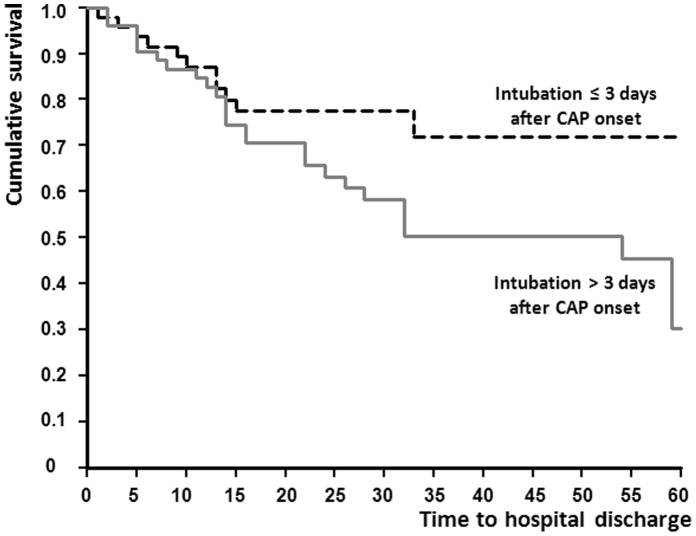
Results: Excepting more COPD patients in the rapid respiratory failure group and more patients with diabetes in the progressive respiratory failure group, these patients had similar characteristics. The overall in-hospital mortality rate was 28% in the rapid respiratory failure group and 51% in the progressive respiratory failure group (P = 0.03). The ICU and the day 30 mortality rates were higher in the progressive respiratory failure group (47% vs. 23%, P = 0.02; and 37.7% vs. 21.3%, P = 0.03; respectively). After adjusting for the propensity score and other potential confounding factors, progressive respiratory failure remained associated with hospital mortality only after 12 days of invasive mechanical ventilation.
Conclusions: This study suggested that the duration or delay in the time to intubation from the onset of CAP symptoms was associated with the outcomes in those patients who ultimately required invasive mechanical ventilation.
Conflict of interest statement
Figures
References
-
- Charles PG, Wolfe R, Whitby M, Fine MJ, Fuller AJ, et al. (2008) SMART-COP: a tool for predicting the need for intensive respiratory or vasopressor support in community-acquired pneumonia. Clin Infect Dis 47: 375–384. - PubMed
-
- Liapikou A, Ferrer M, Polverino E, Balasso V, Esperatti M, et al. (2009) Severe community-acquired pneumonia: validation of the Infectious Diseases Society of America/American Thoracic Society guidelines to predict an intensive care unit admission. Clin Infect Dis 48: 377–385. - PubMed
-
- Renaud B, Brun-Buisson C, Santin A, Coma E, Noyez C, et al. (2012) Outcomes of early, late, and no admission to the intensive care unit for patients hospitalized with community-acquired pneumonia. Acad Emerg Med 19: 294–303. - PubMed
-
- Yandiola PP, Capelastegui A, Quintana J, Diez R, Gorordo I, et al. (2009) Prospective comparison of severity scores for predicting clinically relevant outcomes for patients hospitalized with community-acquired pneumonia. Chest 135: 1572–1579. - PubMed
MeSH terms
Substances
LinkOut - more resources
Full Text Sources
Other Literature Sources
Medical
Miscellaneous
