


Impact of health education on soil-transmitted helminth infections in schoolchildren of the Peruvian Amazon: a cluster-randomized controlled trial
- PMID: 24069469
- PMCID: PMC3772033
- DOI: 10.1371/journal.pntd.0002397
Impact of health education on soil-transmitted helminth infections in schoolchildren of the Peruvian Amazon: a cluster-randomized controlled trial
Abstract
Background: To control soil-transmitted helminth (STH) infections, the World Health Organization recommends school-based deworming programs with a health hygiene education component. The effect of such health hygiene interventions, however, has not been adequately studied. The objective of the present study was to determine the effectiveness of a health hygiene education intervention on the occurrence of STH re-infection four months post-de-worming.
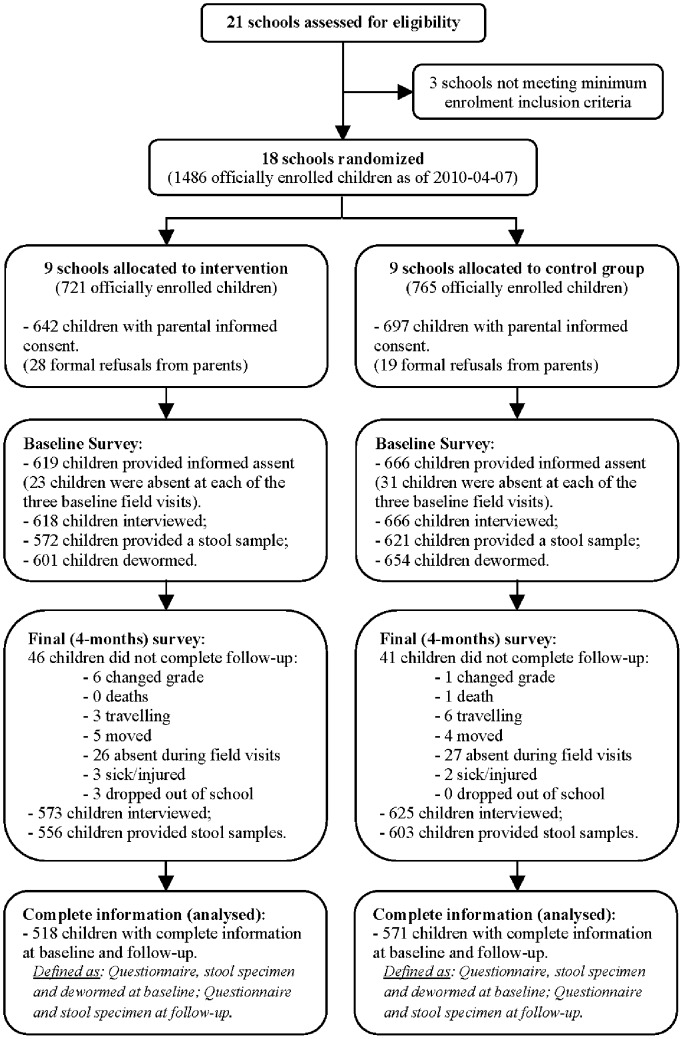
Methodology/principal findings: An open-label pair-matched cluster-randomized trial was conducted in Grade 5 schoolchildren of 18 primary schools (9 intervention and 9 control) in the Peruvian Amazon. Baseline assessment included interview with a pre-tested questionnaire and collection of single stool specimens that were examined using the single Kato-Katz thick smear. All schoolchildren were then treated with single-dose albendazole (400 mg). Schoolchildren in intervention schools then received 1) an initial one hour in-class activity on health hygiene and sanitation and 30-minute refresher activities every two weeks over four months; and 2) a half-day workshop for teachers and principals, while children in control schools did not. Four months later, STH infection was re-assessed in all schools by laboratory technologists blinded to intervention status. From April 21-October 20, 2010, a total of 1,089 schoolchildren (518 and 571 from intervention and control schools, respectively) participated in this study. Intervention children scored significantly higher on all aspects of a test of STH-related knowledge compared with control children (aOR = 18·4; 95% CI: 12·7 to 26·6). The intensity of Ascaris lumbricoides infection at follow-up was statistically significantly lower (by 58%) in children in intervention schools compared with children in control schools (aIRR = 0·42; 95% CI = 0·21 to 0·85). No significant changes in hookworm or Trichuris trichiura intensity were observed.
Conclusions/significance: A school-based health hygiene education intervention was effective in increasing STH knowledge and in reducing Ascaris lumbricoides infection. The benefits of school-based periodic deworming programs are likely to be enhanced when a sustained health hygiene education intervention is integrated into school curricula.
Conflict of interest statement
The authors have declared that no competing interests exist.
References
-
- WHO (2006) Preventive chemotherapy in human helminthiasis - Coordinated use of anthelminthic drugs in control interventions: a manual for health professionals and programme managers. Geneva, Switzerland: World Health Organization. 62 p.
-
- Montresor A, Crompton DWT, Gyorkos TW, Savioli L (2002) Helminth Control in School-Age Children. Geneva: World Health Organization. 64 p.
-
- Crompton DW (2000) The public health importance of hookworm diseases. Parasitology 121: 39–50. - PubMed
-
- Bethony J, Brooker S, Albonico M, Geiger SM, Loukas A, et al. (2006) Soil-transmitted helminth infections: ascaris, trichuriasis, and hookworm. Lancet 367: 1521–1532. - PubMed
Publication types
MeSH terms
Substances
Grants and funding
LinkOut - more resources
Full Text Sources
Other Literature Sources
Miscellaneous
