The impact of New York City's Health Bucks Program on electronic benefit transfer spending at farmers markets, 2006-2009
- PMID: 24070035
- PMCID: PMC3786628
- DOI: 10.5888/pcd10.130113
The impact of New York City's Health Bucks Program on electronic benefit transfer spending at farmers markets, 2006-2009
Abstract
Introduction: Increasing the accessibility and affordability of fresh produce is an important strategy for municipalities combatting obesity and related health conditions. Farmers markets offer a promising venue for intervention in urban settings, and in recent years, an increasing number of programs have provided financial incentives to Supplemental Nutrition Assistance Program (SNAP) recipients. However, few studies have explored the impact of these programs on use of SNAP benefits at farmers markets.
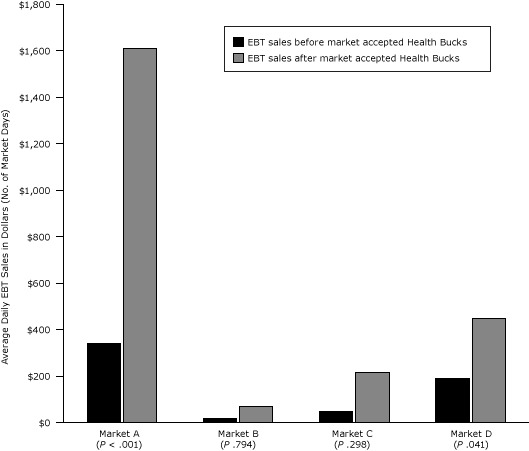
Methods: New York City's Health Bucks Program provides SNAP recipients with a $2 coupon for every $5 spent using SNAP benefits at participating farmers markets. We analyzed approximately 4 years of electronic benefit transfer (EBT) sales data, from July 2006 through November 2009, to develop a preliminary assessment of the effect of the Health Bucks Program on EBT spending at participating markets.
Results: Farmers markets that offered Health Bucks coupons to SNAP recipients averaged higher daily EBT sales than markets without the incentive ($383.07, 95% confidence interval [CI], 333.1-433.1, vs $273.97, 95% CI, 243.4-304.5, P < 0.001) following the introduction of a direct point-of-purchase incentive. Multivariate analysis indicated this difference remained after adjusting for the year the market was held and the neighborhood poverty level.
Conclusion: When a $2 financial incentive was distributed with EBT, use of SNAP benefits increased at participating New York City farmers markets. We encourage other urban jurisdictions to consider adapting the Health Bucks Program to encourage low-income shoppers to purchase fresh produce as one potential strategy in a comprehensive approach to increasing healthful food access and affordability in low-income neighborhoods.
Figures

References
-
- Martínez-González MÁ, de la Fuente-Arrillaga C, López-del-Burgo C, Vázquez-Ruiz Z, Benito S, Ruiz-Canela M. Low consumption of fruit and vegetables and risk of chronic disease: a review of the epidemiological evidence and temporal trends among Spanish graduates. Public Health Nutr 2011;14(12A):2309–15. 10.1017/S1368980011002564 - DOI - PubMed
-
- World Health Organization and Food and Agriculture Organization of the United Nations. Fruit and vegetables for health: report of a joint FAO/WHO workshop, 1-3 September 2004, Kobe, Japan. http://www.who.int/dietphysicalactivity/publications/fruit_vegetables_re...
Publication types
MeSH terms
Grants and funding
LinkOut - more resources
Full Text Sources
Other Literature Sources