. 2013 Sep 27;5(9):89.
doi: 10.1186/gm492. eCollection 2013.

A SNP profiling panel for sample tracking in whole-exome sequencing studies

Affiliations

A SNP profiling panel for sample tracking in whole-exome sequencing studies

Reuben J Pengelly et al. Genome Med. .

Erratum in

Abstract

Whole-exome sequencing provides a cost-effective means to sequence protein coding regions within the genome, which are significantly enriched for etiological variants. We describe a panel of single nucleotide polymorphisms (SNPs) to facilitate the validation of data provenance in whole-exome sequencing studies. This is particularly significant where multiple processing steps necessitate transfer of sample custody between clinical, laboratory and bioinformatics facilities. SNPs captured by all commonly used exome enrichment kits were identified, and filtered for possible confounding properties. The optimised panel provides a simple, yet powerful, method for the assignment of intrinsic, highly discriminatory identifiers to genetic samples.


Figures
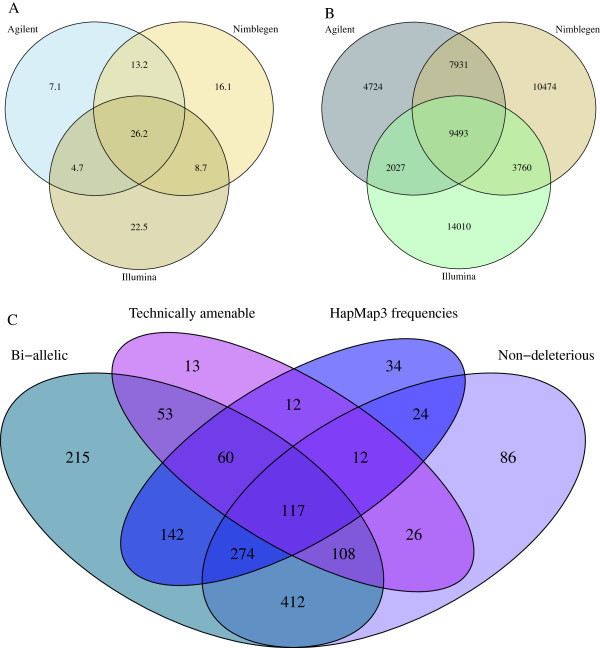
Figure 1
Figure 1
Venn diagrams showing commonality of targeting between capture kits (A,B) and properties of encompassed SNPs (C). Overlap between exome capture kits is presented in Mbp (A) and number of SNPs with an AF ≥0.3 (B). Agilent - SureSelect Human All Exon V4; Illumina - TruSeq Exome Enrichment; Nimblegen - SeqCap EZ Human Exome Library V3.0. For a subset of SNPs present in both the intersection of the three kits shown, and the Illumina TruSight Exome kit, a breakdown of fulfilment of the four classes of candidate filtering criteria is shown (C) (see the main text for details of filtering criteria); 117 SNPs exhibited all desired characteristic; 74 SNPs exhibited none of the desired characteristics.
Figure 2
Figure 2
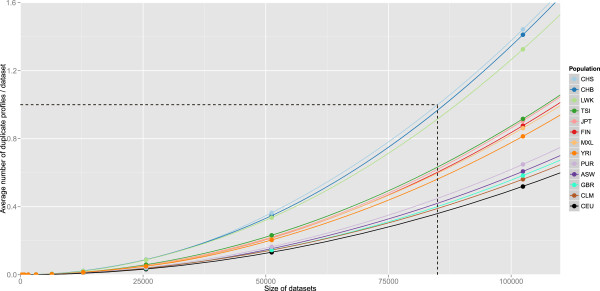
Relationship between size of simulated datasets and the occurrence of non-unique profiles. Thirteen 1000 Genomes Project populations were simulated [20]. Datasets were simulated as described in Methods. With increasing dataset size, the probability of repeat profiles increases. Only populations with a sample size of >50 individuals in the dataset were simulated. Additional populations are Americans of African ancestry in Southwest USA (ASW), Columbians from Medellin, Colombia (CLM), Finnish in Finland (FIN), British in England and Scotland (GBR), Luhya in Webuye, Kenya (LWK), Mexican ancestry from Los Angeles, USA (MXL), Puerto Ricans from Puerto Rico (PUR) and Toscany in Italia (TSI).
Figure 3
Figure 3
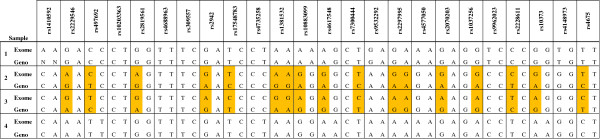
Exome derived and orthogonal genotypes (Geno) for four samples, showing a sample-switch between samples 2 and 3. Informative markers for the resolution of this switch are highlighted in yellow.

References

    1. Need AC, Shashi V, Hitomi Y, Schoch K, Shianna KV, McDonald MT, Meisler MH, Goldstein DB. Clinical application of exome sequencing in undiagnosed genetic conditions. J Med Genet. 2012;5:353–361. doi: 10.1136/jmedgenet-2012-100819. - DOI - PMC - PubMed
    1. Bamshad MJ, Ng SB, Bigham AW, Tabor HK, Emond MJ, Nickerson DA, Shendure J. Exome sequencing as a tool for Mendelian disease gene discovery. Nat Rev Genet. 2011;5:745–755. doi: 10.1038/nrg3031. - DOI - PubMed
    1. Westra H-J, Jansen RC, Fehrmann RSN, te Meerman GJ, van Heel D, Wijmenga C, Franke L. MixupMapper: correcting sample mix-ups in genome-wide datasets increases power to detect small genetic effects. Bioinformatics. 2011;5:2104–2111. doi: 10.1093/bioinformatics/btr323. - DOI - PubMed
    1. Lam CW, Jacob E. Implementing a laboratory automation system: experience of a large clinical laboratory. J Lab Autom. 2012;5:16–23. - PubMed
    1. Pakstis AJ, Speed WC, Fang R, Hyland FC, Furtado MR, Kidd JR, Kidd KK. SNPs for a universal individual identification panel. Hum Genet. 2010;5:315–324. doi: 10.1007/s00439-009-0771-1. - DOI - PubMed